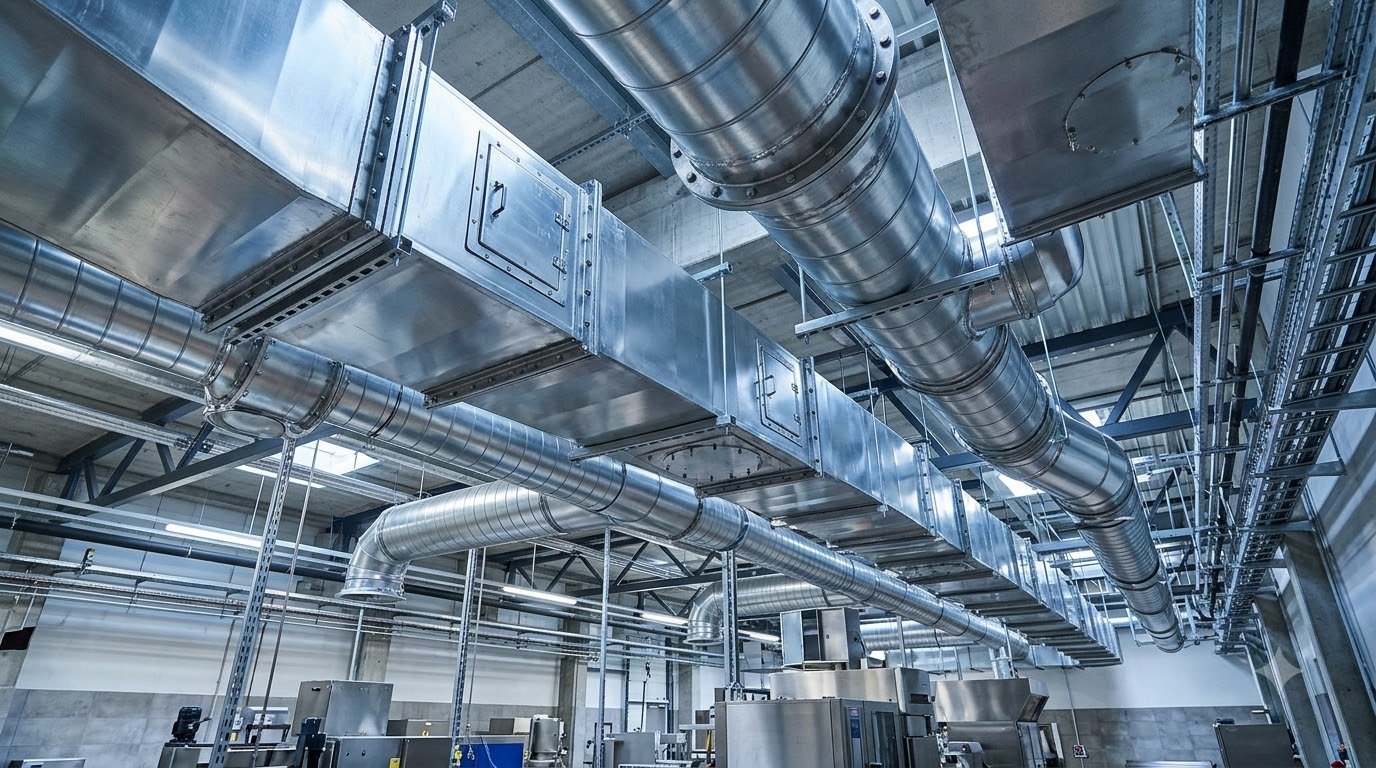
Abu Dhabi’s climate puts building systems under constant strain. Summer temperatures regularly pass 45°C, humidity along the coast is high, and fine desert dust finds its way into almost everything. Add salt-laden air near the shoreline and the demands on ventilation systems become clear. Ductwork has to move air reliably for decades, resist corrosion, stay hygienic and meet strict safety standards.
For many projects, stainless steel is the material that meets those demands. This guide explains what stainless steel ductwork is, where it is used, how it compares with other materials, and what to consider when planning an installation.
Why Ductwork Material Matters
Ducts are the lungs of a building. They carry conditioned air to occupied spaces, extract fumes and moisture, and in some facilities remove hazardous or high-temperature exhaust. If the material fails through rust, leakage or deformation, the result can be poor air quality, higher energy bills, fire risk and costly repairs.
In a region with intense heat, humidity and airborne particles, the choice of material affects:
- Service life: how many years before corrosion or damage requires replacement
- Energy efficiency: leaky or deteriorated ducts waste cooling capacity
- Hygiene: smooth, non-porous surfaces are easier to keep clean
- Fire and safety performance: particularly in kitchens and industrial settings
- Maintenance cost: durable materials reduce long-term spending
What Is Stainless Steel Ductwork?
Stainless steel is an iron-based alloy containing at least about 10.5 percent chromium. The chromium forms a thin, invisible layer of oxide on the surface that protects the metal underneath and repairs itself when scratched. This is what gives stainless steel its resistance to rust.
Ducts made from this alloy are fabricated from sheet metal in rectangular, round or flat-oval profiles, then joined with welded seams, flanges or specialised connectors. Because the material is strong, thinner gauges can sometimes be used without sacrificing rigidity, though the correct thickness always depends on duct size, pressure class and the applicable standard.
Common Stainless Steel Grades
Not all stainless steel is the same. The grade chosen should match the environment.
Grade 304. The most widely used grade. It offers good corrosion resistance and is suitable for general ventilation, commercial kitchens and many indoor applications.
Grade 316. Contains molybdenum, which improves resistance to chlorides and salt. It is the usual choice for coastal locations, marine environments, chemical exposure and swimming pool areas.
Grade 430. A lower-cost ferritic grade used for less demanding dry indoor applications. It has lower corrosion resistance than 304 or 316.
Grades for high heat. Specialised alloys such as 310 or 321 are used where exhaust temperatures are very high, such as in some industrial processes.
Selecting the wrong grade is a common cause of premature failure, so environmental conditions should be assessed before specification.
Where Stainless Steel Ducts Are Used
Stainless steel suits a wide range of sectors across the emirate.
- Commercial kitchens: Hotels, restaurants and catering facilities need ducts that withstand grease, heat and frequent cleaning. Welded stainless ducts are widely used for kitchen exhaust.
- Hospitals and clinics: Smooth surfaces help support hygiene requirements in operating theatres, laboratories and isolation areas.
- Food and beverage production: Facilities benefit from non-porous materials that are easy to sanitise.
- Pharmaceutical and cleanroom environments: Controlled air quality demands materials that do not shed particles or corrode.
- Coastal buildings: Waterfront hotels, towers and resorts face salt exposure that attacks lesser metals.
- Industrial plants: Fume extraction, chemical exhaust and high-temperature ventilation call for robust materials.
- Swimming pools and spas: Chlorinated, humid air is highly corrosive, and grade 316 is commonly specified.
- Data centres and critical facilities: Long service life and low maintenance support reliability.
Stainless Steel Compared With Other Materials
Each duct material has its place. Understanding the differences helps with budgeting and design.
Galvanised steel. The standard choice for general comfort cooling. It is economical and widely available, but the zinc coating can degrade in humid, salty or chemically aggressive conditions.
Aluminium. Lightweight and corrosion resistant, but softer and less suitable for high temperatures or heavy-duty use.
Pre-insulated panel ducts. Fast to install and thermally efficient, but not appropriate for grease exhaust or high-heat applications.
Fibreglass and other composite ducts. Useful in specific chemical or corrosive settings, though they have limitations in fire performance and cleaning.
Stainless steel. Higher upfront cost, but excellent durability, hygiene and resistance to corrosion and heat. For demanding environments, its lifecycle cost can compare favourably because it needs fewer repairs and replacements.
Key Benefits
- Corrosion resistance in humid and coastal conditions
- Long service life, often measured in decades with proper maintenance
- Hygienic surface that resists bacterial build-up and is easy to clean
- Heat tolerance for kitchen and industrial exhaust
- Strength and rigidity under pressure
- Fire performance, as stainless steel is non-combustible
- Clean appearance, which is useful where ducts are exposed in architectural spaces
- Recyclability, supporting sustainability goals
Design and Planning Considerations
Good performance begins at the design stage. Consider the following points early.
- Define the application. Comfort ventilation, grease extraction, chemical fumes and cleanroom supply each have different requirements.
- Select the right grade and thickness. Match them to the environment, temperature and pressure class.
- Plan airflow and sizing. Correct duct dimensions control velocity, noise and pressure drop.
- Specify the joining method. Welded seams are typical for kitchen exhaust and liquid-tight needs, while flanged systems suit other uses.
- Include access panels. Cleaning and inspection points are essential, especially in grease systems.
- Consider insulation. Thermal insulation prevents condensation and reduces energy loss, while fire-rated wrap may be needed in some routes.
- Allow for expansion. Metal expands with heat, so long hot runs need proper supports and expansion provisions.
For project teams researching stainless steel duct systems Abu Dhabi suppliers and fabricators offer, it is sensible to compare their fabrication capability, material certificates, welding quality and experience with similar building types.
Standards and Compliance
Ductwork in the UAE must follow relevant building, fire and ventilation requirements. In Abu Dhabi, projects typically need to align with local authority regulations, civil defence fire and life safety codes, and recognised international standards such as SMACNA for duct construction and NFPA 96 for commercial kitchen ventilation. Requirements vary by project type, so the design consultant and authority approvals should confirm exactly what applies.
Material certification, weld inspection records and pressure testing are common parts of quality assurance on larger projects.
Installation Best Practices
Even high-quality ducts can underperform if installed poorly.
- Use qualified installers familiar with stainless steel fabrication and welding.
- Avoid contact with carbon steel tools that can leave iron particles and cause surface rust.
- Seal joints properly to limit leakage.
- Support ducts at correct intervals to prevent sagging and vibration.
- Test for leakage and airflow before handover.
- Keep the interior clean during construction to prevent dust build-up.
Maintenance and Cleaning
Stainless steel is low maintenance, but not maintenance free. A routine schedule protects performance and safety.
- Kitchen exhaust ducts: Inspect and clean regularly to remove grease, which is a major fire hazard.
- General ventilation ducts: Periodic inspection for dust, leaks and damage.
- Coastal systems: Check for salt deposits and surface staining, and rinse or clean as needed.
- Fans, dampers and filters: Service alongside the ductwork.
Use cleaning products suitable for stainless steel, as chloride-based cleaners can damage the protective layer.
Choosing a Supplier or Fabricator
When selecting a partner for fabrication and installation, look beyond price. Ask about:
- Material sourcing and grade certification
- In-house fabrication and welding capacity
- Quality control and testing procedures
- Experience in your sector, such as healthcare, hospitality or industrial work
- Delivery schedules and project management
- After-sales support and maintenance services
A reliable provider of stainless steel duct systems Abu Dhabi projects depend on should be able to explain material choices, share documentation and describe how their work meets local approvals.
Conclusion
Abu Dhabi’s heat, humidity, dust and coastal air make ductwork material a decision that deserves careful thought. Stainless steel offers strong corrosion resistance, hygiene, durability and fire performance, which is why it is common in kitchens, healthcare, industrial plants and waterfront buildings. While the initial cost is higher than galvanised alternatives, long service life and lower maintenance often justify the investment in demanding settings. Choose the right grade, design for the application, follow local standards and maintain the system, and the ductwork will perform reliably for years.