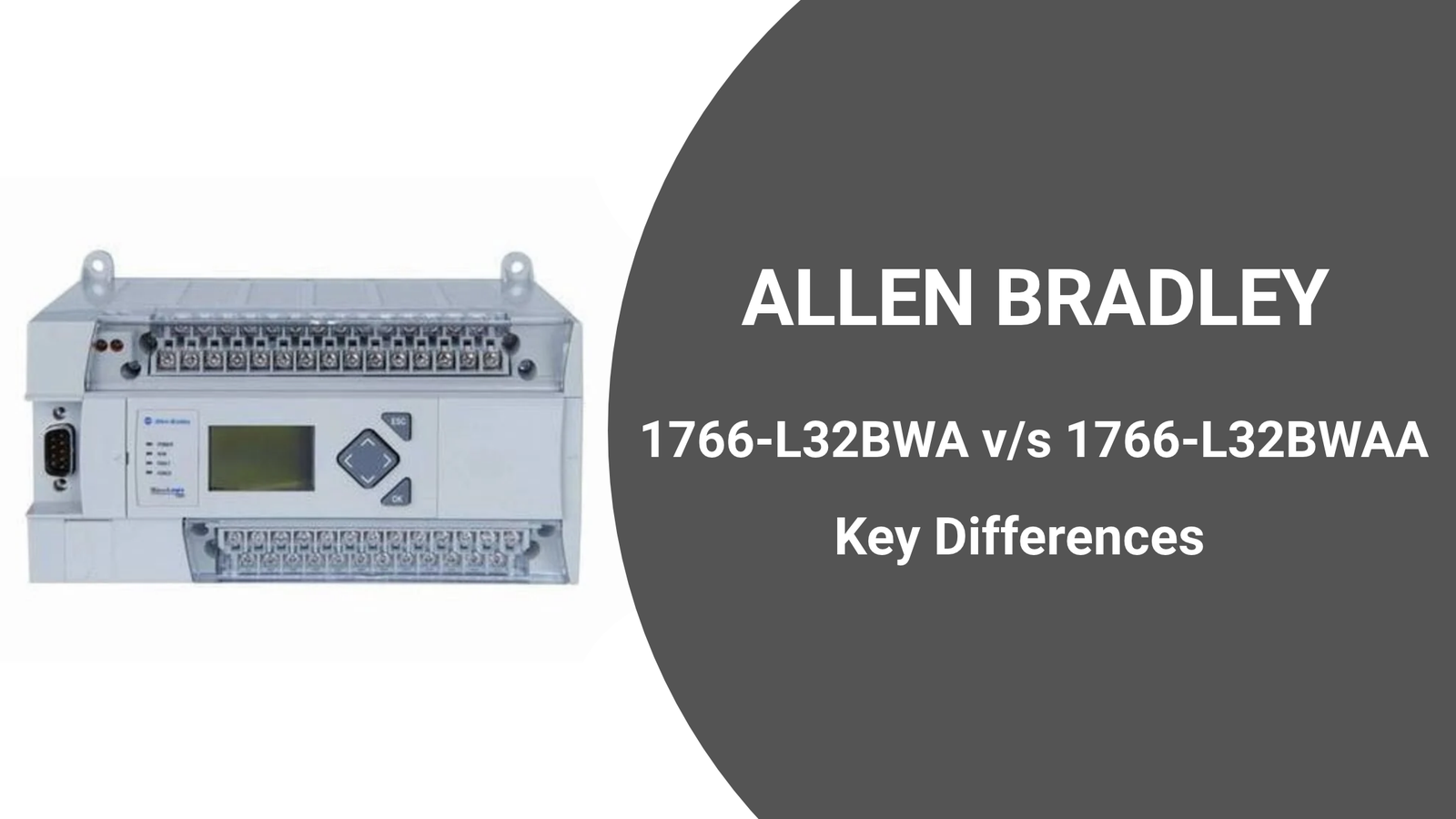
You have likely encountered two almost identical Catalog numbers, 1766-L32BWA and 1766-L32BWAA, if you build or operate systems centered around the Allen-Bradley MicroLogix 1400 PLC. Ordering the wrong one can mean a missing analog channel or a wasted expansion module. This guide explains exactly how they differ, based on Rockwell Automation’s official documentation.
About the MicroLogix 1400 Family
The MicroLogix 1400 offers a higher I/O count, a faster high-speed counter, pulse train output, enhanced network capabilities and a backlit LCD panel. Rockwell lists the controllers in two groups: models without embedded analog provide 32 digital I/O points, while analog versions provide 32 digital points plus 6 analog points. The 1766-L32BWA is in the first group and the 1766-L32BWAA is in the second.
Side-by-Side Comparison
| Feature | 1766-L32BWA | 1766-L32BWAA |
| Power supply | 120/240V AC | 120/240V AC |
| Digital inputs | 12 fast 24V DC + 8 normal 24V DC | 12 fast 24V DC + 8 normal 24V DC |
| Outputs | 12 relay | 12 relay |
| Embedded analog | None | 4 voltage inputs, 2 voltage outputs |
| Total I/O | 32 discrete | 32 discrete + 6 analog |
| Communication | Ethernet, isolated RS232/485, non-isolated RS232 | Same |
| Lifecycle status | Active Mature | Active Mature |
Rockwell’s 1766-L32BWA lists its embedded analog as “None.” The 1766-L32BWAA lists 4 analog (12-bit) inputs and 2 analog (12-bit) outputs. Everything else in the table is identical.
Understanding the Analog I/O on the 1766-L32BWAA
The analog inputs are single-ended (unipolar), 4-channel, 12-bit circuits that use DC between 0 and 10 volts. The analog outputs are 12-bit, two-channel.
This is important if your application uses a voltage signal to drive a speed reference or read a pressure transmitter, level sensor, or potentiometer. With the BWAA you can do that without adding hardware. Please aware that the integrated analog relies on voltage. If you need current (4-20 mA) signals, you will still need a suitable expansion module.
What the Two Controllers Have in Common
Choosing between them is easy because the two share the same platform:
- Communications: DF1, DH-485, Modbus RTU, ASCII, DNP3, EtherNet/IP messaging, DNP3 over IP and Modbus TCP/IP.
- Expansion: Up to seven 1762 MicroLogix expansion I/O modules with a maximum of 256 discrete I/O are supported.
- Display and software: A built-in backlit LCD, and programming with RSLogix 500 software.
- Documentation: Both are covered by the same installation instructions (1766-IN001), user manual (1766-UM001) and reference manual (1766-RM001).
Industrial Applications
Applications for 1766-L32BWA
The 1766-L32BWA can be considered for:
- Conveyor and material-handling systems
- Packaging machinery
- Digital machine sequencing
- Pump and motor control through suitable interfaces
- Machine status monitoring and alarm control
When the necessary signals are compatible with the digital I/O and relay outputs of the controller, these applications can be put into action.
Applications for 1766-L32BWAA
The Allen Bradley 1766-L32BWAA can handle comparable applications while offering supplementary options for analog voltage signals. Potential applications include:
- Machinery requiring analog sensor measurements
- Process equipment using compatible voltage-output instruments
- Automated systems requiring analog reference signals
- Machine control systems combining discrete and analog signals
The actual suitability of either controller depends on the number of I/O points, electrical requirements, communication needs and control-system design.
Which One Should You Choose?
Choose the 1766-L32BWA if your application only needs discrete signals such as switches, sensors, relays and contactors, and you do not need analog.
Choose the 1766-L32BWAA if you need to read or write simple voltage signals directly in the controller, or you want spare analog capacity for future changes.
When substituting a unit that has failed, be sure to match the exact Catalog number. A BWA program has no analog words, while a BWAA program may use them. On the BWAA, input words 4 to 7 hold the analog input values, and output words 4 and 5 hold the analog output values. Putting a BWA in a BWAA application would break any logic that uses those addresses.
Final Thoughts
The only functional difference between the Allen-Bradley 1766-L32BWA and 1766-L32BWAA is the embedded analog I/O. The BWA offers none, while the BWAA provides four voltage inputs and two voltage outputs. In all other respects, power, digital I/O, communications and expansion capability remain the same. Prior to ordering, verify your signal types and always double-check the exact Catalog number on the nameplate.
FAQ
Does the 1766-L32BWA have analog I/O? No. Rockwell specifies that its embedded analog is none.
Can I add analog to a 1766-L32BWA? Yes, by using 1762 expansion modules, which the MicroLogix 1400 supports.
Is the 1766-L32BWAA still supported? Rockwell lists it as Active Mature.