

Humidity is one of the most important factors in maintaining the condition of a Cohiba cigar. Too little moisture can cause tobacco to dry out, while excessive humidity can interfere with combustion and create other storage problems.
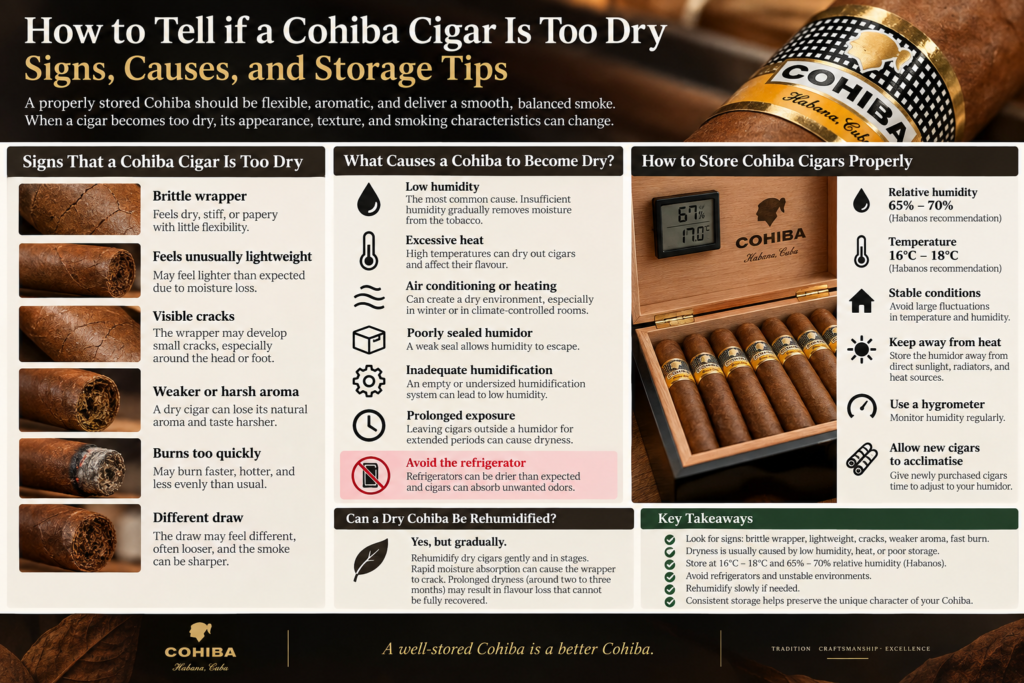
For Habanos, the official recommended storage conditions are 16°C to 18°C with 65% to 70% relative humidity. Maintaining stable conditions is particularly important when cigars are being stored for extended periods or aged in a humidor.
Why Humidity Matters for Cohiba Cigars
A cigar contains several types of tobacco leaves that need to retain an appropriate level of moisture. Humidity helps preserve the physical properties of the wrapper, binder, and filler while allowing the cigar to maintain its intended characteristics.
When humidity falls too low, the tobacco gradually loses moisture. According to Habanos, a dried-out Habano can develop a harsher taste, and prolonged dryness can result in flavour loss.
Excessive humidity creates a different set of problems. Habanos notes that an overly wet Habano may not smoke properly, while prolonged wet conditions can contribute to tobacco deterioration.
The goal is therefore not simply to add as much moisture as possible. It is to maintain a stable environment within an appropriate range.
Signs That a Cohiba Is Too Dry
Several physical and smoking characteristics can indicate excessive dryness.
Brittle Wrapper
A properly conditioned cigar should not feel extremely dry or fragile. If the wrapper feels papery, stiff, or unusually brittle, the cigar may have lost too much moisture.
Cracks around the head or foot can also indicate that the wrapper has become excessively dry.
Harsh or Unbalanced Flavour
Dryness can affect the smoking characteristics of a cigar. Habanos specifically states that a dry Habano can taste harsh.
A cigar that has been stored poorly may therefore taste noticeably different from one that has been maintained under stable conditions.
Rapid Burning
Very dry tobacco can burn more quickly than properly conditioned tobacco. The resulting smoke may also feel hotter or sharper.
However, a fast burn alone does not prove that a cigar is dry. Construction, lighting technique, airflow, and cigar size can also influence the burn rate.
Changes in Weight and Texture
A cigar that has lost substantial moisture may feel lighter and firmer than expected. These signs should be considered together rather than used individually as a definitive test.
What Causes a Cohiba Cigar to Dry Out?
The most common cause is low relative humidity.
Other contributing factors can include:
- Leaving cigars outside a humidor
- A poorly sealed humidor
- Insufficient humidification
- Excessive heat
- Frequent temperature changes
- Long-term storage in a dry environment
- Improperly maintained humidification equipment
Temperature and humidity are closely related. Habanos recommends keeping temperature stable because changes in temperature can also affect humidity conditions inside the storage environment.
A refrigerator is also not recommended as a substitute for a humidor. Habanos explains that refrigerators can be drier than expected and that cigars can absorb unwanted smells from their surroundings.
Recommended Humidity for Cohiba Dry Cigars
For Habanos, including Cuban Cohiba cigars, the manufacturer’s guidance is:
Temperature: 16°C–18°C
Relative humidity: 65%–70%
These conditions are recommended for maintaining Habanos and supporting their development over time.
A reliable hygrometer can help monitor the environment inside a humidor. Consistency is more important than repeatedly making large adjustments.
A humidor should also be positioned away from direct sunlight, radiators, heating equipment, and other sources of excessive heat.
Humidity and Aging Are Not the Same Thing
Aging and drying should not be confused.
According to Habanos, the filler, binder, and wrapper can continue to develop after the cigar has been manufactured when the cigars are kept under appropriate conditions. This gradual development is part of what is referred to as the aging of finished Habanos.
Drying, by contrast, involves the excessive loss of moisture.
A cigar can therefore be several years old without being dry. Conversely, a relatively new cigar can become dry if it is stored incorrectly.
Habanos recommends 16°C–18°C and 65%–70% relative humidity for aging, along with adequate ventilation.
How Long Can Cohiba Cigars Be Aged?
There is no single aging period that applies equally to every Habano.
Habanos explains that opinions differ on when the benefits of aging become noticeable. Some consider several years sufficient, while others prefer longer periods. The results can also vary according to the cigar’s blend, size, tobacco, and individual preferences.
The important point is that aging requires controlled conditions. Simply leaving cigars in a box for several years does not guarantee that they will develop positively.
Temperature and humidity need to remain within suitable ranges throughout the storage period.
How to Rehumidify a Dry Cohiba
If a Cohiba has become excessively dry, restoration should be approached slowly.
Habanos recommends rehumidifying dry cigars gently and in stages. Introducing moisture too quickly can cause the wrapper to absorb moisture unevenly and potentially burst.
This is particularly important with valuable or older cigars. Rapidly increasing humidity may create more problems than it solves.
Habanos also notes that after approximately two or three months of excessive dryness, a cigar can begin losing flavour that may not be recoverable.
Maintaining a Stable Humidor
A good storage routine is more effective than repeatedly correcting poor conditions.
Check the hygrometer regularly and keep the humidor away from heat and direct sunlight. Avoid opening it unnecessarily for long periods, and make sure the humidification system is functioning correctly.
When new cigars are introduced, Habanos recommends allowing them time to acclimatise. A humidor with separate trays can help keep new arrivals apart from cigars that have already been stored in the environment.
For long-term aging, Habanos also recommends a well-ventilated environment so unwanted aromas can disperse.
Final Thoughts
Proper humidity is essential to maintaining the condition of a Cohiba cigar. Too little moisture can lead to brittle tobacco, harsh flavours, rapid burning, and eventually irreversible flavour loss. Excessive moisture can also interfere with smoking and storage.
For Habanos, the manufacturer’s recommended environment is 16°C–18°C and 65%–70% relative humidity. Stable conditions are especially important when cigars are being aged for several years.
As with all tobacco products, cigar smoking carries significant health risks, including exposure to harmful substances and nicotine dependence.