


Brazilian Jiu-Jitsu is a martial art that rewards consistent practice. Learning techniques during academy classes is important, but practitioners can also benefit from having a simple training setup at home for reviewing movements, improving mobility, and maintaining consistency between classes.
A home BJJ training space does not need to be large or filled with expensive equipment. A suitable mat, enough room to move safely, and a few carefully selected training tools can provide a practical environment for solo BJJ training.
The goal is not to replace academy training. Instead, home practice can provide additional opportunities to repeat techniques and movements that have already been taught by a qualified instructor.
Why Create a Home BJJ Training Space?
One of the biggest benefits of a home training area is accessibility. When an academy session is not possible, having a dedicated space can make it easier to complete a short training session.
Home BJJ training can be useful for:
- Reviewing techniques learned during class
- Practicing fundamental movements
- Repeating positional transitions
- Improving mobility
- Working on conditioning
- Developing consistent training habits
- Practicing selected movements without a partner
Even a short session can be useful when it is performed consistently.
Start With a Suitable Training Surface
A safe and appropriate training surface should be one of the first considerations when creating a home grappling area.
BJJ involves movements that place the body in contact with the floor, including bridging, shrimping, rolling, and positional drills. A suitable martial arts or grappling mat can provide cushioning and a more appropriate surface than a hard floor.
The amount of matting required depends on the available space and the type of training being performed.
Before setting up the area, remove objects that could interfere with movement. The training space should allow enough room for the intended exercises without creating unnecessary obstacles.
Practice Fundamental BJJ Movements
Home training is an excellent opportunity to repeat fundamental movements.
Practitioners can work on exercises such as:
- Bridges
- Hip escapes
- Shrimping
- Technical stand-ups
- Sprawls
- Ground transitions
- Controlled mobility drills
These movements may appear simple, but they form an important part of grappling movement.
Focus on body positioning and controlled execution rather than simply trying to complete as many repetitions as possible.
For example, during a hip escape, pay attention to how the hips move away from the imaginary opponent and how the body creates space. Practicing slowly can help make the movement more deliberate.
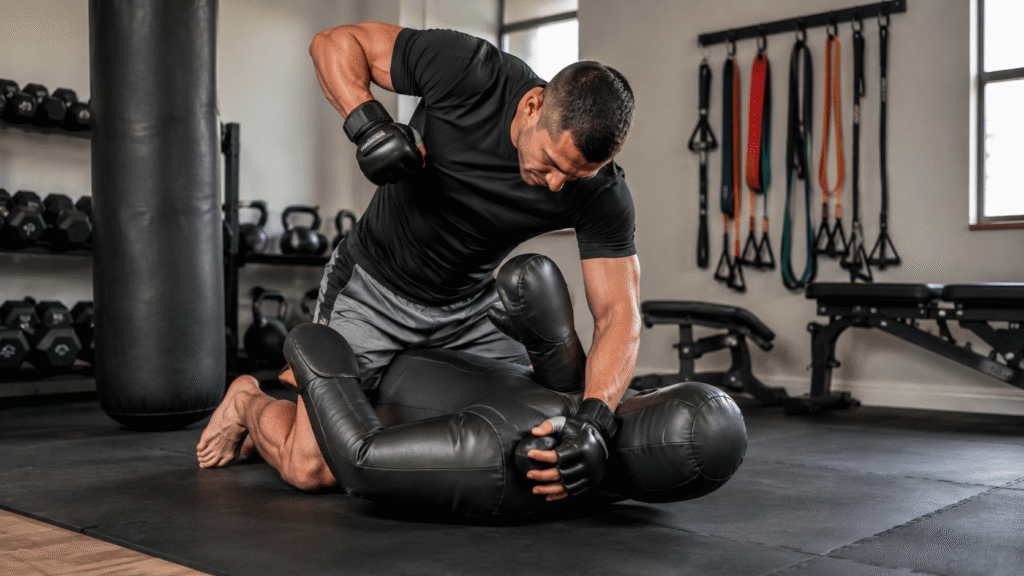
Using a Grappling Dummy
A grappling dummy can provide another option for home BJJ practice.
Unlike conventional fitness equipment, a BJJ grappling dummy is designed with a human-like shape, allowing practitioners to work on selected positional movements and technique repetitions.
Depending on the model, a dummy can be useful for practicing movements related to:
- Mount
- Side control
- Back control
- Guard
- North-south
- Guard passing
- Positional transitions
- Armbar movements
- Triangle positioning
- Kimura and Americana sequences
- Selected wrestling and MMA drills
The exact techniques should depend on the practitioner’s experience and previous instruction.
A dummy has important limitations. It does not move, resist, defend, or react like a live training partner. Therefore, it should be used to reinforce selected movements rather than as a replacement for live practice.
Improve Positional Awareness
BJJ is heavily influenced by position.
Understanding where your body is relative to your training partner is important for controlling positions and transitioning between them.
A grappling dummy can be used to review basic positional sequences.
For example, a practitioner could begin in side control, practice moving into mount, stabilize the position, and then work toward another familiar position.
Rather than practicing many techniques at once, choose one or two sequences and focus on the details.
Pay attention to:
- Hand placement
- Hip position
- Knee placement
- Balance
- Body alignment
- Transition timing
These details can then be discussed with an instructor during live training.
Repeating Submission Movements
Some BJJ submissions involve multiple steps and positional adjustments.
A grappling dummy can provide a stable surface for reviewing movements such as selected armbar, triangle, kimura, or Americana sequences after they have been properly taught.
The purpose of repetition is to become more familiar with the movement.
Practitioners should not rely solely on a dummy or online resources to learn advanced submission techniques. Proper instruction is important for understanding mechanics, control, and safety.
Add Solo BJJ Drills
A grappling dummy does not have to be the center of every home session.
Solo BJJ drills can be performed without any specialized equipment.
A simple session could include:
- Five minutes of mobility
- Five minutes of fundamental movement
- Ten minutes of technical repetition
- Ten minutes of grappling dummy practice
- Five to ten minutes of conditioning
The exact duration can be adjusted according to the practitioner’s schedule and fitness level.
The objective is to create a routine that is realistic enough to repeat regularly.
Choosing Home BJJ Equipment
The best home training equipment depends on the individual’s goals.
Someone primarily interested in Brazilian Jiu-Jitsu may prioritize a quality training mat and grappling dummy.
An MMA practitioner may want equipment that also supports wrestling, striking, and conditioning.
A general fitness enthusiast may prefer resistance bands, kettlebells, adjustable dumbbells, or other strength-training equipment.
Before purchasing anything, consider the following:
Available Space
Measure the training area and determine how much room is available for movement.
Training Goals
Choose equipment based on the techniques and exercises you actually plan to perform.
Frequency of Use
Consider whether the equipment will be used regularly. Frequently used equipment is generally more practical than items that remain stored most of the time.
Storage
Home equipment should be easy to organize and store when the training area is not being used.
Building a Consistent Routine
Consistency is one of the biggest challenges in any training program.
It is easy to create a demanding schedule that looks impressive on paper but becomes difficult to maintain.
A more practical approach is to start with a manageable routine.
For example, practitioners could schedule two or three short home BJJ sessions each week. These sessions could focus on movement, technique review, mobility, and conditioning.
As the routine becomes easier to maintain, additional exercises can be introduced.
Tracking training can also help. Write down which techniques or movements were practiced and identify areas that need more attention.
Home Training vs. Live Training
Home training and live training provide different benefits.
A solo session allows you to control the pace and repeat movements as many times as necessary.
A grappling dummy provides a stable training surface, but it does not react.
A live partner provides resistance, timing, pressure, movement, and unpredictable reactions.
An instructor can also identify technical problems that may be difficult to recognize during solo practice.
For this reason, home BJJ training should complement academy training rather than replace it.
A useful training cycle is:
Learn in class → Review at home → Practice with a partner → Receive feedback → Repeat
This approach allows home practice to support the skills being developed through regular instruction.
Avoiding Common Mistakes
One common mistake is trying to learn advanced techniques without professional instruction.
Another is performing repetitions too quickly. Speed should not come at the expense of technical control.
Practitioners should also avoid creating an unrealistic schedule. A routine that can be maintained consistently is usually more practical than one that requires long daily sessions.
Finally, make sure the training area is appropriate for the exercises being performed. Remove obstacles and use suitable equipment for grappling movements.
Final Thoughts
A home BJJ training setup can be a useful addition to regular martial arts practice. It can provide a dedicated space for movement drills, mobility, conditioning, technique review, and selected grappling exercises.
A grappling dummy can be particularly useful for repeating positional movements and techniques without requiring a live partner. However, it cannot reproduce the reactions and resistance of real grappling.
The best approach is to combine home practice with regular academy instruction and live partner training.
With a suitable training surface, carefully selected equipment, and a realistic schedule, a home training space can become a practical part of a long-term BJJ routine.
For practitioners researching equipment for solo practice, a BJJ grappling dummy can be considered as one option for adding positional and technique repetition to a home training setup.