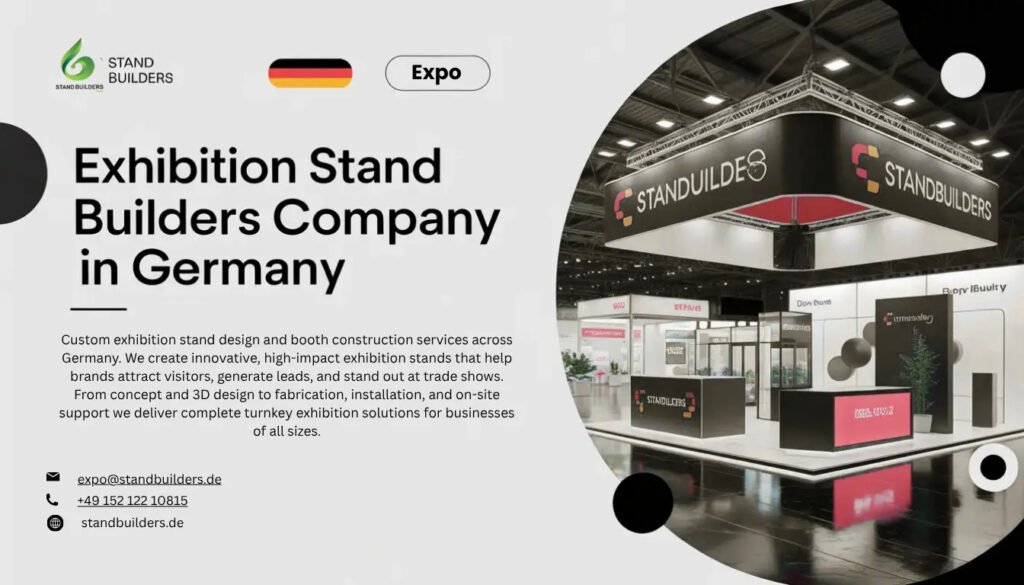

Germany hosts some of Europe’s most significant trade fairs, drawing in exhibitors and professional visitors from a wide range of industries such as automotive and engineering as well as healthcare, technology, logistics, and manufacturing. When companies are planning to take part, an exhibition stand is not merely a temporary building; it is a physical embodiment of the brand and serves as a key area for product demonstrations, business talks, networking, and customer interaction.
A company that builds exhibition stands in Germany can play an important role in turning an exhibition idea into a practical setup. Yet successful exhibiting starts long before the stage of construction reaches it. All the various aspects such as planning, understanding the audience, design, budgeting, logistics, and compliance with venue regulations must be taken into account together.
Understanding the German Exhibition Landscape
Germany holds major exhibitions in cities including Frankfurt, Düsseldorf, Munich, Cologne, Hannover, and Berlin. Since many of these exhibitions draw in highly specialised audiences, exhibitors usually have to provide detailed information in a limited amount of space.
For instance, a manufacturing company might need special areas for demonstrating its machinery, whereas a technology company would concentrate on interactive screens and product presentations. A healthcare business could have private rooms for professional discussions.
That is the reason why ordinary stand builders in Germany usually have to understand both the physical requirements of the stand and the aim of the exhibition.
Planning Before Stand Construction
Effective exhibition planning begins by clearly stating the aim. For example, a company at a trade fair might wish to launch a product, obtain business enquiries, meet its current customers, set up partnerships, or improve its brand visibility.
After the objective has been set, the floor space already available can then be assessed. The position of the stand, its dimensions, the access points, the amount of visitor traffic, the storage needed and the areas allocated for meetings can all affect the final design.
For international exhibitors, early planning is especially important since exhibition venues often have strict deadlines regarding technical submissions, electrical requirements, suspended structures, deliveries, and installation.
Choosing the Right Exhibition Stand Design
No one design will work for all exhibitions; modular, custom-made, portable, corner, peninsula, and island stands are suitable for different purposes.
Modular Stand Designs
Modular stands are useful for companies that take part in a number of exhibitions since their parts can usually be rearranged to suit different floor spaces and the graphics and branding can be changed when needed.
Custom Exhibition Stands
Custom stands provide more flexibility with regard to architecture, materials, lighting, branding, and the design of visitor areas. They can be used when a company needs spaces for demonstrating its products, rooms for meetings, hospitality areas, or a unique visual identity.
When designing an exhibition stand in Germany it is important to combine visual appeal with functionality; although a complicated structure may appear impressive it will still perform poorly if visitors are unable to move around the space comfortably.
Creating a Better Visitor Experience
In modern exhibition design, visitor experience has become something important. The stand must quickly convey the company’s identity and offer a user-friendly route through the space.
Branding must be noticeable from a reasonable distance, and when it comes to important products or services these should be displayed without having too much visual clutter. The meeting areas should provide sufficient privacy for business conversations without making the whole exhibit feel closed.
Lighting can also have an effect on the experience; it is capable of emphasizing products, graphics, architectural features, or demonstration areas and at the same time producing a more welcoming atmosphere.
Exhibition Stand Budget Considerations
The cost of standing depends on a number of factors, since the final expenditure can be influenced by things such as floor area, the materials used in the construction, the graphics, the furniture, the lighting, the audiovisual equipment, transportation, installation, dismantling and the venue services.
A company that is organising a number of exhibitions might choose to use reusable structures instead of having to design a completely new stand for each event. This approach could result in greater flexibility and may help to reduce the need for repeated production.
When assessing the Stand Builders in Germany, companies have the possibility of looking in detail at the contents of the proposed project scope. It is possible to separate the construction costs from those of transportation, installation, storage, technology and other venue services in order to make budgeting more transparent.
Sustainability and Reusability
Sustainability has grown in importance in the exhibition industry, with companies looking into the use of reusable structures, recyclable materials, energy-efficient lighting, and designs that can be adapted.
Reusable components are especially useful for companies that take part in a number of events throughout Europe. Exhibition stand builders in Europe could create systems in which the basic structure stays the same but the graphics, furniture and layouts are altered to suit each particular exhibition.
It does not have to involve giving up on appearance. By choosing materials carefully and using efficient methods of construction, professional spaces can be created at the same time as unnecessary waste is reduced.
Common Exhibition Stand Mistakes
A frequent error is to begin the design process at too late a stage. Making hasty decisions can lead to difficulties with production schedules, the graphics, transportation, and the venue deadlines.
A further problem is having too many displays, messages, pieces of furniture, or promotional materials on the stand. People usually need sufficient open space in order to move about comfortably and to have conversations.
Another consideration that is often neglected is adequate storage; without it, the boxes, the packaging, the promotional materials and the personal possessions would become visible and this would have an effect on the general appearance.
Companies may also fail to realise how important it is to plan after an event. To make sure that valuable conversations don’t vanish after the exhibition, the processes for collecting contacts and carrying out follow-ups should be set up in advance.
When Businesses Work With Exhibition Stand Professionals
For companies which are not familiar with exhibition sites in Germany, arranging the design, production, transportation, installation and dismantling can be a complicated matter. A contractor for exhibition stands in Germany can assist with organising these practical aspects at the same time as making sure that the idea proposed is compatible with the conditions of the venue.
When businesses are looking for people to build Expo Stands in Germany or those who build exhibition stands in Germany, they should take into account various factors such as previous experience at events, the coordination of projects, their production capabilities, the methods they use for installation, the materials they choose, and their ability to work within the specified requirements.
The aim must be to devise an approach which supports the company’s exhibition objectives rather than concentrating only on appearance.
Conclusion
Taking part in a German trade fair demands careful preparation. Whether it’s choosing the appropriate stand format or handling budgets, as well as dealing with visitor flow, logistics, sustainability, and the venue’s requirements, each decision has an effect on the overall exhibition experience.
Exhibition Stand Builders Company in Germany can play a practical role in this process when businesses need help in linking their objectives with the design and construction requirements. In the end, effective exhibition planning is all about creating a space which communicates clearly, encourages useful conversations, and works smoothly during the event.
FAQs
What kinds of exhibition stands are usually used in Germany?
Modular, custom-built, inline, corner, peninsula and island types are all common. The choice of format will depend on the amount of space available, the budget, the objectives and the expected level of visitor interaction.
When should planning for an exhibition stand take place?
It is generally advisable to spend several months preparing, especially when dealing with larger custom projects. More complicated stands might need extra time for design approval, for producing the technical documentation, and for the production and installation.
What factors influence the cost of an exhibition stand?
The total cost can all be affected by stand size, the materials used, the method of construction, the graphics, the furniture, the lighting, the technology, transportation, installation, and the venue services.
Can you use exhibition stands more than once?
Many modular exhibition stands can be used again and rearranged for various events, and the graphics, furniture, and layouts can also be altered to match each individual exhibition.
What is the importance of visitor flow in the design of an exhibition stand?
When the flow of visitors is well planned, it becomes easier for people to enter the site, browse the products, obtain information, and have conversations without there being unnecessary congestion.