Introduction
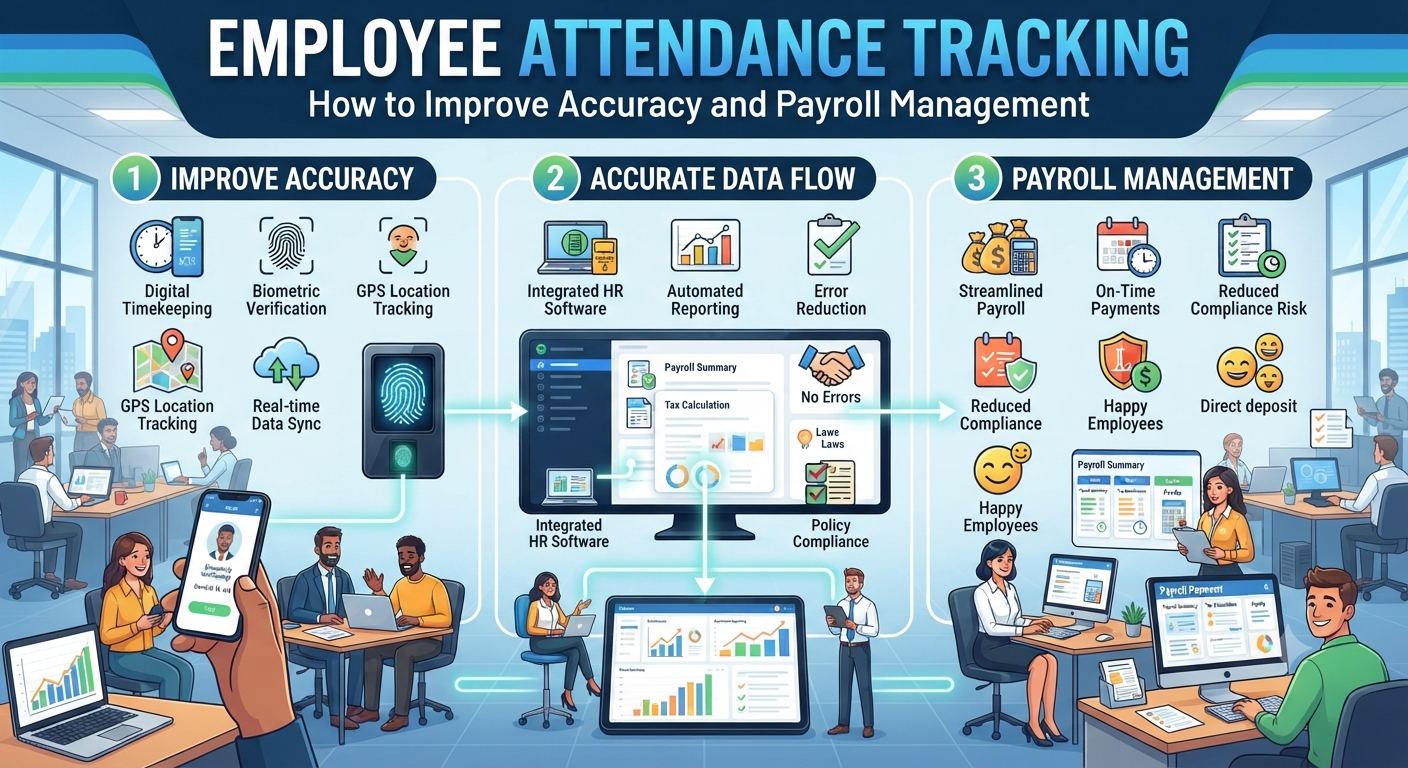
Accurate employee attendance records are essential for maintaining organized business operations and processing payroll correctly. Every business needs to understand when employees start working, when they finish their shifts, and whether their actual working hours match their scheduled hours.
When attendance is managed manually, businesses may experience inaccurate timesheets, missing records, forgotten clock-ins, and payroll calculation errors. These problems can create additional administrative work and reduce employee confidence in the payroll process.
As organizations grow, monitoring attendance becomes more challenging. Managers may need to track employees across different departments, locations, and working schedules.
A structured attendance management process helps businesses maintain accurate working-hour records, improve accountability, and reduce payroll-related problems.
This article explains practical ways to improve attendance tracking and make payroll management more reliable.
1. Establish Clear Attendance Policies
The first step toward accurate attendance management is creating clear workplace policies.
Employees should understand when they are expected to arrive, how attendance must be recorded, and what procedures to follow when they are late or absent.
An effective attendance policy should explain:
- Official working hours.
- Shift start and end times.
- Break policies.
- Late arrival procedures.
- Absence reporting requirements.
- Overtime approval rules.
- Attendance correction procedures.
Managers should communicate these policies during employee onboarding and provide access to updated guidelines.
Clear expectations help prevent misunderstandings and make attendance management more consistent across departments.
2. Move Beyond Manual Attendance Records
Many businesses still depend on paper registers, spreadsheets, or manually maintained timesheets.
Although these methods may work for very small teams, they become difficult to manage as employee numbers increase.
Manual attendance records can contain incorrect entries, missing information, and calculation mistakes. Managers may also spend unnecessary time collecting timesheets and verifying working hours.
Digital attendance systems provide a more organized approach.
Depending on the platform, businesses may be able to record clock-in and clock-out times, review attendance histories, monitor working hours, and generate reports.
Employee Scheduling software can also help connect planned shifts with actual attendance information when the required features are available.
This makes it easier for managers to identify differences between scheduled and recorded working hours.
3. Use Suitable Clock-In and Clock-Out Methods
Businesses should choose attendance recording methods that match their working environment.
Common options include:
Biometric attendance: Employees record attendance using supported fingerprint or facial recognition devices.
Mobile attendance: Employees use an approved mobile application to record their working hours.
Web-based attendance: Employees access a digital system through a browser.
Physical time clocks: Workers use designated devices installed at the workplace.
The appropriate method depends on employee roles, workplace locations, security requirements, and available technology.
Businesses should also establish procedures for situations where an employee forgets to record attendance or a device stops working.
4. Match Attendance Records With Employee Schedules
Attendance records are more useful when compared with planned working schedules.
For example, an employee may be scheduled to work from 9 AM to 5 PM but record a late arrival or early departure.
Managers need to identify these differences before payroll is processed.
A structured process should compare:
- Scheduled start times.
- Actual clock-in times.
- Scheduled end times.
- Actual clock-out times.
- Approved breaks.
- Overtime hours.
- Approved leave.
This comparison helps identify attendance discrepancies and ensures that payroll calculations are based on verified information.
It also allows managers to investigate repeated late arrivals or unexpected changes in working hours.
5. Create a Consistent Process for Managing Absences
Employee absences can affect business operations and payroll calculations.
Businesses should establish a clear process for employees to report planned leave, sickness, emergencies, and other unavoidable absences.
Managers should record approved absences accurately and ensure that attendance reports reflect the correct information.
Useful practices include:
- Providing a clear leave request procedure.
- Defining absence notification deadlines.
- Recording manager approvals.
- Updating employee attendance records.
- Communicating replacement requirements.
- Maintaining appropriate documentation.
For healthcare organizations, Healthcare Staff Scheduling Software can support coordination between attendance information, staffing requirements, and shift coverage, depending on the system.
A consistent absence management process helps prevent inaccurate payroll records and staffing gaps.
6. Improve Attendance Visibility Across Departments
Businesses with multiple departments often struggle to maintain consistent attendance information.
For example, employees working in different locations may use different attendance recording methods. This can make it difficult for management to review workforce information centrally.
Organizations should establish standardized attendance procedures across all departments.
A centralized system can help managers access relevant records and compare attendance patterns.
For businesses operating across multiple sites, it is useful to define who can review, approve, and correct attendance information.
Access permissions should also be configured carefully to protect employee data.
Centralized visibility makes it easier to identify attendance problems and maintain consistent workforce records.
7. Automate Payroll-Related Attendance Calculations
Payroll calculations require accurate information about employee working hours, overtime, breaks, and approved leave.
When these details are calculated manually, mistakes can occur.
Attendance technology can reduce repetitive administrative work by organizing recorded working hours and generating reports for payroll review.
However, businesses should not assume that every attendance system automatically calculates every payroll requirement.
Before selecting a platform, check whether it supports:
- Regular working-hour reports.
- Overtime records.
- Break tracking.
- Leave information.
- Timesheet approvals.
- Payroll integrations.
- Exportable attendance data.
Restaurant Scheduling Software may also help restaurants coordinate staff shifts and attendance information where the appropriate integrations are supported.
Before payroll is finalized, managers should review exceptions and confirm that attendance adjustments are properly authorized.
8. Set Up an Attendance Correction Process
Even reliable attendance systems can contain errors.
Employees may forget to clock in, record the wrong time, or experience technical problems with an attendance device.
Businesses should create a transparent correction procedure.
Employees should be able to report attendance mistakes through an approved process. Managers should verify the request before updating records.
A correction process should include:
- Employee submits an attendance correction request.
- Manager reviews the reported issue.
- Supporting information is checked where necessary.
- Authorized personnel approve the correction.
- The updated record is documented.
Maintaining an audit trail helps businesses understand why attendance records were changed and supports accurate payroll reviews.
9. Protect Employee Attendance Data
Attendance information is sensitive workplace data and should be managed responsibly.
Businesses must ensure that employee records are accessible only to authorized personnel.
Important data protection practices include:
- Using secure login credentials.
- Applying role-based access controls.
- Limiting unnecessary data collection.
- Reviewing system permissions.
- Maintaining appropriate backups.
- Following applicable privacy and employment regulations.
Organizations using biometric or location-based attendance features should pay particular attention to applicable privacy requirements and employee notification obligations.
Security should be considered when selecting attendance technology, not added as an afterthought.
10. Monitor Attendance Trends and Improve Workplace Policies
Attendance data can help managers understand workforce patterns and identify operational problems.
For example, frequent absences in one department may indicate workload concerns, management issues, or scheduling difficulties.
Managers should review attendance information regularly instead of focusing only on individual incidents.
Useful measurements include:
- Absenteeism rates.
- Late arrival frequency.
- Attendance consistency.
- Overtime hours.
- Unplanned leave.
- Missed clock-in records.
- Attendance correction requests.
These measurements can help organizations identify recurring issues and improve workplace policies.
Managers should approach attendance problems fairly and consider legitimate employee circumstances before making decisions.
Conclusion
Accurate attendance tracking is essential for reliable payroll management and effective workforce operations.
Businesses can improve attendance accuracy by establishing clear policies, using suitable digital recording methods, comparing actual working hours with planned shifts, and creating transparent correction procedures.
They should also protect employee information and review attendance trends regularly.
A well-organized attendance management process reduces administrative work, improves payroll reliability, and helps employees understand their workplace responsibilities.
As organizations grow, investing in structured attendance procedures becomes increasingly valuable for maintaining accurate records and supporting long-term business efficiency.