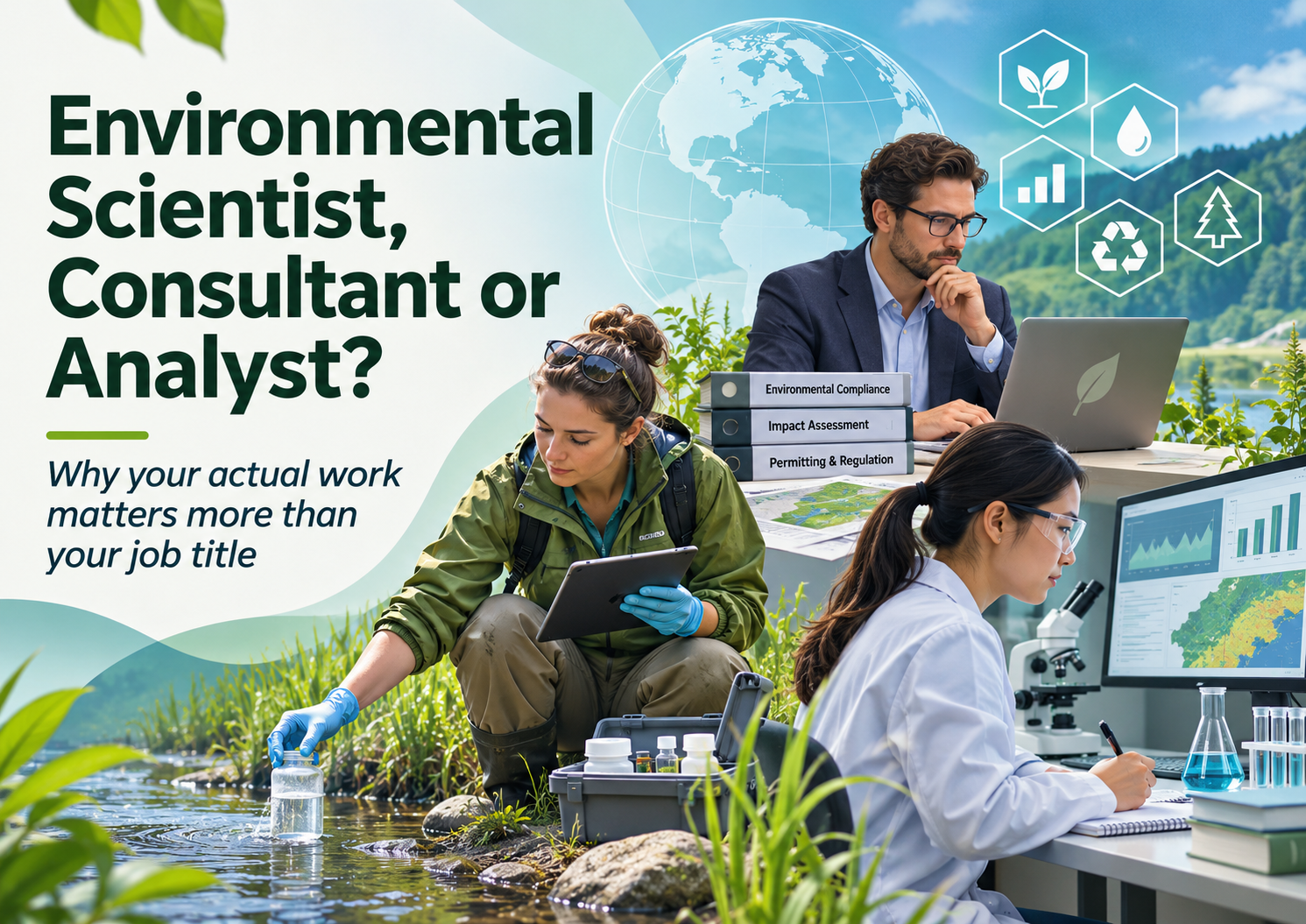
Environmental careers rarely fit neatly into one job title.
One employer may call someone an Environmental Scientist. Another may use Environmental Consultant, Ecologist, Environmental Officer, Water Quality Analyst or Sustainability Specialist.
The problem is that similar titles can represent very different work.
For Australian migration skills assessment purposes, that distinction matters.
Choosing an occupation because its title resembles your business card is a weak strategy. The better approach is to examine what you actually spend your working week doing.
Start With the Main Purpose of Your Role
Ignore your title temporarily.
Ask:
What is my employer actually paying me to produce?
Is your main responsibility to:
- conduct scientific environmental research?
- advise clients on environmental compliance?
- collect and test samples?
- manage environmental programs?
- prepare environmental approvals?
- analyse ecological data?
- develop environmental models?
These activities may all happen within the environmental sector, but they do not necessarily belong to the same occupation.
That is why occupation selection should begin with duties rather than titles.
Research Work Has a Different Purpose
Environmental research is generally about investigating environmental systems and producing scientific findings.
VETASSESS currently describes Environmental Research Scientist ANZSCO 234313 as a Group A occupation concerned with studying environmental conditions and developing approaches to problems such as pollution, ecological imbalance and environmental degradation.
Research-oriented work may include:
- developing a research question
- designing studies
- collecting environmental data
- analysing results
- modelling environmental systems
- interpreting findings
- drawing scientific conclusions
- contributing to environmental policies or management approaches
The critical distinction is that the person is doing more than simply collecting information.
They are analysing it to answer a scientific or environmental question.
Routine Testing Is Not the Same as Research
Consider two people working with water samples.
Person A
Collects water samples, follows a standard laboratory procedure, records contaminant levels and sends the results to a supervisor.
Person B
Designs a water-quality investigation, determines sampling methodology, analyses environmental trends, compares results across locations and develops conclusions about the causes and implications of contamination.
Both may work with water quality.
But the professional nature of the roles is very different.
VETASSESS specifically states that routine testing of water, air, soil or other environmental samples without independent research does not fit the scope of Environmental Research Scientist.
That distinction should be identified before choosing the occupation.
Environmental Consulting Is Also Different
Environmental consultants can perform highly skilled work.
But consulting and research are not automatically interchangeable.
A consultant may spend significant time:
- advising clients
- interpreting regulations
- preparing environmental management plans
- supporting development approvals
- conducting compliance reviews
- recommending mitigation strategies
- communicating with regulators
The purpose is often to help an organisation understand and manage environmental requirements.
Environmental Research Scientist has a different occupational focus.
VETASSESS currently lists Environmental Consultant separately and explicitly states that employment as an Environmental Consultant is not considered highly relevant employment for Environmental Research Scientist.
This is why choosing ANZSCO 234313 simply because your title contains the words “environmental” and “scientist” can be risky.
Ask What Happens After You Collect Data
This is one of the easiest ways to analyse your role.
Suppose your job involves field sampling.
What happens next?
If you mainly:
- collect samples
- label them
- follow standard procedures
- enter results
- submit information to someone else
your role may be more operational or technical.
If you:
- determine sampling methodology
- analyse patterns
- test hypotheses
- interpret ecological significance
- build models
- prepare scientific conclusions
the work looks much more research oriented.
The difference is not whether you work outdoors or in a laboratory.
It is the level of scientific responsibility.
Look at Your Decision-Making Authority
Professional-level roles usually involve more than following instructions.
Ask whether you independently decide:
- research methodology
- analytical approach
- sampling strategy
- statistical methods
- interpretation of results
- recommendations arising from research
The more responsibility you hold for scientific judgement, the easier it becomes to distinguish professional research from routine technical work.
Ecologists Need to Look Beyond the Job Title
Ecology is particularly interesting because VETASSESS currently lists Ecologist as an occupation considered suitable under Environmental Research Scientist ANZSCO 234313.
But that does not mean every person with an ecology-related job automatically fits.
An ecologist conducting:
- ecological investigations
- biodiversity research
- environmental impact analysis
- species studies
- habitat assessment
- environmental modelling
may have a strong research component.
Someone whose work is predominantly project administration or compliance monitoring may have a different occupational profile.
Again, duties matter.
Environmental Engineering Can Overlap With Research
Environmental engineers may also work on environmental research problems.
For example, someone might study:
- pollution behaviour
- water treatment
- contamination
- environmental modelling
- rehabilitation
- environmental systems
But engineering work can also focus heavily on design, implementation and technical engineering solutions.
VETASSESS currently includes Environmental Engineering among the highly relevant fields of study for Environmental Research Scientist, but the employment still needs to meet the occupational requirements.
A relevant degree does not automatically make unrelated employment relevant.
Your Degree and Employment Need to Tell the Same Professional Story
This is where some applications become weak.
Imagine someone has:
Bachelor of Environmental Science
but their employment consists mainly of:
administration, client coordination and compliance documentation.
The qualification may look relevant.
The employment may not.
The opposite problem can also occur.
Someone may perform sophisticated environmental research but hold a degree whose content has limited environmental relevance.
VETASSESS treats Environmental Research Scientist as a Group A occupation requiring both a suitable qualification and suitable employment assessment.
You cannot assume one compensates automatically for weakness in the other.
Build a Duty Map Before Choosing the Occupation
Take your current or most relevant position and divide your work into percentages.
For example:
| Work Activity | Approx. Time |
| Research design | 20% |
| Field investigation | 20% |
| Data analysis | 25% |
| Environmental modelling | 15% |
| Report writing | 15% |
| Administration | 5% |
Now compare that with another profile:
| Work Activity | Approx. Time |
| Client advice | 30% |
| Compliance reviews | 25% |
| Environmental approvals | 20% |
| Management plans | 15% |
| Administration | 10% |
Both people may call themselves Environmental Scientists.
Their occupational alignment could be very different.
This type of exercise is far more useful than relying only on the employment title.
Research Outputs Can Help Explain Your Professional Level
Environmental researchers may produce more than standard workplace records.
Depending on the role, useful professional outputs can include:
- research reports
- scientific papers
- conference work
- environmental models
- research project summaries
- laboratory reports
- grant-related material
- technical analysis
VETASSESS itself notes that applicants may provide supporting material such as research articles, conference proceedings, laboratory reports, patents and research-project lists.
The point is not to produce the biggest document bundle possible.
It is to show what kind of professional work you genuinely performed.
Do Not Rewrite Your Job to Fit an Occupation
This is one of the worst strategies.
Applicants sometimes read an occupation description and then try to rewrite every employment duty using the same terminology.
That creates two problems.
First, it may misrepresent the real job.
Second, the reference may become inconsistent with:
- CV
- employment contract
- research outputs
- company website
- previous documents
- other supporting evidence
The better strategy is to describe the work accurately and select the occupation that genuinely matches it.
Occupation selection should follow the career.
The career should not be rewritten to follow the occupation.
Scientists With Similar Degrees Can Need Different Assessments
Two people might both hold a Master of Environmental Science.
One works in independent ecological research.
The other works for a consultancy advising property developers on environmental approvals.
The degree is similar.
The employment is different.
That difference can completely change the occupation-selection discussion.
Professionals considering ANZSCO 234313 can review Think Higher’s Environmental Research Scientist skills assessment guide for a detailed explanation of the current VETASSESS qualification and employment framework.
Ask These Questions Before Paying for an Assessment
Before selecting an occupation, answer these honestly:
What is the central purpose of my job?
Do I conduct independent research?
Do I mainly advise clients?
Do I primarily perform routine testing?
Am I responsible for scientific interpretation?
Does my qualification genuinely relate to the occupation?
Can my employer verify the duties I am claiming?
If these answers are unclear, the occupation choice probably needs more work.
Final Thoughts
Environmental careers overlap heavily.
Scientists consult.
Consultants conduct research.
Researchers collect samples.
Analysts write reports.
That overlap is precisely why the job title alone is unreliable.
The stronger approach is to identify the dominant professional function of your role.
If your work centres on independent environmental investigation, scientific analysis and research conclusions, Environmental Research Scientist may warrant closer examination.
If the job is primarily consulting, management or routine testing, another occupational classification may be more accurate.
For skills assessment purposes, the goal is not to find the occupation with the most attractive migration possibilities.
It is to find the occupation that your qualification, employment history and professional evidence can actually defend.