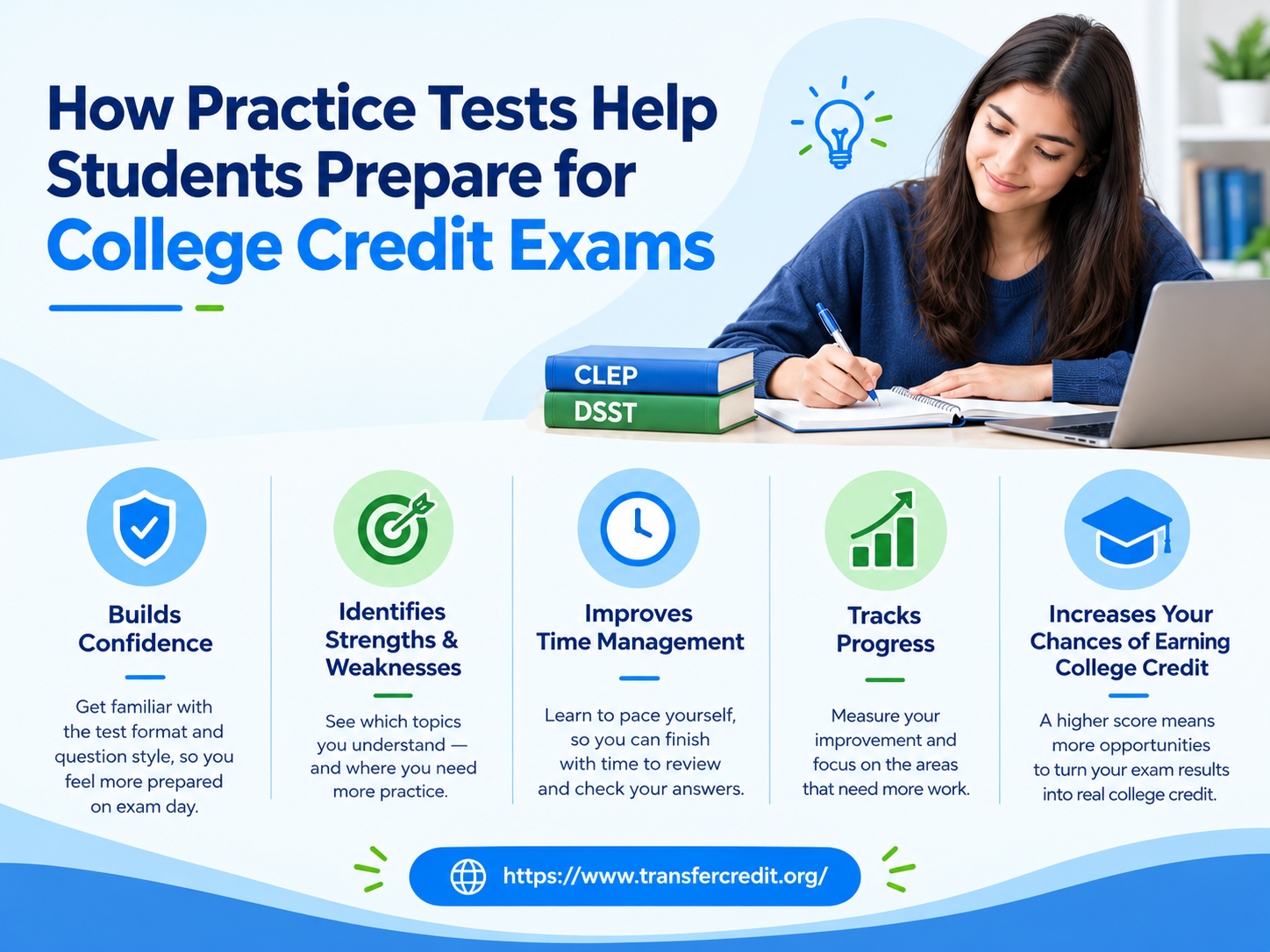
College credit exams offer students an opportunity to demonstrate their knowledge and potentially earn credits without completing a traditional course. However, preparing for these exams requires more than reading textbooks or reviewing class notes. Students need to understand the exam format, practise answering questions, and identify areas that require additional study.
Practice tests can make this preparation more organised. They help students become familiar with different question types, evaluate their knowledge, and develop a study plan based on their performance.
Why Are Practice Tests Important for College Exams?
Practice tests allow students to apply what they have learned in a test-like environment. Instead of simply reading information, students must recall concepts, interpret questions, and choose appropriate answers.
Regular practice can also reveal knowledge gaps before the actual exam. For example, a student may understand a topic while studying but struggle to answer questions within a time limit. Taking practice tests helps identify this difference and highlights areas that need attention.
Students preparing for college credit exams can use practice questions to build familiarity with the subjects and improve their preparation strategies.
How to Use Practice Tests Effectively
1. Start with a Diagnostic Test
Before beginning an intensive study schedule, take a practice test to assess your current understanding. Avoid checking answers during the test because the purpose is to identify your actual strengths and weaknesses.
Review the results and divide topics into three categories: strong understanding, partial understanding, and topics that require more study. This approach helps you prioritise your time instead of reviewing every chapter equally.
2. Create a Study Plan Based on Results
Once you understand your weak areas, create a realistic study schedule. Allocate more time to difficult topics while continuing to review concepts you already understand.
For example, a student preparing for a mathematics exam might need additional practice with algebra while spending less time on familiar arithmetic concepts. A student preparing for a history exam may need to focus on timelines, important events, and cause-and-effect relationships.
A focused study plan makes preparation more manageable and helps students track their progress.
3. Practise Under Timed Conditions
Time management is an important part of exam preparation. Students who know the material may still struggle if they spend too long on individual questions.
Use timed practice tests to understand how quickly you need to work. Practise moving forward when a question takes too long, then return to difficult questions if the exam format allows it.
Timed sessions can also help students become more comfortable with the pressure of completing an assessment within a fixed period.
What to Look for in a Good Practice Test
Not every practice resource provides the same level of preparation. Choosing suitable materials can make a difference in how effectively students use their study time.
Consider these factors when selecting practice tests:
- Relevant subject coverage: Questions should reflect the topics included in the exam.
- Clear explanations: Answer explanations help students understand why an option is correct or incorrect.
- Different question types: A variety of questions helps students practise applying concepts in different ways.
- Realistic difficulty: Questions should challenge students without moving too far beyond the intended subject matter.
- Progress tracking: Results should make it easier to identify recurring mistakes and monitor improvement.
Students should also check the official exam information for the current subject outline, format, and policies. Practice materials are most useful when they align with the exam requirements.
Common Practice Test Mistakes to Avoid
Memorising Answers Instead of Understanding Concepts
Repeating the same questions can improve familiarity, but memorising answers does not guarantee that students understand the underlying concepts. Review explanations and practise similar questions to check whether you can apply the knowledge independently.
Ignoring Incorrect Answers
Simply checking the final score wastes an important learning opportunity. Review every incorrect answer and note why you made the mistake. The issue might be a knowledge gap, a misunderstanding of the question, or a calculation error.
Taking Too Many Tests Without Reviewing
Completing several tests without analysing the results may not lead to meaningful improvement. It is often more useful to take one test, review mistakes carefully, study weak topics, and then attempt another assessment.
Studying Only at the Last Minute
Leaving all practice until the final few days can make preparation stressful. Regular study sessions give students more opportunities to revisit difficult concepts and measure progress over time.
How to Measure Your Progress Before Exam Day
Track your scores across multiple practice sessions, but do not rely on scores alone. Record which topics cause difficulty, how much time you spend answering questions, and whether the same mistakes occur repeatedly.
If your scores improve but you continue struggling with a particular subject, dedicate additional time to that area. If your performance remains consistent across different tests, review the official exam requirements and focus on maintaining your preparation routine.
The goal is not simply to achieve a high score on a practice test. It is to develop the knowledge, accuracy, and time-management skills needed for the actual assessment.
Conclusion
Practice tests can be a valuable part of college credit exam preparation when used alongside focused study and regular review. They help students identify weak areas, become familiar with question formats, and develop better time-management habits.
By reviewing mistakes, choosing relevant materials, and following a consistent study schedule, students can prepare more confidently and make better use of their study time.
FAQs
1. How often should students take practice tests?
Students can begin with a diagnostic test, study their weaker topics, and then take additional tests at regular intervals. The frequency depends on the exam date and how much preparation is needed.
2. Are practice tests enough to prepare for college credit exams?
Practice tests are useful, but they should be combined with subject review, study materials, and official exam information. Understanding concepts is more valuable than memorising answers.
3. Should students take practice tests with a timer?
Yes. Timed practice helps students understand the pace required to complete an exam. Untimed practice can also be useful when learning difficult concepts for the first time.
4. What should students do after a low practice test score?
Review incorrect answers, identify weak topics, and study those areas before taking another test. A low score can help students understand where to focus their efforts.
5. How can students choose the right practice tests?
Choose materials that cover the relevant exam subjects, provide clear answer explanations, and reflect the current exam format. Check official exam information to confirm which topics need to be studied.