Refinancing student loans sounds simple. You swap your current loans for a new one with a lower interest rate, and you save money. For some borrowers, that is exactly what happens. For others, a lower rate hides a longer term that costs more overall, or it costs something that never shows up on a spreadsheet: the protections that come with federal loans.
The key to deciding is your break-even point, the moment when the savings from refinancing outweigh what it costs you, in dollars and in lost options. This guide shows you how to calculate it step by step with real numbers. You can run your own figures through a refinance break-even calculator as you read.
Quick Answer: What Is the Break-Even on a Student Loan Refinance?
For most refinances, the break-even is the number of months it takes for your monthly savings to repay any fees. Many student loan refinance lenders charge no origination fee, which means the dollar break-even can be immediate. But that is only half the picture.
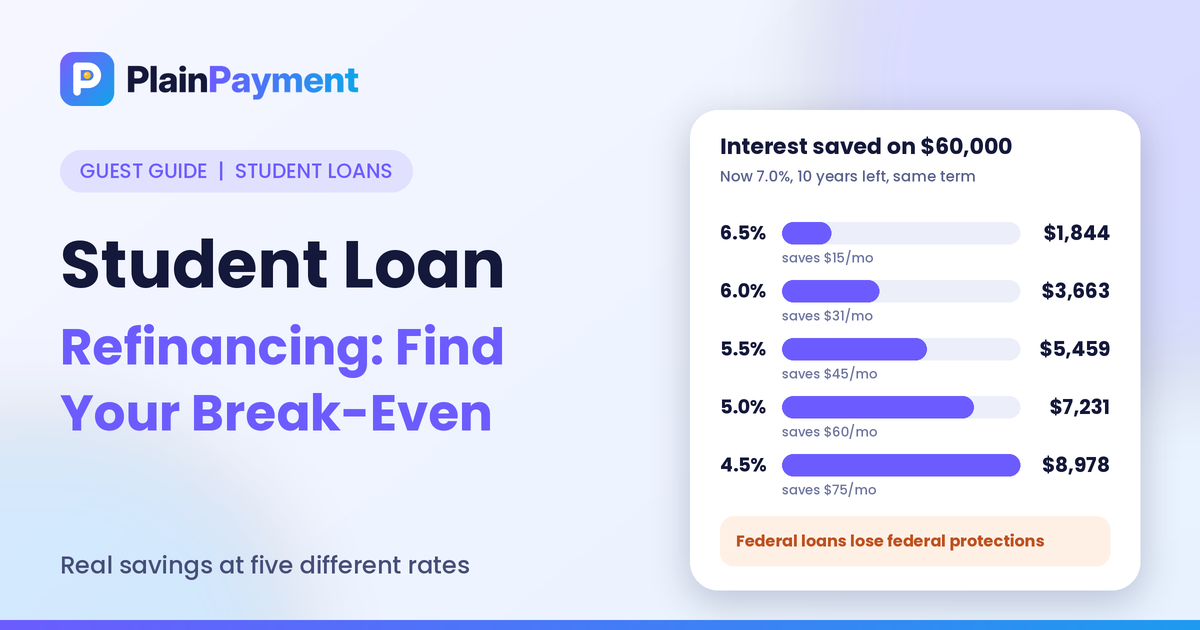
The bigger question is whether you are giving up federal protections. If your loans are federal, refinancing them with a private lender permanently removes access to federal income-driven repayment plans, federal forgiveness programs, and federal forbearance and deferment options. In the example below, refinancing $60,000 from 7.0% to 5.5% saved about $5,459 in interest on the same 10-year term. Whether that is worth the lost protections depends on your job security, income, and goals.
Federal vs Private Loans: Know What You Hold
Before you calculate anything, find out what kind of loans you have.
| Feature | Federal loans | Private loans |
|---|---|---|
| Lender | U.S. Department of Education | Banks, credit unions, online lenders |
| Income-driven repayment | Available, but plans are changing | Generally not available |
| Public Service Loan Forgiveness | Possible with qualifying work and payments | Not available |
| Deferment and forbearance | Federal options | Set by the lender, often more limited |
| Interest rate | Fixed, set by the year of disbursement | Fixed or variable, based on your credit |
| Cosigner | Usually not required | Often required for borrowers with limited credit |
If you hold private loans, refinancing does not cost you federal protections, because you do not have them. The break-even is mostly about rates, fees, and term. If you hold federal loans, the decision is bigger. Refinancing them into a private loan cannot be undone.
Federal repayment rules have been changing quickly. Income-driven plans have been reshaped, and a new Repayment Assistance Plan launched in 2026. Check your current options with your servicer and on the official Federal Student Aid website before you give them up.
Three Ways to Think About Break-Even
There is no single break-even number. Think of it in three layers.
- Fee break-even: How many months of savings does it take to repay any fees?
- Total-cost break-even: Does the new loan cost less in total interest over its life?
- Protection break-even: Is the savings large enough to justify any federal benefits you give up?
We will work through each.
The Example Used in This Guide
All numbers are illustrations, not offers. Your rates and terms will differ.
- Current balance: $60,000
- Current interest rate: 7.0% (a weighted average across your loans)
- Remaining term: 10 years (120 months)
- Current payment: $696.65 per month
- Total interest if you keep the loans: $23,598
- Refinance offers use the same or different terms, as shown in each table
Layer 1: The Fee Break-Even
If the refinance has a fee, divide it by your monthly savings.
Suppose you refinance to 5.5% for 10 years with a $600 fee, which is 1% of the balance.
| Item | Amount |
|---|---|
| Current payment | $696.65 |
| New payment at 5.5% for 10 years | $651.16 |
| Monthly savings | $45.49 |
| Fee | $600 |
| Break-even | about 13.2 months |
After about 13 months, you have recovered the fee, and everything after that is savings. Total interest and fees on the new loan would be about $18,739 compared with $23,598 on the current loans, a savings of about $4,859.
Many lenders charge no origination fee. In that case, the fee break-even is zero, and your focus shifts to the other two layers. Always check the fee line in any offer, and compare the APR, not just the rate. An APR calculator shows how fees change the true yearly cost.
Layer 2: The Total-Cost Break-Even
A lower rate does not always mean a lower total cost. The term matters just as much. Here is how different refinance offers compare with keeping the current loans.
| Option | Monthly payment | Total interest | Monthly change | Total interest vs current |
|---|---|---|---|---|
| Keep current loans (7.0%, 10 years) | $696.65 | $23,598 | $0 | $0 |
| Refinance, 6.5%, 10 years | $681.29 | $21,755 | -$15.36 | saves $1,844 |
| Refinance, 6.0%, 10 years | $666.12 | $19,935 | -$30.53 | saves $3,663 |
| Refinance, 5.5%, 10 years | $651.16 | $18,139 | -$45.49 | saves $5,459 |
| Refinance, 5.0%, 10 years | $636.39 | $16,367 | -$60.26 | saves $7,231 |
| Refinance, 4.5%, 10 years | $621.83 | $14,620 | -$74.82 | saves $8,978 |
| Refinance, 6.0%, 15 years | $506.31 | $31,137 | -$190.34 | costs $7,538 more |
| Refinance, 4.5%, 5 years | $1,118.58 | $7,115 | +$421.93 | saves $16,483 |
Three lessons stand out:
- Same term, lower rate: this is the cleanest win. Each half-point lowers your total interest by roughly $1,800 in this example.
- Longer term, lower rate: the 15-year option looks attractive because the payment drops by about $190 a month. But it costs about $7,538 more in total interest than keeping the current loans. A lower payment is not a lower cost.
- Shorter term, lower rate: the 5-year option saves the most interest, about $16,483, but the payment jumps by about $422 a month. It only works if your budget can handle it.
The lesson is to compare total interest and the monthly payment together. A student loan calculator lets you test different rates and terms side by side.
Layer 3: The Protection Break-Even
This is the part spreadsheets miss. If your loans are federal, ask what you would lose and whether the savings justify it.
Federal loans may offer:
- Income-driven repayment. Payments tied to your income can protect you if your pay drops or you lose your job.
- Forgiveness programs. Public Service Loan Forgiveness and income-driven plan forgiveness require federal loans.
- Deferment and forbearance. Federal options exist for hardship, unemployment, and other situations.
- Possible future relief. Policy changes can affect federal loans, though no one can promise what will happen.
A private lender may offer some hardship options, but they are usually more limited and set by the lender.
Questions to ask yourself
- Do I work, or plan to work, in public service or for a qualifying nonprofit?
- Is my income stable, or could it drop?
- Do I have a strong emergency fund?
- Could I afford my loan payments if I lost my job for six months?
- How much do I save by refinancing, in dollars?
- Would I still pay the loan comfortably if I kept my federal loans and made extra payments?
If you are pursuing public service forgiveness or you have an unstable income, the savings from refinancing would need to be very large to justify giving up federal protections. If your income is high and stable, your emergency fund is strong, and you plan to repay the loans fast, refinancing can make sense.
An Alternative: Keep the Loans and Pay Extra
Refinancing is not the only way to cut interest. You can also keep your current loans and pay more each month. Here is how that compares in the example:
| Strategy | Months to pay off | Total interest | Interest saved vs current |
|---|---|---|---|
| Keep loans, minimum payments | 120 | $23,598 | $0 |
| Keep loans, pay $50 extra a month | 109 | $21,200 | $2,398 |
| Keep loans, pay $100 extra a month | 100 | $19,255 | $4,343 |
| Refinance at 5.5%, same term | 120 | $18,139 | $5,459 |
Paying $100 extra a month saves about $4,343 and cuts the payoff by 20 months, without giving up federal protections. That is close to the savings of the 5.5% refinance. If you can afford extra payments, this approach keeps your options open.
A loan payoff calculator shows how much sooner you finish when you add to your payment.
Combining the Two
You can also refinance and then make extra payments. A lower rate plus extra payments pays the loan off even faster. But keep in mind that you cannot go back to federal loans after refinancing.
How to Calculate Your Own Break-Even
Follow these steps with your own numbers.
- List every loan. Write down the balance, interest rate, remaining term, and whether it is federal or private.
- Find your current payment and total interest. Add up the payments, or use your servicer’s amortization schedule.
- Collect refinance offers. Get prequalified offers, which usually use a soft credit check and do not hurt your score. Compare at least three lenders.
- Record rate, term, fees, and payment. Include the fixed or variable rate type.
- Calculate monthly savings. Subtract the new payment from the current payment.
- Calculate the fee break-even. Divide any fees by monthly savings.
- Compare total interest. Add up all payments and fees on the new loan, and compare with the current loans.
- Check the term. Make sure you are not extending the loan so far that you pay more overall.
- Weigh the lost protections. If your loans are federal, decide what they are worth to you.
- Decide and keep paying extra if you can. A lower rate is the start, not the finish.
Other Factors to Consider
- Fixed vs variable rates. A variable rate may start lower but can rise. A fixed rate gives you certainty.
- Credit score and income. Lenders offer their best rates to borrowers with strong credit and income.
- Cosigner release. If you use a cosigner to qualify, ask whether and when they can be released.
- Autopay discounts. Some lenders reduce the rate for automatic payments.
- Interest deduction. Student loan interest may be deductible up to a limit, subject to income rules. Check current limits or ask a tax professional.
- Prepayment penalties. Most student loans do not charge them, but check.
- Servicing quality. Read reviews and customer service ratings of the lender.
- Hardship options. Ask what the lender offers if you lose your job or become ill.
Protect Yourself With an Emergency Fund
If you refinance federal loans, you lose some of the safety nets that protect you in a hard stretch. A strong cash cushion can fill that gap. An emergency fund calculator can help you set a target, and many people aim for several months of expenses before giving up federal protections.
Refinance, or Invest the Difference?
Some borrowers wonder whether to pay down loans faster or put money into savings and investments instead. The answer depends on your interest rate compared with expected returns, your comfort with risk, and your goals. If your loan rate is high, paying it down is a guaranteed return. If your rate is low, investing may earn more, but returns vary. A compound interest calculator shows how steady monthly investing can grow, which helps you compare it with the interest you would save by paying extra.
Common Mistakes to Avoid
- Refinancing federal loans without thinking about protections. You cannot undo it.
- Choosing the lowest payment. A longer term can cost thousands more.
- Ignoring fees. Even small fees change the break-even.
- Looking at only one offer. Rates vary widely between lenders.
- Picking a variable rate without a plan. Payments can rise.
- Refinancing right before pursuing public service forgiveness. It would end your eligibility.
- Forgetting your emergency fund. A cushion matters more without federal safety nets.
- Assuming a lower rate is always better. Term, fees, and protections count too.
Quick Checklist
- Identify which loans are federal and which are private.
- Calculate your current payment and total interest.
- Get prequalified offers from at least three lenders.
- Compare rate, term, fees, and total interest.
- Calculate the fee break-even.
- Decide what federal protections are worth to you.
- Compare refinancing with paying extra on your current loans.
- Keep an emergency fund in place.
Bottom Line
The break-even on a student loan refinance has three layers: how quickly savings repay any fees, whether total interest falls, and whether the savings justify any federal protections you give up. In the example, refinancing $60,000 from 7.0% to 5.5% on the same term saved about $5,459 in interest, while stretching to 15 years lowered the payment but cost about $7,538 more.
Run your own numbers, compare several offers, and be especially careful before refinancing federal loans. These examples are for education and are not financial advice. A licensed financial professional or a nonprofit student loan counselor can review your situation before you make a permanent decision.
FAQs
How do I calculate the break-even on a student loan refinance?
Divide any upfront fees by your monthly savings. For example, a $600 fee and $45.49 in monthly savings gives about 13.2 months. Then compare total interest over the life of the new loan with your current loans, and consider any benefits you would lose.
Should I refinance federal student loans?
It depends on your goals and your situation. Refinancing federal loans into a private loan removes access to federal income-driven plans, forgiveness programs, and federal forbearance and deferment options. It can make sense if you have stable income, a strong emergency fund, and no plans to use those programs, but it cannot be undone.
Does refinancing student loans hurt my credit?
Prequalification usually uses a soft inquiry and does not affect your score. A formal application can cause a hard inquiry, which may lower your score slightly for a short time. On-time payments afterward help your credit.
Is a lower monthly payment always better?
No. A lower payment can come from a longer term, which often raises total interest. In the example, a 15-year refinance lowered the payment by about $190 a month but cost about $7,538 more than keeping the current loans.
Can I refinance private student loans?
Yes. Private loans do not carry federal protections, so refinancing them is mostly about rate, term, and fees. Compare offers from several lenders and check cosigner options.
What is better: refinancing or paying extra on my loans?
Both can cut interest. In the example, paying $100 extra a month on the current loans saved about $4,343, while refinancing to 5.5% saved about $5,459. Paying extra keeps federal protections, while refinancing may offer a lower rate. You can also do both if you refinance private loans or choose to give up federal protections.
Can I go back to federal loans after refinancing?
No. Once federal loans are refinanced into a private loan, they are no longer federal loans, and the protections and programs tied to them are no longer available for those balances.