

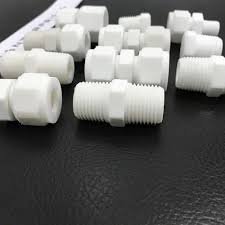

Teflon (PTFE) tube fittings are widely used in industries that demand high chemical resistance, temperature stability, and reliable performance under harsh operating conditions. Made from polytetrafluoroethylene, these fittings are designed to handle aggressive media while maintaining system integrity and safety.
Key Properties of PTFE Tube Fittings
PTFE is known for its exceptional chemical inertness, making it resistant to almost all acids, alkalis, and solvents. It can operate across a wide temperature range, typically from –200°C to +260°C, without losing its physical or mechanical properties. PTFE also has a very low coefficient of friction, which minimizes wear and prevents material buildup inside the system. Additionally, it is non-reactive, non-toxic, and electrically insulating, making it suitable for sensitive industrial applications.
Benefits of Using PTFE Tube Fittings
One of the main advantages of Teflon tube fittings is their long service life, even in highly corrosive environments. They do not rust, degrade, or contaminate the fluid being transported. Their smooth internal surface reduces pressure loss and ensures consistent flow rates. PTFE fittings are also lightweight and easy to install, helping reduce overall system weight and maintenance requirements. These benefits make teflon tube fittings a preferred choice for applications where reliability and purity are critical.
Industrial Applications
PTFE tube fittings are extensively used in chemical processing plants for handling corrosive chemicals and solvents. In the pharmaceutical and food processing industries, they are valued for their non-contaminating and hygienic properties. Semiconductor and electronics manufacturing rely on PTFE fittings for high-purity fluid transfer systems. They are also used in oil & gas, automotive, and laboratory applications where high temperature and chemical resistance are essential.
Conclusion
Teflon (PTFE) tube fittings offer a unique combination of chemical resistance, thermal stability, and durability, making them suitable for a wide range of demanding industrial applications. Their ability to perform reliably in extreme environments helps improve system safety, efficiency, and long-term operational performance.