

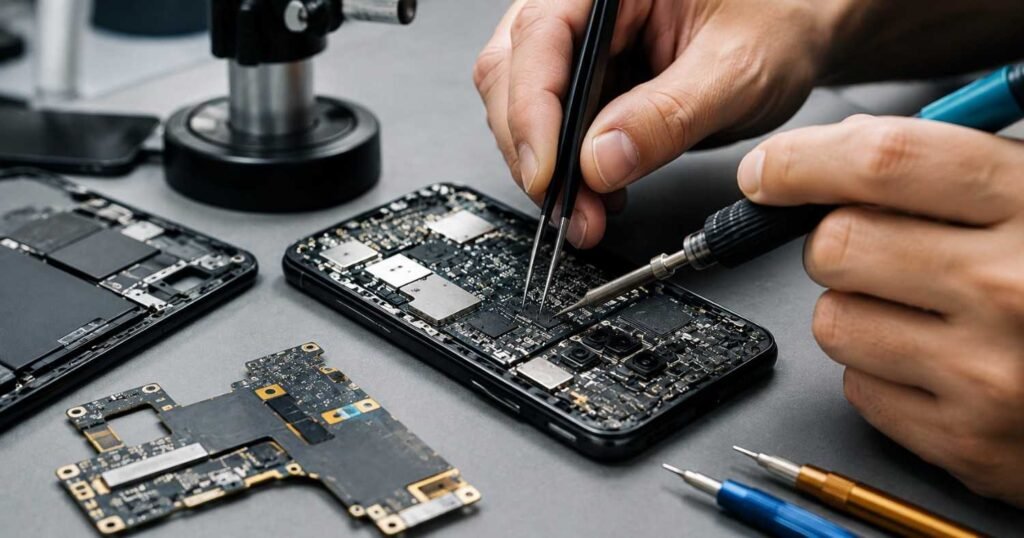

Mobile phones have become an important part of everyday life. People use them for communication, banking, shopping, education, entertainment, and business. When a smartphone develops a serious hardware problem, basic repair methods may not always be enough. This is where chip level mobile repairing becomes important. Students who want to develop advanced technical skills can consider professional training from a mobile repairing institute in Delhi to understand how smartphone components, circuits, and chips work together.
What Is Chip Level Mobile Repairing?
Chip level mobile repairing is an advanced method of diagnosing and repairing problems found on a mobile phone’s motherboard. Instead of simply replacing an entire motherboard or major part, a technician identifies the exact component causing the problem and works on that particular section.
A smartphone motherboard contains many small components, including ICs, resistors, capacitors, connectors, coils, and other electronic parts. A chip level technician learns how these components function and how to identify faults when a phone stops working properly.
For example, if a phone does not switch on, the problem may be related to its power section, charging circuit, battery connector, or another motherboard component. Proper diagnosis helps the technician understand the actual reason instead of replacing parts without checking them.
How Is Chip Level Repair Different from Basic Mobile Repair?
Basic mobile repairing generally focuses on common problems such as broken displays, damaged charging ports, faulty batteries, speakers, microphones, cameras, and other replaceable parts. These repairs are important and form the foundation of mobile servicing.
Chip level repairing goes deeper into the device. It involves understanding motherboard circuits and diagnosing faults at the component level.
A technician may need to use tools such as a multimeter, soldering station, hot air machine, DC power supply, and microscope. Learning how to use these tools correctly is important because modern smartphone components are extremely small and require careful handling.
A professional mobile repairing institute in Delhi can help students move step by step from basic concepts to more advanced motherboard repair techniques.
What Do You Learn in Chip Level Mobile Repairing?
A good training program usually begins with basic electronics. Students need to understand concepts such as voltage, current, resistance, continuity, and different electronic components before working on complicated smartphone motherboards.
After learning the fundamentals, students can move towards practical diagnosis and repair.
Training may cover motherboard identification, circuit understanding, soldering and desoldering, component testing, IC removal and installation, jumper techniques, charging problems, power faults, display-related motherboard issues, network faults, audio problems, and other common smartphone failures.
Students may also learn how to read circuit diagrams or schematics where applicable. These diagrams can make it easier to understand connections between different motherboard sections.
The exact course content can vary depending on the training program, so students should always check the syllabus before enrolling.
Why Should You Learn Chip Level Mobile Repairing?
One major reason to learn chip level repairing is that it can expand your technical knowledge. A person who only knows basic repairs may be able to handle common replacement jobs, but motherboard faults require more advanced skills.
Learning chip level techniques can help technicians diagnose problems more accurately. Instead of immediately suggesting motherboard replacement, they may be able to identify a smaller faulty component and determine whether repair is possible.
Another advantage is skill development. Modern smartphones continue to become more advanced, so technicians need to keep improving their knowledge. Understanding electronics and motherboard repair provides a stronger technical foundation for working with different types of devices.
Importance of Practical Training
Mobile repairing cannot be learned effectively through theory alone. Practical experience is an important part of developing repair skills.
Students should get opportunities to understand real components, practice soldering, test circuits, use repair equipment, and diagnose different faults. Regular practice also helps improve hand control and confidence while working with delicate motherboard components.
At AK Info, the focus can be placed on helping learners understand mobile repairing concepts through a combination of technical knowledge and practical exposure. Students looking for a mobile repairing institute in Delhi should consider factors such as practical sessions, course structure, trainer guidance, tools used during training, and the range of repair topics covered.
Who Can Learn Chip Level Mobile Repairing?
Chip level mobile repairing can be useful for different types of learners. Beginners interested in electronics and smartphones can start by learning basic mobile repairing before moving towards advanced techniques.
Existing mobile repair technicians can also learn chip level repair to improve their diagnostic abilities. People who already operate a mobile repair shop may use these skills to handle a wider range of technical problems.
It can also be considered by students who prefer practical, skill-based learning and want to explore technical work related to smartphones.
You do not necessarily need advanced electronics knowledge before starting, but patience, attention to detail, and regular practice are important. Since motherboard components are small and sensitive, careful working habits are essential.
What Should You Look for in a Training Institute?
Choosing the right institute is an important part of learning mobile repairing. Before joining a course, check whether the training covers both basic and advanced repair concepts.
Look at the practical training facilities and find out whether students get sufficient opportunities to work with repair tools and motherboard components. It is also useful to understand the course duration, syllabus, batch structure, and level of trainer support.
When comparing options for a mobile repairing institute in Delhi, avoid making a decision based only on course fees. The quality and depth of practical learning should also be considered.
Final Thoughts
Chip level mobile repairing is about understanding what happens inside a smartphone motherboard and learning how to diagnose faults at the component level. It requires knowledge of electronics, proper use of tools, careful observation, and consistent hands-on practice.
For learners who want to go beyond simple screen, battery, and part replacement, chip level training can provide valuable advanced skills. Training at AK Info can help learners understand the technical side of mobile repair in a structured manner. By choosing suitable training, practising regularly, and continuing to learn about newer smartphone technologies, students can build stronger and more useful mobile repairing skills.
Read More: