

If you have ever looked at a jar of Manuka honey, you may have noticed numbers such as MGO 100+, MGO 550+, MGO 850+, MGO 1200+ or even MGO 1500+. These numbers can be confusing, especially if you are buying Manuka honey for the first time.
So, what is MGO in Manuka honey?
MGO stands for methylglyoxal, a naturally occurring compound that is an important characteristic of Manuka honey. The MGO rating provides a measurable indication of the concentration of methylglyoxal in the honey.
Understanding MGO can help Australian consumers compare different Manuka honey products and choose a product based on clear information.
What Does MGO Stand For?
MGO means methylglyoxal. It is a naturally occurring compound associated with the characteristic activity of Manuka honey.
MGO develops from another compound called dihydroxyacetone (DHA), which occurs naturally in the nectar of some Leptospermum plants. As Manuka honey matures, DHA can convert into MGO.
This natural process is one reason Manuka honey can contain much higher levels of MGO than many conventional honeys.
How Is MGO Measured?
MGO concentration can be measured through laboratory testing. The Australian Manuka Honey Association (AMHA) states that MGO can be directly measured using HPLC, or high-performance liquid chromatography.
MGO is generally expressed in milligrams per kilogram (mg/kg), which is equivalent to parts per million (ppm).
For example, an MGO 850+ label represents a high concentration of methylglyoxal associated with that rating.
What Do MGO Numbers Mean?
The basic principle is simple:
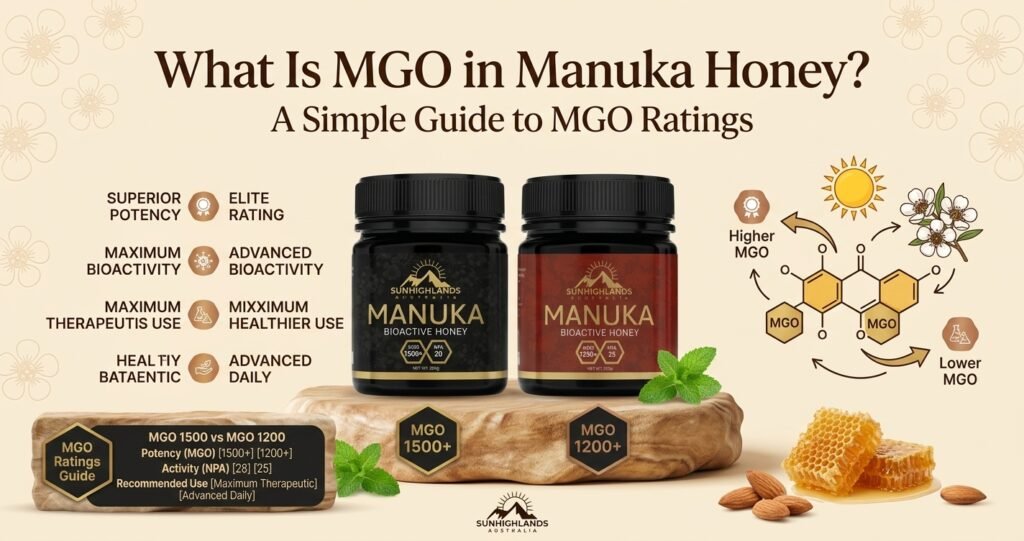
The higher the MGO number, the higher the measured concentration of methylglyoxal.
Common MGO ratings include:
| MGO Rating | General Meaning |
|---|---|
| MGO 100+ | Lower MGO level |
| MGO 263+ | Moderate MGO level |
| MGO 550+ | High MGO level |
| MGO 850+ | Very high MGO level |
| MGO 1200+ | Higher MGO level |
| MGO 1500+ | Very high MGO level |
These numbers are useful for comparing products, although individual brands may offer different rating ranges.
It is also important to remember that an MGO rating measures one characteristic of the honey. It is not a medical dosage and should not automatically be interpreted as a guarantee of a particular health outcome.
Why Does Manuka Honey Have MGO?
The answer starts with the Leptospermum plant.
Australian Manuka honey is produced by bees collecting nectar from Leptospermum species. Australia has a wide diversity of native Leptospermum plants, and differences between species can affect the natural compounds found in their nectar.
Some nectar contains higher levels of DHA. During honey maturation, this DHA can naturally convert into MGO.
As a result, the final MGO concentration depends on factors such as floral source, nectar composition and honey maturation.
Does Every Manuka Honey Have the Same MGO Level?
No.
Manuka honey can naturally have different MGO concentrations. Australian Manuka honey may be monofloral or multifloral, and its chemical characteristics can vary depending on floral sources and regional conditions.
This is why you can find Manuka honey with MGO 100+, MGO 550+, MGO 850+ or much higher ratings.
The MGO level should therefore be checked on the product label rather than assumed simply because a product is called Manuka honey.
Why Is MGO Important When Buying Manuka Honey?
MGO provides consumers with a measurable reference point.
Words such as “premium,” “active” or “strong” can be subjective, while an MGO value refers to a quantifiable concentration.
The AMHA describes MGO as the centrepiece of its Australian Manuka honey rating system and uses scientific testing to assess MGO levels.
This can make it easier to compare different products within the Manuka honey category.
What Does MGO 850+ Mean?
An MGO 850+ rating indicates a high MGO concentration.
It is particularly relevant for consumers looking for a high-MGO Australian Manuka honey. The number should be understood as a measurement of methylglyoxal concentration rather than as an instruction for how much honey to consume.
When buying MGO 850+, it is useful to check whether the stated MGO level is supported by laboratory testing and whether the product provides clear information about its Australian origin.
MGO and UMF: Are They the Same?
MGO and UMF™ are often mentioned together, but they are not identical systems.
MGO measures the concentration of methylglyoxal. UMF is a separate grading and certification system that considers several characteristics.
For this reason, an MGO rating may be compared with an approximate UMF reference based on MGO concentration, but an MGO-labelled product should not automatically be considered UMF-certified.
Consumers should check the actual certification displayed on a product rather than assuming that two different labels mean exactly the same thing.
How Can You Tell if MGO Claims Are Reliable?
When purchasing premium Manuka honey, look for independent testing and transparent product information.
The AMHA’s quality framework includes independent laboratory testing and traceability. Its Mark of Authenticity requires qualifying Australian Manuka honey to be produced in Australia and independently tested against defined MGO and DHA requirements.
You can also check:
- MGO rating
- Country of origin
- Ingredients
- Testing information
- Authenticity or certification details
- Batch information where available
These details provide more information than the MGO number alone.
Does Higher MGO Mean Better Honey?
A higher MGO rating means a higher measured concentration of methylglyoxal. However, that does not mean the highest MGO rating is automatically the right choice for every consumer.
Someone buying honey for breakfast or cooking may prefer a lower rating, while another consumer may specifically want MGO 850+, 1200+ or 1500+.
Taste, intended use, budget, origin and testing can all influence which product is appropriate.
Is MGO a Health or Medical Rating?
MGO is sometimes discussed in connection with the natural activity of Manuka honey. However, consumers should be careful about interpreting an MGO number as a medical strength or dosage.
MGO 850+ does not mean that you should consume 850 mg of honey, nor does the number itself establish that the honey can treat a particular medical condition.
It simply describes the concentration of methylglyoxal measured in the product.
Manuka honey should be treated as a food unless a specific honey product is manufactured and approved for a particular medical application.
Final Thoughts
So, what is MGO in Manuka honey?
MGO, or methylglyoxal, is a naturally occurring compound associated with Manuka honey. It develops from DHA found in the nectar of certain Leptospermum plants and can be measured through laboratory testing.
The MGO rating helps consumers compare different Manuka honeys. In general, MGO 850+ contains a higher measured concentration of MGO than MGO 550+, while MGO 1200+ and MGO 1500+ represent progressively higher ratings.
For Australian consumers, however, choosing Manuka honey should involve more than looking at the biggest number. Consider MGO concentration, Australian origin, independent testing, authenticity and product labelling together.
Once you understand what MGO means, Manuka honey labels become much easier to read and you can choose a product based on measurable information rather than marketing terms alone.