

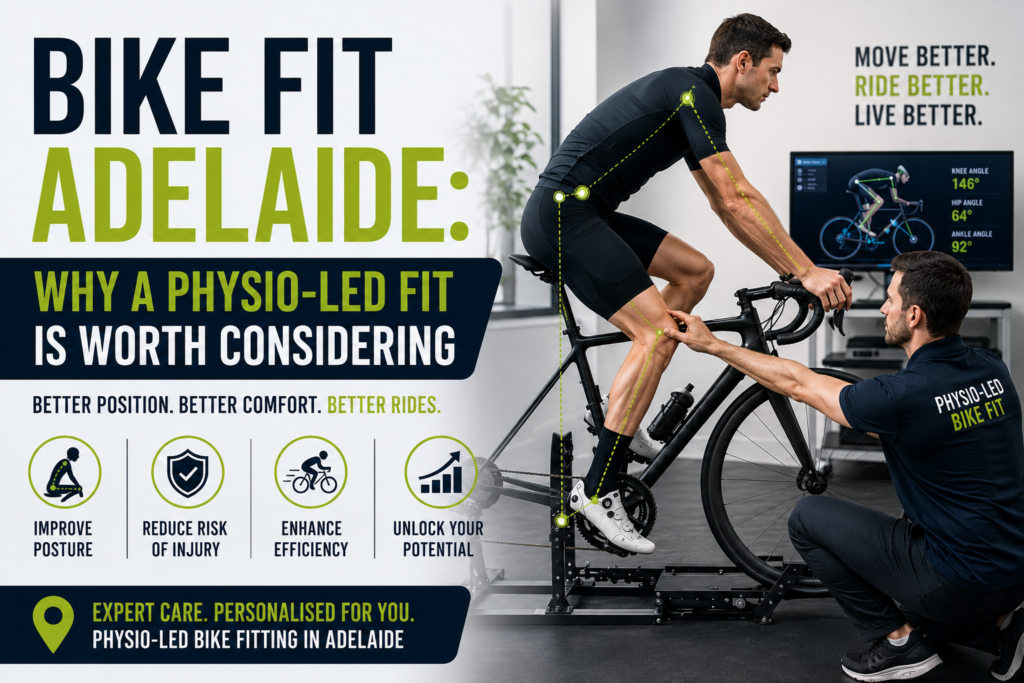

Most cyclists in Adelaide put real thought into their bike. The frame, the wheels, the groupset. Far fewer put the same thought into how they actually sit on it. Yet the way your body meets the bike affects almost everything — comfort, power, handling, and your risk of overuse injury.
If you have been searching for a bike fit Adelaide cyclists trust, it helps to understand what a professional fit involves, why a physiotherapy background changes the process, and how to know whether you would benefit from one. This article walks through each of those questions in plain terms.
What a bike fit actually is
A bike fit is a structured process of adjusting your bike to suit your body, your goals, and the way you ride. It is not a quick saddle-height check or a chart based on your inseam.
A thorough fit looks at the full picture: saddle height, set-back and tilt, cleat position, handlebar reach, seat-to-bar drop, and how your weight is balanced across the contact points. Each adjustment interacts with the others. Raise the saddle and you change the load on your knees, your hips, and your hands. Move the cleats and you change how force travels through the pedal stroke.
Because these adjustments are connected, good fitting is a reasoning process, not a checklist. The fitter needs to understand why a change is being made, observe how your body responds, and adjust from there.
Why the physio part matters
Plenty of people can adjust a bike. Fewer can assess the body riding it.
A physiotherapist brings clinical assessment into the fitting process. Before touching the bike, a physio-led fit typically examines your flexibility, joint range, movement patterns, and any history of injury or pain. That assessment shapes every decision that follows.
Here is a simple example. Two riders can present with the same knee pain. In one, the cause is saddle height and stance width. In the other, it is cleat position combined with restricted hip movement. The bike adjustment that helps the first rider may do nothing for the second. Without assessing the body, the fitter is guessing.
This is the core difference with a physio bike fit: the position is built around any body limitations that may be present, rather than forcing your body into a textbook position it cannot sustain.
Common problems a proper fit can address
Riders usually book a fit for one of a few reasons. The most common are:
Knee pain. Often linked to saddle height, set-back, cleat position, or asymmetry through the pedal stroke. Anterior knee pain and lateral knee pain tend to have different causes, which is why a careful assessment matters.
Lower back discomfort. Frequently related to sub-optimal saddle tilt, seat-to-bar drop, or body balance on the bike. Sometimes the bike is fine and the limitation sits in hip or spine mobility — something a physio can identify and address.
Hand numbness. Usually a sign of too much weight on the hands, or handlebar and arm-pad positioning that loads the wrists poorly. Adjusting body balance often relieves it.
Saddle discomfort. Saddle pressure problems can come from the saddle itself, but just as often from tilt, set-back, or pelvic position — especially over time and in hotter conditions.
Numb feet or hot spots. Commonly connected to cleat position, shoe fit, or stance width.
None of these should be accepted as a normal part of cycling. Discomfort that appears ride after ride is information, and it usually has an identifiable cause.
What happens during a professional fitting session
While every studio runs its process a little differently, a professional bike fitting Adelaide riders can expect generally follows a clear structure.
- Interview. The session starts with a conversation about your riding history, goals, injuries, and any current discomfort. A rider training for a triathlon has different needs from a daily commuter.
- Physical assessment. Off the bike, the fitter assesses flexibility, joint range, and movement patterns. This identifies anything that will shape your position.
- Observation on the bike. You ride on a trainer while the fitter watches how your body moves under load. Video capture is often used, because some issues are less noticeable to the naked eye and easier to see frame by frame.
- Adjustments. Changes are made one at a time, with feedback from the rider and observation guiding each step. Saddle first in most cases, because saddle position affects everything downstream.
- Documentation and follow-up. A good fit ends with a record of your bike measurements (before and after) and clear recommendations. Reputable studios also follow up after you have ridden in the new position, because the real test happens on the road, not in the studio.
Adjusting the rider, not just the bike
This is where a physio-led approach separates itself most clearly.
Sometimes the honest answer is that the bike is already close, and the limitation is the body. Restricted hips, a stiff thoracic spine, or weakness through the trunk can all cap how sustainable a position is — no matter how carefully the bike is adjusted.
A physiotherapist can identify these limitations during the fit and give you targeted exercises to address them. Over weeks, that work can open up positions that were not sustainable before. The fit becomes a starting point rather than a final answer, which is a more realistic reflection of how bodies adapt.
Who benefits from a bike fit
A common misconception is that fitting is only for racers. In practice, an Adelaide bike fit is useful for a much wider range of riders:
- New cyclists setting up their first proper road bike, who want to start with a position that prioritises efficiency and minimises injury risk rather than correcting bad habits later.
- Riders returning from injury, where the position needs to respect what the body can currently tolerate.
- Anyone experiencing pain or numbness that keeps showing up on rides.
- Triathletes and time trial riders, whose positions need to be both aerodynamic and sustainable over extended periods of time.
- Riders buying a new bike, where a pre-purchase fit helps confirm the right size and geometry before money changes hands.
- High-mileage riders and commuters, for whom small inefficiencies compound over time.
If you ride regularly and have never been fitted, the odds are good that something in your position can be improved.
How to choose a fitter in Adelaide
Not all fits are equal, so it is worth asking a few questions before booking:
What assessment is included? A fit that skips the physical assessment is working with half the information.
What are the fitter’s qualifications? A background in physiotherapy or another clinical field means injury and pain are assessed properly, not guessed at. If you are dealing with pain, this matters a great deal.
Is the session unhurried? A thorough fit takes time. Interview, assessment, observation, and adjustment cannot be compressed into twenty minutes.
Is follow-up included? Positions need to be tested over real rides. A studio that checks in afterwards is taking responsibility for the outcome.
Do they document the fit? Before-and-after measurements protect the work and make future changes easier.
For riders looking for a physio bike fit Adelaide has options, and among them Aerro Physio Bike Fit takes exactly this clinical, assessment-first approach — combining physiotherapy expertise with detailed fitting to build positions catered to each rider’s individual needs.
Getting the timing right
There is no bad time for a fit, but some moments offer more value than others:
- Before a big training block, so you adapt to the improved position while volume builds.
- After buying a new bike, since even the same size from a different brand can position you quite differently.
- When pain first appears, rather than months later. Early adjustment is simpler than treating an established overuse injury.
- After a significant change — injury, surgery, a long break from riding, or a shift in flexibility.
Riders sometimes wait until discomfort becomes impossible to ignore. Acting earlier is almost always the easier path.
Conclusion
A quality bike fit is one of the most cost-effective improvements available to any cyclist. It addresses comfort, efficiency, and injury risk in a single session, and its benefits apply to every ride afterwards.
The key is choosing a process that assesses the rider, not just the bike. A physio-led bike fit Adelaide cyclists can rely on starts with your body — your flexibility, your history, your goals — and builds the position from there. Whether you are chasing performance, managing a niggle, or simply want your Sunday rides to feel better, a professional assessment is a sensible place to start.
If discomfort has been part of your riding for a while, it does not have to stay that way. Book an assessment, ask questions, and expect clear reasoning behind every adjustment. Your body will notice the difference.