

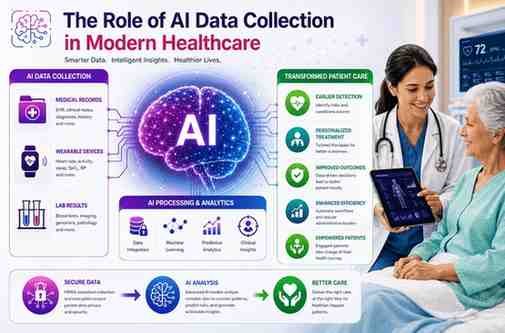

Healthcare is becoming increasingly data-driven. From electronic health records (EHRs) and medical imaging to wearable devices and telehealth platforms, providers generate enormous amounts of information every day. The challenge is no longer simply collecting healthcare data—it is collecting, organizing, securing, and analyzing it effectively.
This is where AI Data Collection for Healthcare is becoming increasingly important. Artificial intelligence can help healthcare organizations capture information from multiple sources, identify meaningful patterns, automate data processing, and support better decision-making.
As healthcare organizations across the United States continue investing in digital transformation, several important trends are shaping the future of AI-powered healthcare data collection.
1. Automated Data Collection From Multiple Sources
One of the biggest trends in AI Data Collection for Healthcare is the automation of information gathering. Traditional healthcare data collection can involve manual data entry, paper forms, disconnected systems, and repetitive administrative processes.
AI-powered solutions can collect and process information from EHRs, clinical notes, medical documents, diagnostic images, patient portals, connected devices, and other digital sources. Natural language processing (NLP), optical character recognition (OCR), and machine learning can help convert unstructured information into usable data.
For healthcare organizations, automation can reduce administrative workloads while helping improve data consistency and accessibility.
2. Greater Focus on Interoperability
Healthcare data is often distributed across hospitals, physician practices, laboratories, insurers, pharmacies, and digital health applications. Connecting these systems is essential for creating a complete view of patient information.
Interoperability will therefore remain a major trend in AI Data Collection for Healthcare. U.S. healthcare initiatives increasingly emphasize standards-based data exchange, including Fast Healthcare Interoperability Resources (FHIR) APIs. CMS continues to promote FHIR and other standards to support secure information exchange among patients, providers, and payers.
As more systems become connected, AI can help collect information from these sources, normalize it, and prepare it for analytics and clinical applications.
3. Real-Time Data From Wearables and IoT Devices
Healthcare data is moving beyond the hospital and doctor’s office. Smartwatches, fitness trackers, remote patient monitoring devices, glucose monitors, and other connected technologies can generate continuous streams of health-related information.
AI can help collect and analyze this real-time data to identify changes that may require attention. For example, healthcare providers can use patient-generated data to monitor trends in vital signs, activity levels, or other relevant measurements.
This shift toward continuous data collection can support more proactive and personalized healthcare rather than relying solely on information captured during periodic appointments.
4. Privacy and Security Will Become Even More Important
More healthcare data means greater responsibility. Patient information is highly sensitive, making privacy and security critical considerations when implementing AI data collection systems.
In the United States, HIPAA provides important privacy protections for protected health information (PHI), while organizations may also need to consider other applicable requirements depending on how consumer health information is collected and used. HHS specifically notes that businesses handling consumer health information may have obligations under HIPAA, the FTC Act, and the Health Breach Notification Rule.
Future AI data collection platforms will increasingly emphasize encryption, access controls, audit trails, data minimization, secure APIs, and responsible data governance.
5. AI-Powered Data Quality and Cleaning
Collecting large amounts of healthcare data is only useful when that information is accurate and consistent. Duplicate records, incomplete fields, inconsistent terminology, and outdated information can reduce the value of healthcare datasets.
AI can assist with data validation, deduplication, classification, normalization, and anomaly detection. This can help organizations build cleaner datasets for analytics, research, population health management, and AI applications.
Better data quality can ultimately make downstream healthcare AI systems more reliable and useful.
6. Synthetic Data for Healthcare AI
Another trend to watch is the use of synthetic healthcare data. Synthetic datasets can be generated to resemble real-world healthcare information without directly reproducing identifiable patient records.
Organizations and researchers may use synthetic data for software testing, model development, simulations, and other applications where access to real patient data can be difficult or restricted.
While synthetic data does not eliminate privacy and governance considerations, it can become an important tool for expanding AI development while reducing reliance on directly identifiable datasets.
7. More Intelligent and Personalized Healthcare
The long-term goal of AI Data Collection for Healthcare is not simply to gather more information. It is to turn data into actionable insights.
As AI systems become better at combining clinical, administrative, behavioral, and patient-generated information, healthcare organizations can move toward more personalized approaches to care. AI-assisted data analysis may help identify trends, support risk assessment, streamline workflows, and provide clinicians with more relevant information at the right time.
CMS is also continuing efforts to modernize healthcare data exchange and use technology to improve care coordination and reduce administrative burdens.
The Future of AI Data Collection for Healthcare
The future of healthcare data collection will be defined by automation, interoperability, real-time information, stronger security, and smarter analytics. Organizations that build reliable data foundations today will be better positioned to adopt advanced AI technologies tomorrow.
For U.S. healthcare providers, technology companies, and digital health organizations, the opportunity is significant—but responsible implementation is essential. AI data collection solutions should prioritize data quality, patient privacy, interoperability, security, and practical business outcomes.
As these trends continue to evolve, AI Data Collection for Healthcare will play an increasingly important role in creating a more connected, efficient, and data-driven healthcare ecosystem.