

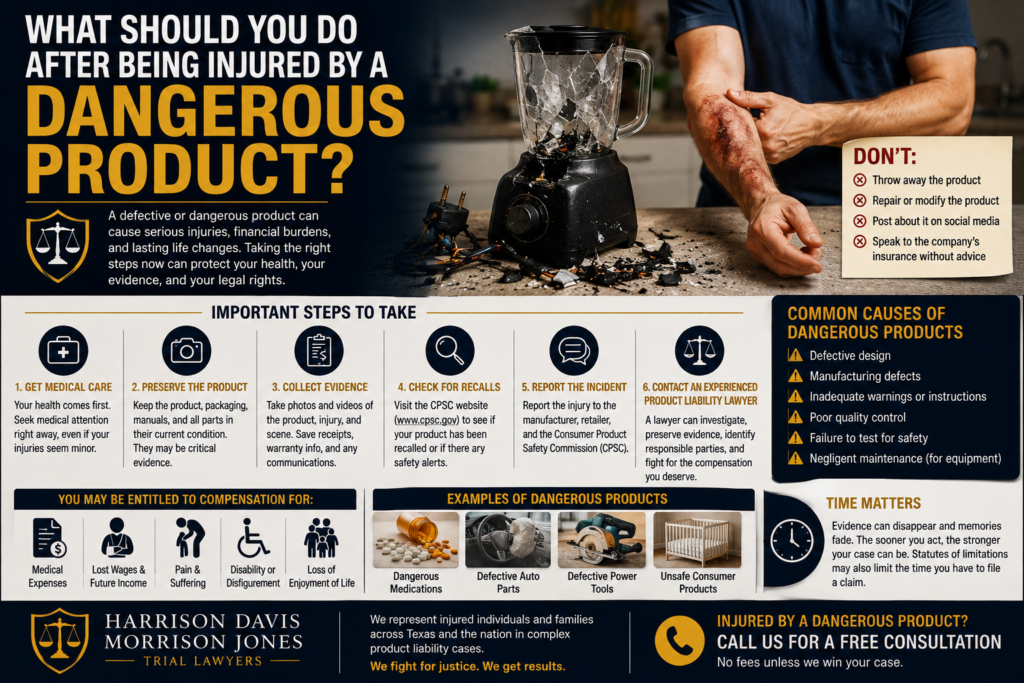

When a product that should have been safe causes an injury, you may be left dealing with medical bills, lost income, pain, and uncertainty about what went wrong. If you were injured by a dangerous or defective product, an experienced Product Liability Trial Lawyer can help investigate the product, preserve important evidence, identify potentially responsible parties, and determine whether you may have a product liability claim. Harrison Davis Morrison Jones handles product liability cases involving defective automobiles and parts, dangerous drugs, medical devices, machinery, power tools, and other dangerous products.
What Is a Dangerous or Defective Product?
A dangerous product is not necessarily automatically defective. Products can have risks that consumers reasonably expect, but manufacturers and other companies may potentially be responsible when a product has a defect that makes it unreasonably dangerous or when important safety information is missing.
Product liability cases commonly involve three types of defects:
- Design defects — the product’s basic design creates an unreasonable safety risk.
- Manufacturing defects — something goes wrong during manufacturing or assembly.
- Marketing defects — warnings, instructions, or other safety information are inadequate.
A dangerous product may also be involved in a recall, but a recall is not the only circumstance in which a product liability claim may arise.
What Should You Do Immediately After a Dangerous Product Injury?
Your first priority should always be your health and safety.
1. Get Medical Attention
Seek appropriate medical treatment as soon as possible. Some product-related injuries may appear minor initially but can become more serious over time.
Medical records can also document:
- The nature of your injuries
- When symptoms began
- Treatment you received
- Medications prescribed
- Follow-up care
- Recommended future treatment
- Medical expenses
If the product caused burns, fractures, lacerations, neurological injuries, respiratory problems, or another serious condition, prompt medical evaluation can be particularly important.
2. Stop Using the Product
If the product remains dangerous, stop using it unless doing so would create another safety risk.
Do not attempt to repair, modify, disassemble, or throw away the product simply because you believe it caused your injury. The product itself may become important evidence.
If the product is an appliance, tool, vehicle component, medical device, or piece of machinery, its condition may help experts determine what went wrong.
Why Should You Preserve the Product?
Preserving the product can be one of the most important steps after an injury.
A lawyer or qualified expert may need to examine it to determine whether the problem involved its design, manufacturing, warnings, maintenance, or another factor.
If possible, preserve:
- The product itself
- Packaging
- User manuals
- Warning labels
- Receipts
- Purchase records
- Serial or model numbers
- Photographs
- Videos
- Warranty information
- Repair records
Do not discard damaged parts or packaging without first understanding whether they may be relevant to your claim.
What Evidence Should You Collect?
Evidence can help explain exactly what happened and how the product caused your injury.
Take photographs of the product, the accident scene, your injuries, and any visible damage. If someone witnessed the incident, keep their contact information if possible.
You should also preserve:
- Medical records and bills
- Purchase receipts
- Credit-card or online purchase records
- Product registration information
- Emails with the manufacturer or retailer
- Communications with insurance companies
- Recall notices
- Repair invoices
- Product instructions
- Photographs of warning labels
- Videos showing the product malfunction
If the product was purchased online, save the product listing and description if they are still available.
Should You Check Whether the Product Was Recalled?
Yes. Finding out whether the product has been recalled may provide useful information.
A recall can indicate that a manufacturer, government agency, or another organization identified a potential safety issue. However, a product does not necessarily have to be recalled for a person to investigate a possible product liability claim.
Harrison Davis Morrison Jones has experience with defective automobile and auto-part cases involving recalls, including cases involving brakes, tires, airbags, seatbelts, ignition systems, and other defective components.
If you discover a recall, save the recall notice and information identifying your specific product.
Who Could Be Responsible for a Dangerous Product?
The manufacturer is not necessarily the only company that may need to be investigated.
Depending on the circumstances, potentially responsible parties could include:
- Product manufacturers
- Component manufacturers
- Distributors
- Retailers
- Suppliers
- Repair companies
- Other businesses involved in placing the product into the marketplace
The responsible parties will depend on the specific product, defect, circumstances of the injury, and applicable law.
For example, a vehicle injury may involve a manufacturer or defective component. A machinery injury may raise questions about the machine’s design, maintenance, warnings, or safety features.
What Types of Products Can Cause Product Liability Injuries?
Product liability claims can involve a wide range of consumer and industrial products.
Harrison Davis Morrison Jones specifically handles claims involving:
- Defective automobiles and car parts
- Dangerous prescription and over-the-counter drugs
- Defective medical devices
- Choking hazards
- Lead paint
- Dangerous machinery and industrial equipment
- Defective power tools
- Defective designs
- Failure to warn or properly train consumers
The firm’s product liability practice represents clients throughout Texas and nationally in claims involving injuries or deaths caused by dangerous or defective products.
What If the Manufacturer Says the Product Was Used Incorrectly?
A manufacturer or insurer may argue that the product was misused or that the user’s actions caused the injury.
That is why it is important to document how the product was being used when the incident occurred.
Do not guess about what happened or make statements about fault that you cannot support. Preserve the instructions and warnings that came with the product so an attorney and appropriate experts can compare them with how the product was actually designed and intended to be used.
Can a Dangerous Product Cause a Catastrophic Injury?
Yes. Product-related accidents can result in severe and permanent injuries.
Depending on the product and circumstances, victims may suffer:
- Traumatic brain injuries
- Spinal cord injuries
- Amputations
- Severe burns
- Fractures
- Internal injuries
- Vision or hearing loss
- Permanent disabilities
- Serious illness
- Wrongful death
Harrison Davis Morrison Jones also handles catastrophic injury cases involving defective products and other major accidents.
The financial impact can extend well beyond the initial emergency treatment. A serious injury may require rehabilitation, additional surgeries, long-term medical care, changes to employment, and ongoing assistance.
When Should You Contact a Product Liability Lawyer?
Consider speaking with an experienced product liability attorney as soon as possible, particularly if you suffered a serious injury or believe the product was defective.
An attorney can investigate the product’s history, identify potentially responsible parties, preserve evidence, review available records, and determine whether expert analysis may be necessary.
Product liability cases can involve technical questions about engineering, manufacturing, warnings, medical treatment, and causation. Harrison Davis Morrison Jones states that its product liability lawyers have more than 40 years of experience handling these claims and have resources for complex litigation.
What Compensation May Be Available?
Depending on the circumstances and applicable law, an injured person may potentially seek compensation for losses such as:
- Medical expenses
- Future medical care
- Lost wages
- Reduced earning capacity
- Physical pain
- Emotional suffering
- Other injury-related damages
If a dangerous product causes a death, eligible family members may also have potential wrongful death claims.
The amount and types of compensation available depend on the facts of the individual case.
What Should You Do After Being Injured by a Dangerous Product?
If a dangerous product injured you, get medical care, stop using the product, preserve the product and related evidence, document what happened, check for recalls, and avoid making unsupported statements about fault.
Do not assume that the manufacturer, retailer, or another company will preserve every piece of evidence needed for your case. An early investigation can be important, particularly when the product may be repaired, discarded, modified, or otherwise become unavailable.
If your injury was serious or you believe a defective product caused the incident, an experienced product liability trial lawyer can help you understand your legal options and determine what steps may be appropriate.
Frequently Asked Questions
1. Can I sue if a dangerous product injured me?
Potentially. A product liability claim may be possible when a defective product causes an injury, but the available legal claim depends on the product, nature of the defect, circumstances of the accident, evidence, and applicable law.
2. What should I do with the defective product after an injury?
Preserve it in its existing condition when reasonably possible. Avoid repairing, modifying, disassembling, or discarding it because the product may be important evidence in determining what caused the injury.
3. Do I need a product recall to file a lawsuit?
Not necessarily. A recall may provide useful information about a safety issue, but a product liability investigation does not necessarily depend on whether the product was formally recalled.
4. What evidence helps prove a defective product claim?
Useful evidence can include the product itself, photographs, videos, receipts, packaging, warning labels, instruction manuals, medical records, repair records, recall information, witness statements, and communications with the manufacturer or retailer.
5. What if the manufacturer says I used the product incorrectly?
The circumstances of the accident should be carefully investigated. Preserve the product’s instructions, warnings, photographs, and other documentation showing how the product was used. An attorney and qualified experts can evaluate whether the alleged misuse actually explains the injury or whether a defect or inadequate warning may have contributed.