

Best Haircuts for Boys with Straight Hair
Choosing the best haircuts for boys with straight hair starts with understanding one simple truth: straight strands offer a clean, smooth base that holds nearly any shape well. Unlike curly or wavy hair, straight hair lies flat naturally, which makes precise lines easy but can also mean less built-in volume. The good news is that straight hair is forgiving for barbers and low-effort for parents. Whether your son wants a classic crew cut or a trendy textured crop, straight hair adapts quickly to both structured and relaxed styles. This guide breaks down the best options by length, occasion, and hair behavior, so you can pick a cut that actually works for his daily routine, not just how it looks fresh from the chair.
What Makes Straight Hair Unique to Cut
Straight hair grows in a smooth, even pattern from root to tip, which means it reflects clipper lines and part lines with total clarity. There’s no natural texture to hide an uneven cut, so precision matters more here than with curly or wavy types. On the plus side, straight hair takes fades, side parts, and sharp edges beautifully, since nothing disrupts the line. The tradeoff is a tendency to lie flat, especially on fine strands, so barbers often layer or texture the top to fake movement and lift where straight hair naturally lacks it.
Best Short Haircuts for Straight Hair
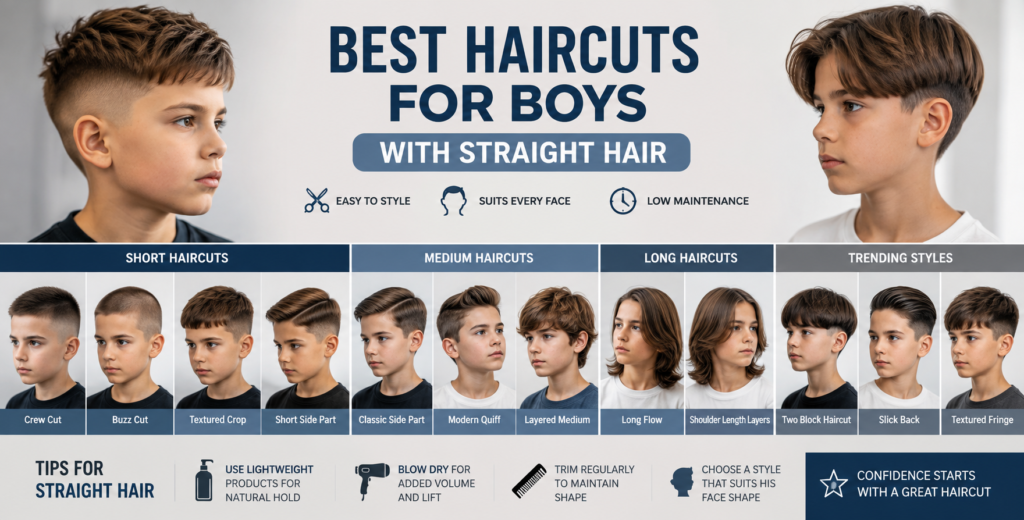
Short cuts remain the most popular choice because they’re tidy, low-fuss, and grow out evenly on straight hair. The crew cut is a go-to classic — short, clean, and nearly zero styling required. A buzz cut takes things even further, offering a completely uniform length with no daily upkeep at all. For boys wanting more personality, the textured crop keeps sides short while layering the top for movement straight hair doesn’t naturally have. A short side part rounds out the list, giving structure that holds all day without heavy product.
Best Medium Haircuts for Straight Hair
Medium lengths give straight hair room to show some shape without losing manageability. A classic side part styles easily with just a touch of product and works for school or dressier occasions alike. The modern quiff adds lift at the front, which helps counter straight hair’s tendency to sit flat. A layered medium cut reduces bulk at the ends and lets natural movement show through, avoiding the “helmet” look straight hair can fall into when left one length.Visit Apex Haircuts for more informational content.
Best Long Haircuts for Straight Hair
Longer straight hair can look sharp when it’s healthy, trimmed, and shaped with intention — not just left to grow. A long flow style works well for active boys, since straight hair moves naturally without curling out of place. Shoulder-length layers reduce overall weight, which stops hair from clinging to the neck and sides in warm weather or during sports. Long styles need trims roughly every 8 to 10 weeks to keep ends from looking limp or splitting.
Trending Styles Worth Trying
For boys who want something beyond the basics, a few current trends stand out. The two-block haircut keeps the top long while cutting the sides and back very short, creating bold contrast that straight hair handles cleanly. A slick back style looks especially polished on straight hair, since there’s no frizz to fight when combing it into place. A textured fringe brings the front section forward for a relaxed, modern look that still reads as intentional, not messy.
Choosing a Cut by Face Shape
The right straight-hair cut should work with your son’s face shape, not just his hair type. Round faces benefit from added height on top, like a quiff or textured crop, to create the illusion of length. Square faces look balanced with softer, layered cuts that ease sharp angles. Oval and heart-shaped faces are the most flexible, handling almost any style from a crew cut to a slicked-back look without needing major adjustments.
Adding Volume to Flat, Straight Hair
Flat, lifeless-looking hair is one of the most common frustrations with straight strands. The fix usually starts at the cut: layered styles and textured tops naturally create more visual lift than one-length cuts. From there, lightweight styling products make the real difference — matte clay, texturizing powder, or sea salt spray all add grip without weighing hair down the way heavier gels can. Blow-drying at the roots with a round brush, or simply tousling with fingers, gives straight hair the lift it doesn’t have on its own.
Fixing Cowlicks and Stubborn Patterns
Cowlicks can’t really be removed, only managed, and straight hair tends to show them more clearly than textured hair does. Shorter cuts often make a cowlick more visible, since there’s no length or weight to pull it down — which is why many barbers recommend working with the swirl rather than against it. A tapered style that follows the cowlick’s natural direction, or a slightly longer length at the crown to add weight, both help. In stubborn cases, a full buzz cut acts as a reliable reset, since uniform length eliminates the swirl pattern entirely.
When Should Boys Get Their First Haircut
Most boys are ready for their first real haircut somewhere between 12 and 18 months, once hair starts growing past the eyes or ears. Timing really depends on growth rate and how comfortable a child is sitting still, more than any fixed rule. Many parents opt for a simple, even trim at this stage rather than a styled cut, since baby hair texture can still shift as it grows in fully over the following year or two.
Low-Maintenance Cuts for Active Boys
For boys who play sports or sweat through the school day, the priority is a cut that holds up without constant restyling. Buzz cuts and crew cuts lead this category, since short, uniform length doesn’t shift out of place or stick to a sweaty forehead. Textured crops with tighter sides also work well, keeping length manageable on top while staying practical during recess, practice, or hot weather.
Formal vs Casual Styling Options
The best part of many straight-hair cuts is that they flex between casual and formal with just a change in product or part. A crew cut styled loosely with fingers reads casual for school or weekends, while the same cut slicked with a touch of pomade and combed into a defined side part looks sharp for family events or photos. This versatility is one of straight hair’s biggest advantages over more structured curl patterns.
Trim Schedule for Straight Hair
Short cuts like buzz cuts and crew cuts typically need a trim every 3 to 4 weeks to stay clean, since any growth shows quickly on close-cropped styles. Medium-length cuts can usually stretch to 4 to 6 weeks between visits. Longer styles are the most forgiving, needing trims only every 8 to 10 weeks, mainly to prevent split ends rather than to maintain shape.
Surviving the Growing-Out Phase
Growing out a short straight-hair cut often means a few awkward weeks where hair is too long to look sharp but too short to style easily. Asking the barber for a soft taper on the sides during this stretch helps the cut age gracefully instead of looking unkempt. Regular trims to the neckline and sideburns during this phase also go a long way, even if the top is left to grow.
Best Products for Boys with Straight Hair
Straight hair generally needs less product than curly or wavy types, but the right lightweight formula still matters. Matte clay works well for texture without shine, ideal for crops and quiffs. Light gel or cream suits slicked styles that need hold without stiffness. For added volume, a texturizing spray or powder at the roots gives lift that straight hair otherwise lacks. Less is more here — straight hair weighs down fast with heavy product.
How to Ask Your Barber for the Right Cut
Clear communication makes all the difference in getting the haircut you actually pictured. Bring a reference photo whenever possible, and describe length in specific terms — inches on top, guard number on the sides — rather than vague phrases like “a little shorter.” Mention your son’s hair behavior too, like a cowlick or how fast it grows, so the barber can shape the cut to work with it rather than against it.
Common Straight Hair Haircut Mistakes to Avoid
One of the biggest mistakes is cutting straight hair to one uniform length without any layering, which often results in a flat, heavy look. Skipping regular trims is another common issue, since straight hair shows split ends and shape loss faster than textured hair. Overusing heavy styling products is a third pitfall — they tend to weigh straight hair down rather than adding the lift most parents are actually hoping for.
Frequently Asked Questions
What Haircut Gives Straight Hair More Volume?
Layered cuts and textured crops add the most volume, since varying length at the top creates natural lift that a single-length cut can’t achieve on straight strands.
How Often Should Boys Get a Trim?
Short cuts need trims every 3 to 4 weeks, medium cuts every 4 to 6 weeks, and longer styles can stretch to every 8 to 10 weeks.
Can Straight Hair Handle a Textured Crop?
Yes, straight hair takes a textured crop especially well, since the layered top adds movement and definition that flat, straight strands don’t have on their own.