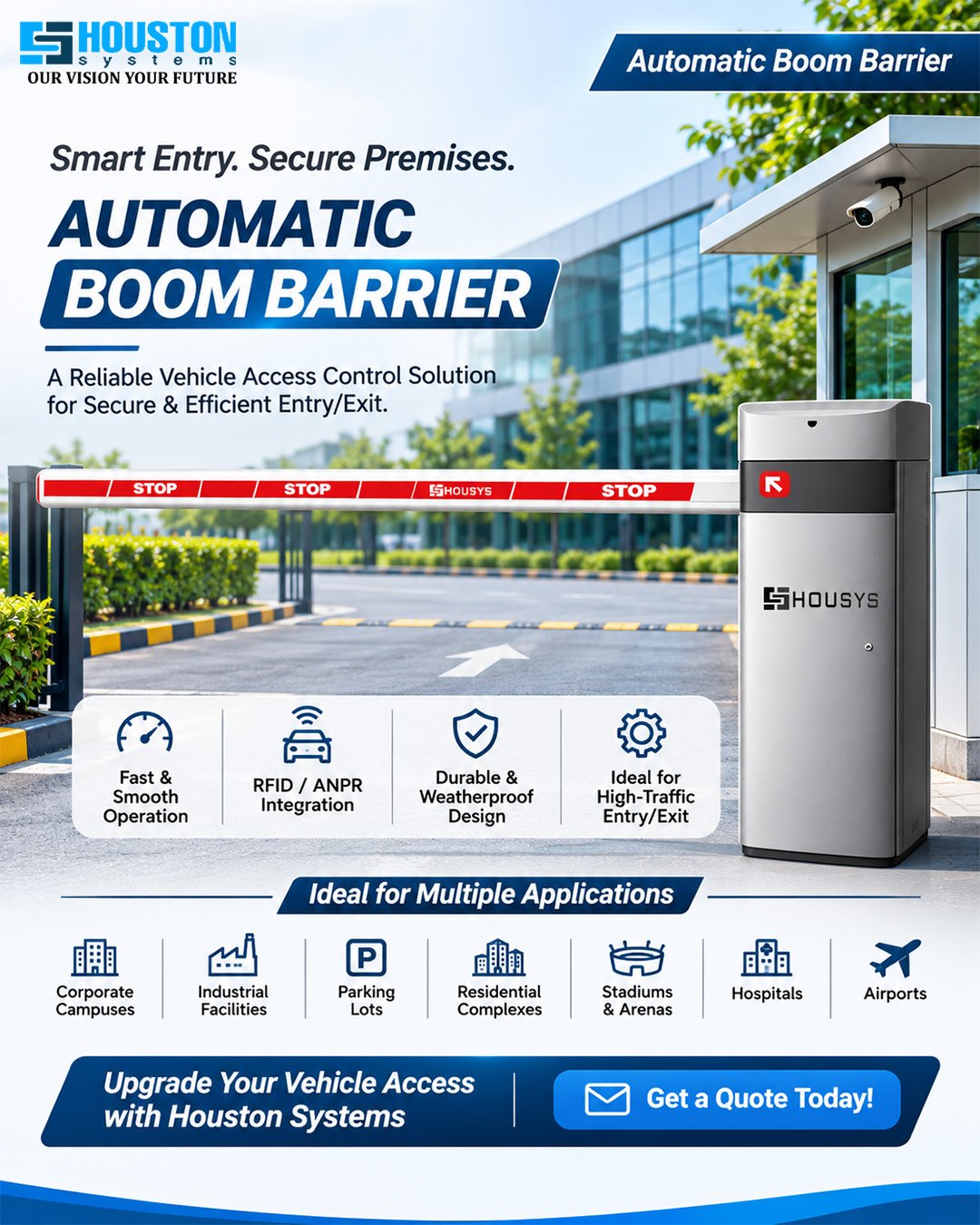
What is a boom barrier? Learn how an automatic boom barrier works, the main types, key features and how to choose one for parking, toll and gated entry.
Vehicle access management is important for properties where multiple vehicles enter and leave throughout the day. An automatic boom barrier can help regulate this movement by creating a controlled point at the entrance and exit. These systems are suitable for parking facilities, residential complexes, corporate offices, industrial areas, commercial properties and other premises requiring organized vehicle access. Houston Systems offers automatic boom barrier solutions that can be used as part of an access-control system. The right configuration can be selected according to the location, traffic volume and specific requirements of the property.
What Is a Boom Barrier?
A boom barrier is a pole-shaped gate that lifts and lowers across a vehicle lane to allow or stop traffic. An automatic boom barrier is driven by a motor and is controlled by a card reader, remote, ticket machine, camera or software, so it opens only for approved vehicles and closes again after they pass. It is one of the most common tools for vehicle access control at parking lots, toll plazas, factories, campuses and residential societies.
This guide explains how a boom barrier gate works, the main types, the features that matter, and how to choose one.
How Does an Automatic Boom Barrier Work?
The working is simple and the same in most installations:
- A vehicle stops at the lane. The boom is down and blocks the way.
- The driver is verified by a card, RFID tag, remote, ticket, number plate camera or an operator’s button.
- The controller sends an open signal to the motor, and the boom rises.
- A sensor detects when the vehicle is under or beside the boom.
- Once the vehicle has passed, the boom lowers automatically.
The key point is the safety sensor in step 4. It stops the boom from coming down on a vehicle.
What Are the Main Parts of a Boom Barrier?
- Housing (cabinet): Holds the motor, gearbox and electronics. It is usually made of coated or stainless steel.
- Boom arm: The pole that blocks the lane. It is usually aluminium and often has reflective or LED strips for visibility.
- Motor and drive: Moves the arm up and down. Speed and duty cycle depend on the model.
- Controller: The electronic brain that receives signals from readers or software.
- Safety devices: Loop detectors or infrared sensors that prevent the boom from closing on a vehicle.
- Manual release: Lets you lift the arm by hand during a power failure.
What Are the Types of Boom Barrier?
1. Straight Boom Barrier
The standard design with a single straight arm. It suits most parking and gate entrances where there is enough overhead clearance.
2. Articulated (Folding) Boom Barrier
The arm folds in the middle as it lifts. This design is useful in basements, low ceilings and covered parking, where a straight arm cannot rise vertically.
3. Fence or Skirt Boom Barrier
The arm has hanging skirts or a fence-style panel. It blocks people from walking or crawling under the boom and is used where pedestrian security matters.
4. LED Boom Barrier
The arm has LED lights that show its position, which helps at night and in poorly lit lanes.
5. Manual vs Automatic
A manual barrier is lifted by hand and suits very low-traffic entrances. An automatic boom barrier is used wherever speed, records or access control are needed.
What Features Should You Check Before Buying?
- Opening and closing speed: Faster arms reduce queues, but ask what is suitable for your lane width and traffic.
- Boom length: Choose according to the lane width. Longer arms may need support or a different design, so confirm with your supplier.
- Duty cycle: Check whether the motor is built for continuous, heavy-duty use, such as at a busy plaza, or for light use.
- Safety sensors: Loop detector, infrared sensor or both.
- Build and finish: Weather resistance and corrosion protection for outdoor use.
- Power-failure options: Manual release and battery backup.
- Integration: Support for RFID, remote, tickets, number plate recognition and your management software.
- Service support: Spare parts, installation and a clear warranty.
Where Is a Boom Barrier Used?
- Parking lots in offices, malls, hospitals and hotels
- Toll plazas and entry points of private roads
- Residential societies and gated communities
- Factories, warehouses and industrial estates
- Airports, ports and campuses
In a parking lot, a boom barrier works together with entry and exit terminals and management software. In toll applications, it works with lane sensors and a lane controller. In both cases, the barrier is the physical gate and the software is what makes the decisions.
Common Mistakes to Avoid
- Choosing the wrong boom length for the lane width
- Using a straight boom where overhead clearance is low
- Skipping safety sensors to save cost
- Not planning for power cuts
- Placing the reader too far from the driver’s window
- Ignoring regular maintenance
Basic Maintenance Tips
- Check the arm, hinges and bolts regularly.
- Keep the sensors and reflectors clean.
- Test the safety sensor and manual release periodically.
- Lubricate moving parts as the manufacturer advises.
- Arrange a periodic service for high-traffic lanes.
Frequently Asked Questions
What is a boom barrier used for? It controls vehicle entry and exit at a lane. It is used in parking lots, toll plazas, factories, campuses and residential societies.
What is the difference between a boom barrier and a boom barrier gate? They mean the same thing. “Boom barrier gate” is simply another common name for it.
Which boom barrier type is best for basement parking? An articulated (folding) boom barrier is usually preferred when ceiling height is limited, because the arm folds as it lifts.
Can a boom barrier work during a power cut? Many models have a manual release, and some support battery backup. Confirm this with your supplier before buying.
Can I connect a boom barrier to RFID or number plate recognition? Yes, most automatic boom barriers can be connected to RFID readers, remotes, ticket systems and cameras through a controller.
Final Thoughts
A boom barrier is simple in design but important in function. The right choice depends on your lane width, headroom, traffic and security needs. Match the type, speed and safety features to your site, and pair the barrier with the right readers and software.
If you need help selecting a boom barrier for your site, visit houstonsystems.in or contact the Houston Systems team for a recommendation.