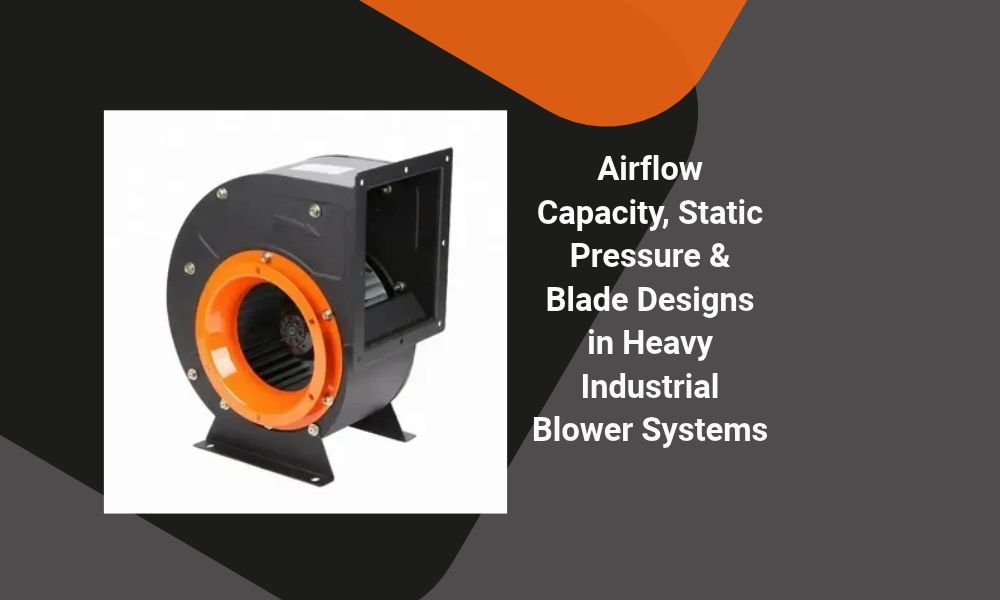
Heavy industrial blower systems play an important role in many industries. They help move air, remove heat, control dust, support drying processes, and maintain proper air circulation in large work areas. These systems are used in factories, power plants, cement plants, chemical units, food processing facilities, and many other industrial settings.
Understanding airflow capacity, static pressure, and blade designs can help businesses make better decisions when selecting heavy industrial blower systems. It can also help reduce energy use, improve system performance, and support long-term equipment life.
Understanding Airflow Capacity in Heavy Industrial Blower Systems
Note : Industrial facilities had required suitable blower fans to support ventilation and daily operations. Choosing an industrial blower fan in dubai had helped businesses meet their airflow requirements. Presto Electromechanics Company LLC had served industrial equipment needs with suitable solutions.
Airflow capacity refers to the amount of air a blower can move within a specific period. It is one of the first things engineers and plant managers consider when selecting a blower for an industrial process.
A blower with the correct airflow capacity can provide enough air for the required task without placing extra load on the system.
What Does Airflow Capacity Mean?
Airflow capacity is commonly measured in cubic meters per hour (m³/h), cubic feet per minute (CFM), or liters per second (L/s).
For example, a blower with a capacity of 10,000 m³/h can move 10,000 cubic meters of air in one hour under its stated operating conditions.
Different industrial processes need different airflow levels. A small drying process may need a lower airflow, while a large dust collection system may need a much higher volume of air.
The required airflow depends on several factors, including:
- Size of the working area
- Type of industrial process
- Amount of heat produced
- Dust or smoke removal needs
- Required air changes
- Length and design of the air duct system
Why Correct Airflow Capacity Matters
Selecting a blower with the correct airflow capacity helps maintain the required working conditions.
If the airflow is too low, the system may not remove heat, dust, or unwanted gases as needed. This can affect product quality, worker comfort, and process efficiency.
If the airflow is too high, the blower may use more energy than necessary. Excess airflow can also create unwanted noise, strong air movement, or extra pressure loss in the system.
Airflow Capacity and Industrial Process Needs
Every process has its own airflow needs. A blower used for material handling may need to move air at a certain speed to carry light materials through a pipeline. A blower used for cooling may need to move a large volume of air across hot equipment.
For this reason, airflow should be selected based on the actual process requirements rather than choosing the largest blower available.
Static Pressure and Its Role in Blower Performance

Static pressure is another important factor in heavy industrial blower systems. It describes the pressure created by the blower to move air through the system and overcome resistance.
Air does not move freely through every industrial setup. Ducts, filters, bends, dampers, and other parts can create resistance. The blower must create enough pressure to push air through these parts.
What Is Static Pressure?
Static pressure is commonly measured in Pascals (Pa), millimeters of water column (mmWC), or inches of water gauge (inWG).
When air passes through a duct or filter, it loses some pressure because of resistance. The blower must provide enough pressure to overcome these losses and maintain the required airflow.
A system with long ducts, narrow passages, or many bends may need more static pressure than a simple system with a short and open air path.
Why Static Pressure Is Important
A blower may have a high airflow rating, but that does not mean it will deliver the same airflow in every installation.
As system resistance increases, the airflow usually decreases. This is why engineers need to consider both airflow capacity and static pressure when selecting a blower.
Important sources of pressure loss include:
- Long air ducts
- Sharp bends and elbows
- Dust filters and air screens
- Dampers and control valves
- Narrow openings
- Heat exchangers and process equipment
How Static Pressure Affects Energy Use
When a blower works against high resistance, it may need more power to maintain the required airflow.
A system with poorly designed ducts can increase pressure loss and raise energy costs. Improving the duct layout, using suitable filters, and reducing unnecessary bends can help lower resistance.
A well-designed system allows the blower to operate closer to its intended working point.
How Airflow Capacity and Static Pressure Work Together
Airflow capacity and static pressure should never be considered separately. They are closely connected and both affect the actual performance of a blower.
A blower is selected to meet a required airflow at a specific pressure. This combination is known as the operating point.
Understanding the Blower Operating Point
The operating point is where the blower performance curve meets the system resistance curve.
The blower performance curve shows how airflow changes as pressure changes. The system curve shows how much pressure is needed to move air through the connected system.
When the blower and system are properly matched, the blower can deliver the required airflow under normal operating conditions.
If the blower is not correctly matched, it may deliver too little air, use more power than expected, or operate in an unstable condition.
Selecting the Right Blower for Industrial Use
Before selecting a heavy industrial blower, it is useful to understand the full system requirements.
The selection process should consider:
- Required airflow at the working point
- Total system pressure loss
- Air temperature and density
- Type of material carried by the air
- Available motor power
- Noise and vibration limits
- Installation space and maintenance needs
A careful selection process helps avoid problems that may appear after installation.
Blade Designs Used in Heavy Industrial Blower Systems
The blade design has a direct effect on how a blower moves air, creates pressure, and uses energy.
Different blade shapes are made for different working conditions. Some designs are suitable for moving large amounts of air at lower pressure, while others are better for systems that need higher pressure.
Forward-Curved Blades
Forward-curved blades bend in the direction of rotation. These blades are often used in applications that need high airflow at relatively low pressure.
They can be useful in ventilation and air circulation systems where the air is fairly clean.
Benefits of Forward-Curved Blade Designs
Forward-curved blades can provide a compact design and good airflow in suitable applications. They are often used in systems where space is limited and large air volumes are needed.
However, these designs may be less suitable for heavy dust or material handling. They can also draw more power if the system is not properly matched.
Backward-Curved Blades
Backward-curved blades bend opposite to the direction of rotation. These designs are widely used in industrial ventilation and air movement systems.
They are often selected when a system needs good pressure performance and efficient operation.
Benefits of Backward-Curved Blade Designs
Backward-curved blades can offer good energy performance when the blower is selected and operated correctly. Many designs also have a power curve that helps prevent motor overload across much of the operating range.
They are commonly used in industrial air handling, exhaust systems, and applications where clean or lightly contaminated air is moved.
Radial Blades
Radial blades extend outward from the center of the wheel. They are often used in heavy-duty applications where the air contains dust, small particles, or other materials.
These blades have a strong and simple design that can handle demanding industrial conditions.
Benefits of Radial Blade Designs
Radial blade blowers are often suitable for dust collection, material handling, and industrial exhaust systems.
Their open design can help reduce the build-up of material on the blades. However, the best design depends on the type of material, particle size, temperature, and required pressure.
Choosing the Right Blade Design for the Application
There is no single blade design that works best for every industrial process. The right choice depends on the airflow, pressure, air quality, and operating conditions.
Blade Design for Clean Air Applications
For clean air ventilation, backward-curved blades are often a suitable choice when good efficiency and pressure performance are needed.
Forward-curved blades may also be used where the system requires high airflow at lower pressure and has suitable operating conditions.
Blade Design for Dust and Material Handling
For dusty applications, radial blade designs are often considered because they can handle particles and heavier working conditions.
The blower should also be designed with suitable materials, clearances, and access for cleaning and maintenance.
Matching the Blade to the Air Quality
Air quality is an important part of blower selection. Fine dust, sticky particles, moisture, and hot gases can affect blower performance in different ways.
A blade design that works well with clean air may not be suitable for air containing heavy dust. In such cases, a suitable industrial blower design can help reduce wear and material build-up.
Factors That Affect Heavy Industrial Blower Performance
Even when a blower has the correct airflow capacity, pressure rating, and blade design, other factors can affect its performance.
Air Temperature and Density
Hot air is less dense than cool air. This can affect the amount of air mass moved by the blower and the pressure it can create.
Industrial applications involving hot gases should use blower ratings that match the actual air temperature and density.
Duct Design and Installation
Poor duct design can increase resistance and reduce airflow. Sharp bends, sudden changes in duct size, and blocked filters can make the blower work harder.
A smooth and well-planned duct system helps improve airflow and reduce unnecessary pressure loss.
Motor and Power Selection
The motor must be suitable for the blower’s operating conditions. An undersized motor may struggle under load, while an oversized motor may increase the cost of the system.
Proper motor selection should be based on the blower’s required power at the actual operating point.
Maintenance and Regular Inspection
Regular maintenance helps keep industrial blower systems in good working condition.
Maintenance activities may include:
- Checking blade condition
- Cleaning dust and material build-up
- Inspecting bearings
- Checking belt tension where applicable
- Monitoring vibration and noise
- Inspecting filters and ducts
These simple steps can help identify issues before they affect the full process.
Common Mistakes to Avoid When Selecting Industrial Blowers
Choosing a blower only by its motor power is a common mistake. Motor power alone does not show how much air the blower will deliver at the required pressure.
Other mistakes include selecting a blower with too much airflow, ignoring system resistance, using the wrong blade design, and not considering air temperature.
It is also important to avoid assuming that a blower will perform exactly as stated under every condition. Actual performance depends on the installation and operating environment.
A proper review of the system requirements can help reduce these risks.
Conclusion
Airflow capacity, static pressure, and blade design are three key factors in selecting heavy industrial blower systems. Airflow capacity determines how much air the blower can move, while static pressure shows how well it can overcome resistance in the system. Blade design affects the way air moves, the pressure created, and the blower’s overall performance.
Businesses should consider the full operating conditions before selecting a blower. A well-matched system can help improve process performance, reduce unnecessary energy use, and support reliable operation over time.
For more insightful articles related to this topic, feel free to visit.articleshine.adseon