
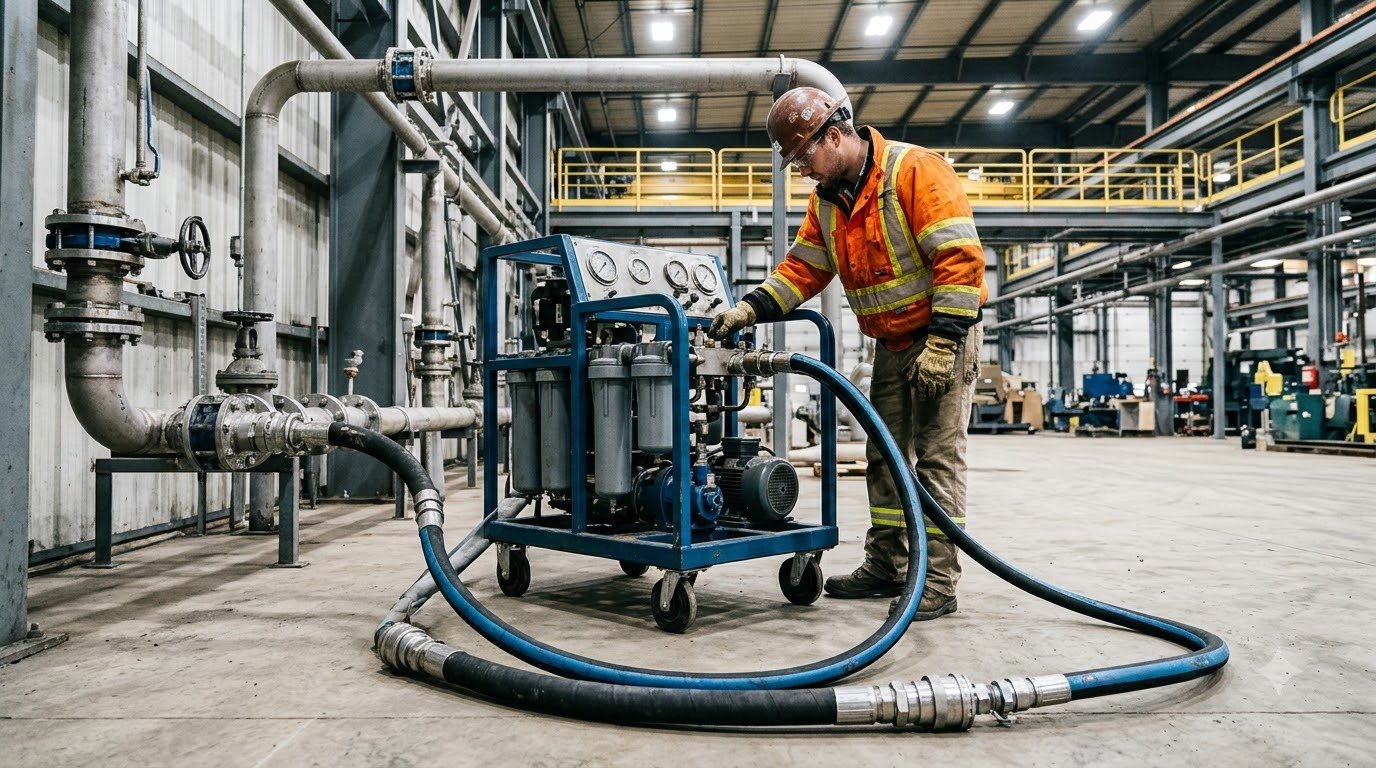
Hydraulic systems power some of the most demanding machinery in the world, from excavators and presses to offshore equipment and manufacturing lines. They work by transmitting force through pressurised fluid, which means the cleanliness of that fluid is critical. Even microscopic particles can scratch precision components, block valves and shorten the life of expensive pumps.
Flushing is the process that removes contamination from pipes, hoses and components before a system enters service or after a failure. This guide explains what hydraulic flushing involves, why it matters, how it is done, and what to consider when planning it for your equipment.
Why Hydraulic Cleanliness Matters
Industry studies commonly attribute a large share of hydraulic failures to contaminated fluid. Modern pumps, servo valves and proportional valves operate with extremely tight tolerances, often just a few microns. A particle too small to see can still cause wear, sticking or leakage.
Contamination leads to:
- Component wear: Hard particles act like abrasive grit inside pumps and motors.
- Valve malfunction: Debris can jam spools and cause erratic or slow response.
- Reduced efficiency: Internal leakage wastes energy and generates heat.
- Unplanned downtime: Failures often occur at the worst moments.
- Higher maintenance costs: Replacing pumps and valves is expensive.
- Shorter fluid life: Dirty oil degrades faster and needs more frequent changes.
Keeping the system clean from day one is one of the most cost-effective ways to protect equipment.
Common Sources of Contamination
Contaminants enter a hydraulic system in several ways.
- Built-in contamination: Weld spatter, scale, rust, machining swarf, sealing compound and dirt left during fabrication or assembly.
- New oil: Fresh fluid is not always clean enough for critical systems when delivered.
- Ingression: Dust and moisture entering through breathers, seals, cylinder rods and open reservoirs.
- Internally generated particles: Wear debris from pumps, motors and cylinders.
- Maintenance activity: Opening lines, replacing hoses or topping up with unfiltered oil.
- Fluid degradation: Oxidation products, sludge and varnish formed by heat and age.
In hot, dusty environments such as the Gulf region, ingression of fine sand and dust is an especially common concern.
What Is Hydraulic Pipe Flushing?
Flushing circulates clean fluid through a hydraulic circuit at high velocity to dislodge and carry away contaminants. The fluid passes through filters that capture the debris, and the process continues until the fluid meets a defined cleanliness target.
Flushing is different from a normal oil change. Draining and refilling does not remove particles stuck to pipe walls, trapped in corners or lodged in fittings. Flushing uses flow, and often turbulence, to scour surfaces and carry particles to the filter.
When Flushing Is Needed
Flushing is typically carried out:
- Before commissioning of new pipework or systems
- After installation or modification of piping, especially if welding was involved
- After a major component failure, such as a pump breakdown that has sent debris through the circuit
- When changing fluid type or converting between oil grades
- After long storage or shutdown that may have allowed corrosion or contamination
- When oil analysis shows high particle counts that normal filtration cannot correct
- During overhaul or refurbishment of major equipment
How the Flushing Process Works
While procedures vary by system, the typical steps are similar.
- Planning and assessment. Engineers review drawings, fluid type, volume, pipe sizes, flow rates and the required cleanliness level.
- Isolating sensitive components. Servo valves, pumps, motors and cylinders are bypassed using flushing blocks or jumper hoses so debris does not pass through them.
- Connecting the flushing rig. A portable unit with pump, heaters, filters and instruments is connected to the circuit.
- Circulating fluid. Clean fluid is pumped at high velocity through the piping, often in both directions and in sections.
- Applying heat and turbulence. Warming the oil lowers viscosity and improves its ability to dislodge particles. Some procedures use flow reversal or pulsing to loosen stubborn debris.
- Monitoring cleanliness. Particle counters take samples to track progress until targets are reached.
- Final filtration and sampling. Results are recorded and verified.
- Reinstating components and refilling. The system is reassembled and filled with clean oil, ready for commissioning.
Cleanliness Standards Explained
Cleanliness is measured by counting particles of different sizes in a fluid sample. The most widely used references include:
- ISO 4406: A code showing particle counts at 4, 6 and 14 microns per millilitre. A code such as 18/16/13 describes the contamination level.
- NAS 1638 and SAE AS4059: Alternative classification systems, common in aerospace and some industrial specifications.
The target depends on the system. High-pressure servo systems need much cleaner fluid than low-pressure mobile equipment. Equipment manufacturers usually publish recommended cleanliness levels, and these should guide the flushing target.
Types of Flushing Methods
Standard high-velocity flushing. Circulates fluid at flow rates that create turbulence in the pipework, commonly used for new installations.
Reverse flow flushing. Changes the flow direction to dislodge particles from different angles.
Pulse or surge flushing. Alternates flow rates or pressure to release stubborn deposits.
Chemical or pickling processes. Used in some cases to remove scale and rust from steel pipe, followed by neutralising and flushing.
Offline or kidney-loop filtration. A side-stream filter unit cleans fluid continuously, often as a follow-up or maintenance measure.
Component-by-component flushing. Individual sections are cleaned separately for large or complex systems.
Industries That Depend on Flushing
- Oil, gas and petrochemical: Control systems, lube oil circuits and offshore equipment.
- Power generation: Turbine lube and control oil systems.
- Manufacturing: Presses, injection moulding machines and automation lines.
- Construction and mining: Heavy mobile machinery.
- Marine and shipbuilding: Deck machinery, steering gear and stabilisers.
- Steel and metals: Rolling mills and casting equipment.
- Aerospace and defence: Test rigs and ground support equipment.
Lubrication and hydraulic systems in these sectors often have strict contractual cleanliness requirements.
Benefits of Professional Flushing
Contamination control requires specialist equipment, trained personnel and reliable measurement. The main advantages are:
- Longer component life
- Fewer breakdowns and less downtime
- Verified cleanliness with documented results
- Faster commissioning
- Reduced risk to warranties and performance guarantees
- Lower long-term operating cost
For plant managers evaluating hydraulic pipe flushing services, the key question is whether the work will be documented, measured and aligned with the equipment manufacturer’s cleanliness targets.
Planning a Flushing Project
Good preparation improves results.
- Provide system documentation: Piping diagrams, fluid specifications and component lists.
- Define the target cleanliness: Confirm the required ISO or NAS code.
- Schedule shutdown time: Allow for setup, circulation, sampling and reinstatement.
- Prepare site access and utilities: Power, drainage and safe working areas.
- Plan fluid supply and disposal: Arrange clean replacement oil and compliant disposal of used fluid.
- Agree on reporting: Request particle count records and a completion certificate.
Choosing a Service Provider
When comparing providers, look at more than price.
- Experience with your type of system and industry
- Calibrated particle counters and documented procedures
- Appropriately sized flushing rigs with proper filtration and heating
- Trained technicians who follow safe working practices
- Clear reporting and certification
- Responsiveness for urgent or emergency work
- Environmental and waste-handling compliance
A capable provider of hydraulic pipe flushing services should be able to explain its method, share sample reports and recommend a cleanliness target based on your equipment, rather than offering a one-size-fits-all approach.
Safety and Environmental Considerations
Flushing involves hot, pressurised fluid, so safe procedures are essential. Technicians should follow lockout and tagout practices, use appropriate protective equipment, secure hoses against whip, and check connections before starting. Spill containment and correct handling of used oil protect both people and the environment.
Preventing Recontamination
Flushing is most effective when followed by good housekeeping.
- Fit quality breathers and filters suited to the operating environment
- Filter new oil before it enters the reservoir
- Keep fittings capped and hoses sealed during storage
- Maintain a regular oil sampling programme
- Replace filter elements on schedule
- Train staff in clean handling practices
Conclusion
Clean fluid is the foundation of reliable hydraulic performance. Contamination from construction, maintenance and operation can quietly damage components until a costly failure occurs. Flushing removes that risk by circulating clean fluid through the system until it meets a measured standard. By understanding when flushing is needed, how it is performed and how to choose a capable provider, operators can protect their equipment, reduce downtime and extend system life.