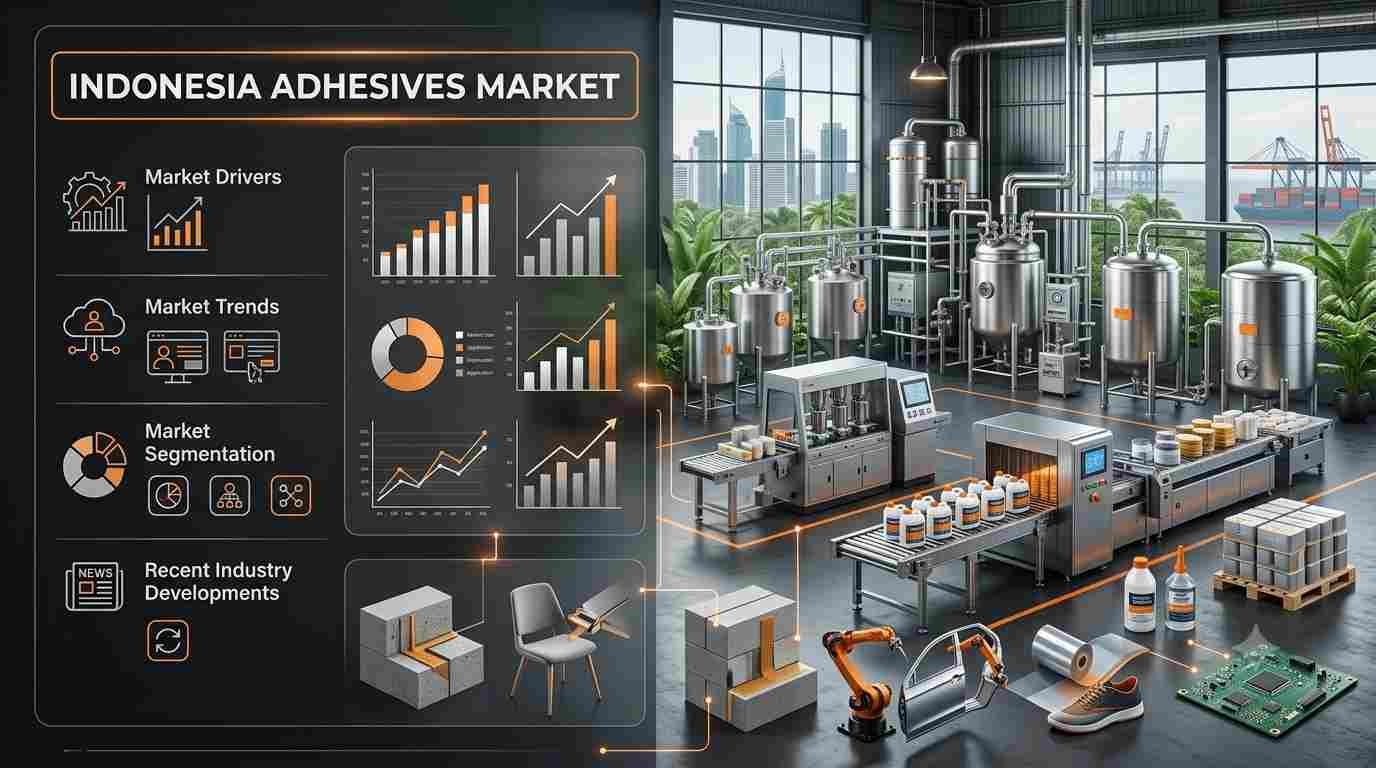
IMARC Group, a leading global market research and management consulting firm, has published its latest market intelligence report on the Indonesia Adhesives Market. The Indonesia adhesives market size was valued at USD 868.6 Million in 2025 and is projected to reach USD 1,262.4 Million by 2034, exhibiting a CAGR of 4.24% during 2026-2034. Growth is being driven by the thriving construction sector, rising consumer awareness about sustainability, the development of high-performance adhesives, a growing consumer goods sector, supportive government policies, and the rising adoption of automated manufacturing processes.
Adhesives are quietly embedded across Indonesia’s industrial and consumer economy, from tile and wood bonding on construction sites to assembly in automotive plants, footwear and furniture factories, packaging lines, electronics and healthcare. As the government pushes housing, infrastructure and local manufacturing, and as exporters aim to meet international quality standards, demand is shifting toward high-performance, water-based and bio-based formulations that offer strong bonds with lower environmental impact. At the same time, global suppliers such as Henkel, Sika, 3M and H.B. Fuller are expanding local production and technical support, while domestic formulators compete on price, distribution and application know-how. Automation is raising the bar further, with adhesives now expected to match the application speed and bonding strength of mechanized production lines. Combined with strong underlying housing demand and a growing manufacturing base, these forces are shaping a steady, long-term growth path across Java, Sumatra, Kalimantan, Sulawesi, and other regions.
Indonesia Adhesives Market at a Glance:
- Market Size (2025): USD 868.6 Million
- Market Forecast (2034): USD 1,262.4 Million
- Growth Rate (2026-2034): CAGR of 4.24%
- Base Year: 2025 | Historical Period: 2020-2025 | Forecast Period: 2026-2034
How AI is Reshaping the Future of the Indonesia Adhesives Market
- AI-Driven Formulation at Global Suppliers: Henkel Adhesive Technologies, which operates in Indonesia through Henkel Adhesive Indonesia, has used the AI-based Albert Invent platform to speed up product development, with a case study showing that AI-driven formulation shortened the development timeline of a semiconductor underfill product by about 30% compared with other products launched between 2020 and 2022.
- AI and Machine Vision in Automated Dispensing: Industry publication Adhesives & Sealants reported in January 2026 that AI, machine learning, and 3D computer vision can raise assembly-line throughput, reduce scrap and improve product quality in adhesive dispensing, supporting the shift toward automated manufacturing processes in Indonesian factories.
- Digital and Automation-Ready Solutions: At INDEX 2026 in May, Henkel showcased adhesive application and material supply concepts designed for automated production under the theme of automation driving efficiency, while 3M unveiled an AI-powered assistant at CES 2026 to accelerate customer design workflows.
Grab a sample PDF of this report: https://www.imarcgroup.com/indonesia-adhesives-market/requestsample
Indonesia Adhesives Market Trends and Drivers:
Adhesive demand in Indonesia is fueled by construction projects and increased adhesive consumption for concrete and wood products‚ as well as higher vehicle production and repair demand․ Indonesia is one of the world’s top five tile-consuming countries․ Sika increased production capacity at its largest Indonesian plant in Bekasi and more than tripled its number of distributors in 2024 to meet tile and other construction needs․ Significant unmet demand for housing‚ with more than 10 million unfulfilled home orders in Indonesia‚ and Hyundai’s planned investment of USD 1․55 Billion at its Cikarang plant by 2030 point to future growth in adhesive demand․
The market is characterized by stronger demand for products made with eco-friendly and higher-performance materials․ Growing demand from consumers and other industries is boosting interest in eco-friendly waterborne adhesives‚ and manufacturers are launching adhesives with improved performance features for use in harsh environments‚ including high temperatures and chemical exposure․ Adhesive manufacturers are primarily located around Jakarta‚ Indonesia‚ and include both multinational and domestic companies such as Sika and PT Pamolite․ They supply other industries‚ including construction and packaging․
Another factor increasing demand for adhesives is a wide range of products and interest in domestic manufacturing․ Increasing consumer product manufacturing is creating demand for lightweight and durable adhesives used in other consumer products‚ such as furniture and apparel․ Medical adhesives are also finding use in health care and other fields․ Government initiatives to increase local manufacturing and exports of domestic products are increasing demand for adhesives that meet international standards․ Demand for adhesives is likely to remain strong over the next 10 years․
Government Schemes and National Development Programs Driving Demand:
- 3 Million Houses Program: President Prabowo Subianto’s flagship housing program targets 3 million homes a year, including 2 million in villages and 1 million in cities, to address a housing backlog of more than 10 million units, with the Housing Task Force estimating that the housing sector could contribute 1.5% to 2% to economic growth. Execution has been uneven, with developers citing rising construction costs and licensing delays.
- Mortgage Financing and 40-Year Tenor: In a May Day 2026 address, the President announced a tiered financing scheme with mortgage tenors of up to 40 years, and on 30 July 2026 he presided over the signing of 62,000 subsidized housing mortgages worth Rp880 billion under the Housing Credit Program.
- Self-Help Housing Assistance Program (BSPS): The renovation program set a 2026 target of 400,000 units, with plans to raise the target fivefold to 2 million units in 2027, supporting demand for repair and renovation materials such as tile and construction adhesives.
- Danantara Housing Expo 2026: The Danantara Housing Expo, scheduled for 11 August 2026, brought together state-owned property firms, state banks, private developers and industrial suppliers and listed more than 200,000 housing units as part of the 3 million homes drive.
- Local Manufacturing and Export-Oriented Trade Policies: Policies that encourage local manufacturing, together with the Indonesia-EU Comprehensive Economic Partnership Agreement, which is expected to open the EU market for sectors including footwear and wood products, incentivize exporters to adopt adhesives that meet international standards.
Indonesia Adhesives Market Industry Segmentation:
The report has segmented the market into the following categories:
Breakup By Resin:
- Acrylic
- Cyanoacrylate
- Epoxy
- Polyurethane
- Silicone
- VAE/EVA
- Others
The report provides a detailed breakup and analysis of each resin type, reflecting the range of base materials used, including polyurethane, epoxy, silicone and cyanoacrylate, each offering distinct properties such as high tensile strength, shear resistance, thermal stability and chemical resistance across construction, automotive, packaging and electronics applications.
Breakup By Technology:
- Hot Melt
- Reactive
- Solvent-borne
- UV Cured Adhesives
- Water-borne
The report analyzes each technology, with water-borne and other lower-emission systems benefiting from sustainability awareness and tightening environmental expectations, while hot melt, reactive and UV cured adhesives are supported by the adoption of automated manufacturing processes that require fast application and strong bonding.
Breakup By End Use Industry:
- Aerospace
- Automotive
- Building and Construction
- Footwear and Leather
- Healthcare
- Packaging
- Woodworking and Joinery
- Others
The report provides a detailed breakup across end use industries, including building and construction, where tiles, concrete and wood bonding drive demand, as well as automotive assembly, footwear and leather, woodworking and joinery, packaging and healthcare, with Bank Indonesia’s survey in April 2026 pointing to the furniture and leather and footwear industries among the stronger manufacturing sub-sectors.
Breakup By Region:
- Java
- Sumatra
- Kalimantan
- Sulawesi
- Others
The report provides a comprehensive regional analysis, reflecting the concentration of formulation plants, factories and housing projects around Greater Jakarta and West Java, alongside infrastructure and housing programs expanding into Sumatra, Kalimantan, Sulawesi and other regions.
Competitive Landscape:
The report provides a comprehensive analysis of the competitive landscape, covering market structure, key player positioning, top winning strategies, the competitive dashboard and the company evaluation quadrant, along with detailed profiles of major companies. Key players include:
- Henkel AG & Co. KGaA
- H.B. Fuller Company
- 3M
- Sika AG
- BASF SE
- Pidilite Industries Ltd.
- PT Pamolite Adhesive Industry
- PT Alteco Chemical Indonesia
- Dextone Indonesia
Global suppliers such as Henkel, Sika, 3M and H.B. Fuller compete through broad portfolios, regional technical support and local production, while domestic formulators such as Pamolite, Alteco and Dextone compete on price, distribution reach and application knowledge across construction, woodworking and consumer segments.
Market Concentration Analysis:
- The Indonesia adhesives market is moderately concentrated in premium and industrial-grade niches, where multinationals such as Henkel, Sika, 3M, and H.B. Fuller combine regional R&D, technical service and automated production, reflecting the technical requirements of automotive, packaging, electronics and construction applications.
- Fragmentation increases in general-purpose, retail, woodworking and construction channels, where domestic players such as Pamolite, Alteco, and Dextone compete with imported brands across distributors, contractors and do-it-yourself customers, creating a tiered structure where global leaders dominate high-performance and industrial segments while local players focus on price-sensitive and distribution-led niches.
- Capacity investments and portfolio expansion are intensifying, exemplified by Sika more than doubling production capacity at its Bekasi plant in 2024 and Henkel announcing five acquisitions worth about EUR 1.6 Billion in sales volume in the first half of 2026, including ATP Adhesive Systems, as global leaders strengthen their adhesives portfolios.
What Does The Full Report Cover?
- Historical, current, and forecast market size for the Indonesia adhesives market from 2020 to 2034
- Market breakup by resin, technology, end use industry, and region
- Regional analysis covering Java, Sumatra, Kalimantan, Sulawesi, and Others
- Key growth drivers, challenges, and opportunities shaping the market
- Porter’s Five Forces analysis and value chain assessment
- Competitive landscape, market structure, and player positioning
- Detailed profiles of major adhesives companies in Indonesia
Recent News and Developments in the Indonesia Adhesives Market
- September 2026: Indonesia’s Industry Ministry reported a manufacturing PMI of 49.8 for August amid intense domestic competition, while highlighting the Indonesia-EU Comprehensive Economic Partnership Agreement as an opportunity for textiles, footwear, electronics and wood products, all adhesive-consuming sectors.
- August 2026: Henkel raised its 2026 organic sales growth outlook for the Group and Adhesive Technologies to 1.5% to 3.5%, after reporting strong first-half performance and five M&A transactions worth about EUR 1.6 Billion in sales volume.
- July 2026: President Prabowo Subianto presided over the mass signing of 62,000 subsidized housing mortgages worth Rp880 billion, as the government stepped up efforts to revive housing distribution under the 3 million homes program.
- May 2026: President Prabowo announced mortgage tenors of up to 40 years at his May Day address, alongside the goal of building 3 million homes a year, including 1 million high-rise apartments near industrial hubs.
- April 2026: Bank Indonesia reported that its Prompt Manufacturing Index rose to 52.03% in the first quarter of 2026, with expansion led by the paper, printing, leather and footwear, and food and beverage industries, and the furniture industry expected to be among the strongest in the second quarter.
Note: If you require specific details, data, or insights that are not currently included in the scope of this report, we are happy to accommodate your request. As part of our customization service, we will gather and provide the additional information you need, tailored to your specific requirements. Please let us know your exact needs, and we will ensure the report is updated accordingly to meet your expectations.
Key Questions This Report Answers
- How big is the Indonesia adhesives market and what is its growth outlook through 2034?
- What are the key growth drivers, challenges, and opportunities in the Indonesia adhesives market?
- How is the market split by resin, technology, end use industry, and region?
- How are construction, housing programs, and manufacturing growth influencing adhesive demand?
- How is the shift toward water-based, bio-based, and high-performance adhesives shaping the market?
- Who are the key players in the Indonesia adhesives market, and how is the competitive landscape evolving?
- What role are automation and AI playing in the future of adhesives in Indonesia?
About Us
IMARC Group is a global management consulting firm that helps the world’s most ambitious changemakers to create a lasting impact. The company provides a comprehensive suite of market entry and expansion services. IMARC offerings include thorough market assessment, feasibility studies, company incorporation assistance, factory setup support, regulatory approvals and licensing navigation, branding, marketing and sales strategies, competitive landscape and benchmarking analyses, pricing and cost research, and procurement research.
Media and Sales Contact
IMARC Group
Email: sales@imarcgroup.com
United States: +1-201-971-6302
India: +91-120-433-0800
United Kingdom: +44-753-714-6104