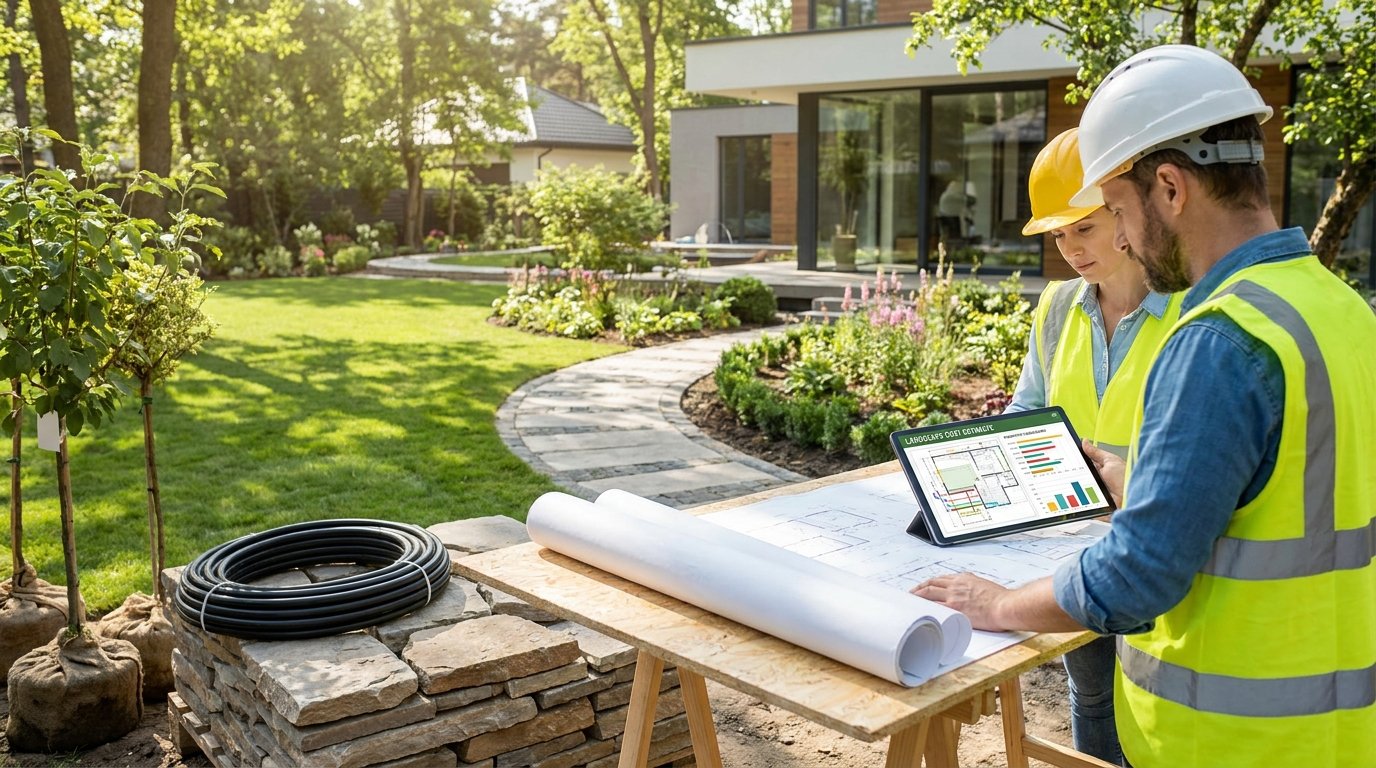
A reliable landscaping services cost estimate starts with more than the size of a property. Landscaping estimating services turn planting plans, hardscape drawings, irrigation layouts, grading information, specifications, and site details into measurable quantities and project costs.
A landscape bid can contain hundreds of individual items. Trees may be priced by species and size, sod by square footage, mulch by volume, pavers by area, edging by linear footage, and irrigation by individual components. Labor and equipment then have to be matched to the actual installation conditions.
That is why landscape estimating works best when the estimator follows the design element by element instead of applying one broad cost per square foot.
What Makes Landscape Estimating Different?
Landscape projects combine several types of work that behave differently during construction.
A single project might include:
- Planting
- Trees and shrubs
- Turf and sod
- Mulch
- Topsoil
- Pavers
- Concrete
- Retaining walls
- Fencing
- Irrigation
- Drainage
- Landscape lighting
- Grading
- Site preparation
Each scope has its own measurement method, material requirements, production rate, and installation process.
For example, two landscape plans may contain the same total area but require very different budgets. One could have large turf areas with limited planting. Another could contain extensive planting beds, intricate paver patterns, retaining walls, irrigation zones, and mature tree installations.
The square footage alone would not tell the contractor enough.
Read the Landscape Plan Before Measuring It
Good landscape estimating begins with document review.
The estimator may need to compare:
- Landscape plans
- Planting plans
- Plant schedules
- Hardscape plans
- Irrigation plans
- Lighting plans
- Grading plans
- Drainage plans
- Details
- Specifications
- General notes
- Addenda
The plan may show where a tree is located, while the plant schedule identifies its species, container size, or caliper.
A hardscape drawing may show the area of a patio, while a detail specifies the paver thickness, base assembly, edge restraint, or installation method.
That is why measuring the plan without reading the associated schedules and details can produce incomplete quantities.
Softscape Quantities Need More Than Plant Counts
Softscape is one of the areas where a landscape estimate can become surprisingly detailed.
A takeoff may include:
- Trees
- Shrubs
- Perennials
- Groundcover
- Ornamental grasses
- Annuals
- Sod
- Seed
- Mulch
- Topsoil
- Planting soil
- Soil amendments
Plants are commonly identified by species and size, while turf and planting areas are generally measured by area.
The estimator also needs to pay attention to planting density.
A planting bed with widely spaced shrubs is not equivalent to one requiring dense groundcover or closely spaced plants.
The difference can affect both material quantities and installation labor.
Hardscape Has Its Own Cost Drivers
Hardscape can include patios, walkways, plazas, retaining walls, seat walls, steps, outdoor structures, and other constructed landscape features.
Depending on the design, quantities may be developed for:
- Pavers
- Natural stone
- Concrete
- Base aggregate
- Bedding material
- Sand
- Edging
- Geotextile
- Retaining-wall units
- Caps
- Steps
- Joint materials
A hardscape takeoff should consider the complete assembly rather than measuring only the finished surface.
For example, a paver installation may require excavation, aggregate base, bedding material, pavers, edge restraints, joint material, and compaction.
If only the paver surface is measured, the estimate can miss several materials and labor activities.
Irrigation Is a System, Not a Single Line Item
Irrigation estimating requires the estimator to understand how the system is laid out.
Depending on the project, quantities may include:
- Mainline pipe
- Lateral pipe
- Valves
- Valve boxes
- Sprinkler heads
- Drip irrigation
- Controllers
- Backflow prevention
- Sleeves
- Fittings
- Wire
- Quick couplers
- Rain or weather sensors
The number of irrigation zones can also affect the amount of equipment and labor required.
A planting plan may show extensive beds, but the irrigation drawing determines how those areas are supplied.
The estimator should therefore coordinate the planting and irrigation documents instead of treating each drawing as an isolated scope.
Landscape Drainage and Grading Affect the Installation
Water management can influence both the landscape design and the construction cost.
A project may require:
- Area drains
- Catch basins
- Drainage pipe
- French drains
- Swales
- Inlets
- Grading
- Soil amendments
- Drainage structures
Grading information can also affect excavation, soil placement, planting areas, and hardscape installation.
If a patio needs to drain toward a specific collection point, the required elevations can influence subgrade preparation and drainage installation.
This is one reason landscape estimating should be coordinated with sitework information when both scopes overlap.
How Landscape Takeoff Services Turn Drawings Into Quantities
Landscaping takeoff services convert the design into measurable quantities that can be priced.
The measurement units depend on the item.
For example:
Plants: Each
Trees: Each, separated by species and size
Sod: Square feet
Mulch: Cubic yards or other specified quantity
Topsoil: Cubic yards
Pavers: Square feet
Edging: Linear feet
Fencing: Linear feet
Irrigation pipe: Linear feet
Irrigation heads: Each
Drainage structures: Each
This level of organization gives the contractor a much better basis for obtaining supplier pricing and calculating installation labor.
It also makes revisions easier to manage.
Labor Should Follow the Installation Method
Material quantity is only one part of a landscape bid.
The estimator also needs to determine how much labor is required to install the work.
Production can vary depending on:
- Crew size
- Site accessibility
- Material handling
- Ground conditions
- Plant size
- Excavation requirements
- Hardscape complexity
- Equipment availability
- Installation method
- Project phasing
Installing 500 square feet of simple sod on an accessible site is very different from installing 500 square feet of detailed pavers around existing trees and structures.
The same principle applies to planting.
Large trees may require specialized equipment and additional labor compared with smaller container plants.
A useful estimate connects quantities to realistic production assumptions.
A Landscape Estimator Should Review the Numbers After Takeoff
Digital tools can make measurement considerably faster, but software does not eliminate the need for review.
The National Association of Landscape Professionals has highlighted the growing use of automated site measurement and digital takeoff tools in the landscaping industry. Its guidance also emphasizes reviewing measurements against the actual project scope and field requirements rather than accepting automated results without verification.
That is an important distinction.
A digital tool can measure an area.
An experienced landscape estimator still has to determine whether the measured area represents the correct scope.
A planting bed may contain an excluded area.
A drawing may have a revised detail.
An irrigation route may require a sleeve beneath a walkway.
A paver area may have a different installation assembly from the adjacent surface.
Human review connects the measurement to the construction reality.
Choosing the Right Landscape Construction Estimating Software
Landscape construction estimating software can help organize measurements, material libraries, labor assumptions, and project pricing.
Depending on the workflow, software may support:
- Digital plan measurement
- Property measurement
- Quantity takeoffs
- Material databases
- Labor calculations
- Equipment costs
- Estimate templates
- Proposal preparation
- Revision tracking
The software itself should not become the estimating strategy.
A good workflow starts with accurate drawings and a defined scope.
The estimator then uses the software to organize and calculate the information.
Different platforms can be useful for different stages of the process, so contractors should select tools based on the type of landscape work they estimate and the way their team handles bids.
Local Pricing Matters More Than a Generic Landscape Rate
A landscape cost estimator should consider the project’s actual location.
Material and labor costs can vary because of:
- Local nursery pricing
- Plant availability
- Aggregate costs
- Paver suppliers
- Labor rates
- Equipment rental
- Delivery distance
- Disposal
- Site accessibility
Plant availability can be especially important.
A specified plant may be readily available in one market but require special sourcing in another.
Transportation can then become part of the cost.
Using a generic national allowance may be acceptable for very early budgeting, but detailed bidding should use project-specific information whenever possible.
Residential and Commercial Landscaping Need Different Assumptions
Residential landscape work can involve highly customized planting, patios, outdoor kitchens, retaining walls, pools, fencing, lighting, and irrigation.
Commercial projects can involve much larger planting quantities, parking-lot landscaping, entry plazas, pedestrian areas, irrigation networks, drainage, and strict installation specifications.
A commercial landscape package may also require coordination with civil, architectural, electrical, and sitework drawings.
The estimator needs to understand those differences before selecting labor and material assumptions.
What Should a Landscaping Cost Estimate Show?
A useful estimate should make the scope easy to review.
Depending on the project, a detailed landscaping cost estimator services package may include:
Planting Quantities
Trees, shrubs, perennials, groundcover, turf, seed, and related planting materials.
Soil and Amendments
Topsoil, planting soil, compost, mulch, fertilizers, and specified amendments.
Hardscape
Pavers, concrete, stone, retaining walls, steps, edging, base materials, and related components.
Irrigation
Pipe, valves, heads, controllers, fittings, sleeves, wire, and other specified components.
Drainage
Drainage pipe, structures, inlets, catch basins, and associated installation.
Labor
Crew hours or labor costs associated with planting, hardscape, irrigation, grading, and other landscape installation.
Equipment
Excavators, loaders, compactors, lifts, trucks, trenching equipment, and other applicable equipment.
Assumptions and Exclusions
Items that are unclear, excluded, owner-supplied, or dependent on information that has not yet been provided.
The goal is not to produce the longest estimate possible.
It is to make the number understandable and traceable.
When Outsourcing Landscaping Estimating Makes Sense
A landscape contractor may have excellent installation crews but limited time for detailed bid preparation.
Another company may have several commercial bids arriving at the same time.
A design-build firm may need quantities before its internal team can complete the full pricing process.
In these situations, outside estimating support can provide additional capacity.
Landscaping cost estimator services can be used for:
- New landscape construction
- Renovation projects
- Commercial developments
- Residential properties
- Municipal projects
- Planting packages
- Hardscape packages
- Irrigation scopes
- Drainage scopes
- Change orders
- Bid revisions
The contractor can then apply its own final markup, overhead, profit strategy, supplier quotes, and business-specific adjustments.
How All State Estimation Supports Landscape Bids
All State Estimation provides landscaping estimating services for contractors, landscape subcontractors, landscape architects, developers, construction managers, nurseries, irrigation contractors, and other professionals.
Its current landscaping estimating scope covers softscape and hardscape quantities, planting, trees, shrubs, turf, mulch, topsoil, pavers, irrigation, drainage, grading, lighting, fencing, and other landscape elements. The service also supports residential, commercial, industrial, institutional, hospitality, multifamily, and public-sector projects.
The published workflow includes plan and specification review, digital takeoff, quantity measurement, material and labor pricing, quality-control review, and delivery of organized estimate files and marked-up plans.
For contractors who already have their own pricing structure, standalone takeoffs can also provide the measured quantities needed for internal pricing.
Frequently Asked Questions
What are landscaping estimating services?
They are professional services used to measure landscape construction quantities and develop material, labor, equipment, and other project costs from drawings, specifications, and related project information.
What do landscaping takeoff services include?
They can include plants, trees, shrubs, turf, mulch, soil, pavers, concrete, retaining walls, irrigation components, drainage, fencing, lighting, and other landscape elements shown in the project documents.
What does a landscape cost estimator do?
A landscape cost estimator reviews project documents, develops quantities, applies material and labor costs, considers equipment and project conditions, and organizes the resulting estimate for bidding or budgeting.
Why are planting schedules important?
Planting schedules can contain species, sizes, quantities, or other information that may not be completely visible on the landscape plan. Reviewing both documents helps prevent incomplete plant quantities.
Is landscape estimating software enough to produce an accurate estimate?
No. Software can improve measurement and organization, but the estimator still needs to interpret drawings, specifications, scope boundaries, and project conditions and review the resulting quantities.
What is included in a landscaping services cost estimate?
Depending on the scope, it can include planting, soil, mulch, turf, hardscape, irrigation, drainage, grading, lighting, fencing, labor, equipment, and other applicable project costs.
Can landscaping estimating be outsourced?
Yes. Contractors can outsource complete estimates or individual tasks such as landscape takeoffs, material quantities, labor calculations, change-order pricing, or bid revisions.
Are residential and commercial landscape estimates different?
Yes. Commercial projects often involve larger quantities, more coordination, detailed specifications, and larger irrigation, drainage, and hardscape systems, while residential projects can contain more customized landscape features.
Better Landscape Bids Start With Better Quantities
Landscape estimating is not simply a matter of measuring the property and applying a rate.
The estimator needs to understand what is being planted, what is being built, how the site will be prepared, how irrigation and drainage will work, what materials are required, and how the crews are expected to install everything.
That is why a strong estimate follows the design from the drawing to the finished landscape.
The best landscape estimate is the one that gives the contractor a clear answer to three questions: What has to be installed? How much is required? What will it realistically take to complete the work?
When those questions are answered with measurable quantities, project-specific assumptions, and documented pricing, contractors can approach landscape bids with far greater clarity and control.