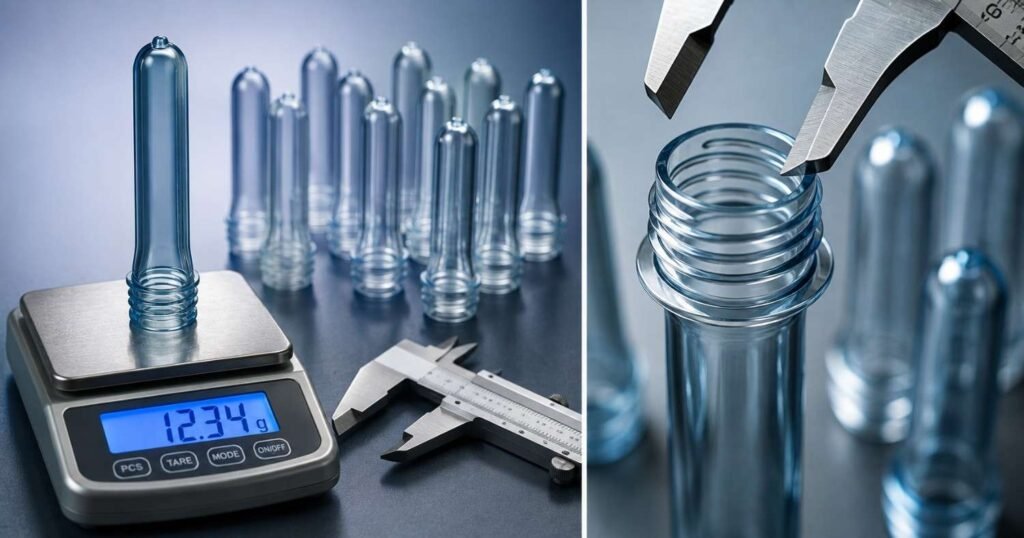

PET bottles are used every day for packaged water, beverages, edible oils, personal care products, household liquids, and many other products. While the finished bottle may look simple, its quality depends heavily on the PET preform used during manufacturing. Two of the most important factors in selecting a preform are its weight and neck size.
For bottle manufacturers and packaging companies, choosing the correct preform specifications can influence bottle strength, appearance, material usage, compatibility, and production efficiency. This is why experienced pet preform manufacturers in gujarat focus carefully on these specifications before supplying preforms for different applications.
What Is a PET Preform?
A PET preform is a small, tube-shaped plastic component manufactured from polyethylene terephthalate, commonly known as PET. It already has the finished neck and thread design of the future bottle, while the remaining portion is later heated and stretched into the required bottle shape through the blow moulding process.
The quality and dimensions of the preform directly influence the final bottle. A properly designed preform helps manufacturers achieve consistent bottle thickness, clarity, strength, and shape.
Companies such as MP Petpreforms manufacture PET preforms for different packaging requirements, where factors like weight, neck size, bottle capacity, and intended use need to be considered carefully.
Why Does PET Preform Weight Matter?
Preform weight refers to the amount of PET material used to manufacture an individual preform. It is generally measured in grams. Different bottle designs and capacities require different preform weights.
For example, a small bottle usually requires less PET material than a large bottle. However, bottle capacity is not the only consideration. The bottle’s shape, wall thickness, application, and expected strength can also influence the required preform weight.
Selecting the right weight is important because it helps distribute the PET material properly throughout the bottle during blow moulding.
1. Bottle Strength
Preform weight has a direct connection with the amount of material available to form the bottle walls and base. If there is insufficient material for a particular bottle design, some areas may become too thin during stretching.
The correct preform weight helps manufacturers achieve suitable wall thickness and structural strength according to the intended packaging application.
At the same time, simply using a heavier preform is not always better. Excess material may increase packaging weight and production costs unnecessarily. The objective is to select an appropriate weight rather than automatically choosing the heaviest option.
2. Material Distribution
During stretch blow moulding, the heated preform expands considerably. PET material must spread across the bottle body, shoulder, base, and other sections.
Correct preform weight helps provide enough material for this stretching process. Poor material distribution can result in uneven bottle walls, weak sections, or inconsistent appearance.
Reliable pet preform manufacturers in gujarat therefore consider the relationship between preform specifications and the final bottle design instead of treating weight as an isolated measurement.
3. Packaging Cost
PET material contributes significantly to the overall cost of bottle production. Even a small difference in preform weight can become important when bottles are manufactured in very large quantities.
Using an unnecessarily heavy preform means consuming additional resin for every bottle. On the other hand, reducing weight too aggressively may affect bottle performance.
Manufacturers need to find a practical balance between material efficiency and required bottle performance.
Why Is Neck Size Equally Important?
The neck is the upper section of the preform where the cap or closure is fitted. Unlike the preform body, the neck is already formed before blow moulding and generally retains its basic dimensions during bottle production.
Neck size therefore needs to match the bottle’s closure system accurately.
Different products may require different neck standards depending on the type of cap, bottle design, filling process, and application.
1. Proper Cap Fitting
One of the main purposes of selecting the correct neck size is ensuring compatibility between the bottle and its closure.
If the neck finish and cap are not properly matched, the closure may not perform as intended. This can create problems during filling, capping, storage, transportation, or consumer use.
Manufacturers should therefore confirm neck dimensions and closure requirements before ordering preforms.
2. Product Application
Neck requirements can differ depending on what the bottle is designed to contain. Water bottles, edible oil bottles, juice bottles, household product containers, and personal care bottles may use different closure systems.
A wider opening may be suitable for certain applications, while another product may require a smaller or application-specific neck finish.
This makes neck selection an important part of bottle development rather than simply a visual design choice.
3. Production Compatibility
Bottle manufacturing involves several machines working together, including heating systems, blow moulding equipment, filling lines, and capping machines.
The preform neck should be compatible with the intended production setup. Incorrect specifications can lead to avoidable adjustments or production difficulties.
Before placing a bulk order, manufacturers should clearly communicate bottle capacity, neck requirements, closure type, and other technical details to their PET preform supplier.
Weight and Neck Size Must Work Together
Preform weight and neck size should not be selected independently. Both specifications need to support the intended bottle design.
A particular neck finish may be available across several preform weights because different bottle capacities and shapes can use the same or similar closure systems. Similarly, two bottles with similar capacities may require different preform weights because their shapes or performance requirements are different.
That is why selecting a PET preform only according to bottle volume may not always provide the desired result.
How to Choose the Right PET Preform
Before selecting a preform, bottle manufacturers should consider the final bottle capacity, shape, required strength, neck finish, closure type, filling conditions, blow moulding equipment, and intended product.
Testing is also valuable when introducing a new bottle design. Trial production allows manufacturers to evaluate material distribution, bottle appearance, closure compatibility, and overall performance before moving to large-scale manufacturing.
Working with an experienced supplier such as MP Petpreforms can also make specification selection easier by allowing requirements to be discussed clearly before production.
Conclusion
Preform weight and neck size may appear to be small technical details, but they have an important role in successful PET bottle manufacturing. Weight affects material availability, bottle structure, distribution, and packaging cost, while neck size influences closure compatibility, application suitability, and production requirements.
Choosing the right combination helps manufacturers produce bottles that meet their intended design and functional needs without unnecessary material usage.
When evaluating pet preform manufacturers in gujarat, businesses should therefore look beyond basic pricing and consider consistency, available specifications, manufacturing quality, and technical understanding. With careful preform selection and a dependable supplier such as MP Petpreforms, bottle manufacturers can build a more consistent and efficient packaging process.
Read More: