

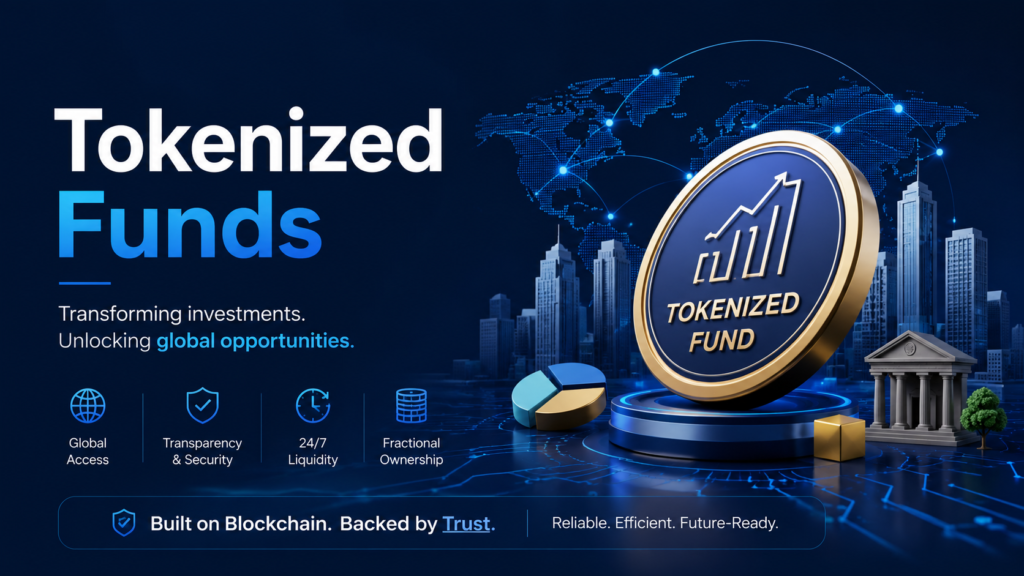

Investment funds have traditionally operated through centralized systems involving fund managers, custodians, transfer agents, and clearing mechanisms. While this structure has supported global capital markets for decades, it also introduces inefficiencies such as delayed settlements, limited liquidity, high administrative overhead, and restricted investor access.
Tokenized funds represent a structural evolution of this model. By leveraging blockchain technology, fund units are converted into digital tokens that represent ownership in underlying assets. These tokens can be issued, transferred, tracked, and managed through programmable smart contracts.
This transformation is creating a more efficient, transparent, and accessible investment ecosystem where capital flows are increasingly digital, automated, and globally connected.
What Are Tokenized Funds?
Tokenized funds are investment vehicles where fund shares are represented as blockchain-based tokens. Each token corresponds to a proportional ownership stake in the fund’s underlying portfolio, which may include assets such as equities, real estate, bonds, commodities, or alternative investments.
Unlike traditional fund units recorded in centralized databases, tokenized fund ownership is stored on a distributed ledger. This allows real-time tracking, transparent reporting, and programmable financial operations. Smart contracts govern the fund’s behavior, including issuance of tokens, transfer of ownership, profit distribution, and compliance enforcement.
How Tokenized Funds Work in Digital Investment Systems
Tokenized funds operate through a layered digital architecture that combines blockchain infrastructure, smart contracts, asset custody solutions, and compliance frameworks. The process begins when an investment fund is structured and its underlying assets are defined. These assets are then represented digitally through token issuance on a blockchain network.
Investors purchase tokens that represent fractional ownership in the fund. Smart contracts manage the lifecycle of these tokens, including transfers, redemption, and distribution of returns. This system eliminates the need for multiple intermediaries while improving transparency and operational efficiency.
Key Components of Tokenized Fund Systems
1. Blockchain Infrastructure
Blockchain acts as the foundational layer that records ownership and transaction data. It ensures that fund records are immutable, transparent, and accessible to authorized participants.
2. Smart Contracts
Smart contracts automate fund operations such as capital allocation, profit distribution, compliance checks, and investor onboarding. They reduce manual intervention and enforce predefined rules consistently across all transactions.
3. Token Standards
Tokenized funds often use standardized digital asset frameworks that define how tokens behave within a blockchain ecosystem. These standards ensure interoperability and secure transferability across platforms.
4. Digital Custody Solutions
Custody systems manage the secure storage of digital assets and private keys associated with fund tokens. These solutions are critical for institutional adoption.
5. Compliance and Identity Systems
Regulatory compliance is integrated into tokenized fund systems through identity verification, investor accreditation, and transaction monitoring mechanisms.
Advantages of Tokenized Funds in Modern Investment Systems1. Enhanced Liquidity
Traditional investment funds often have long lock-in periods. Tokenized funds introduce secondary market trading, enabling investors to buy or sell fund tokens more easily under regulated conditions. This improves capital mobility and provides investors with greater flexibility.
2. Fractional Ownership Accessibility
Tokenization allows high-value investment funds to be divided into smaller units. This enables broader investor participation by lowering entry barriers. It also allows portfolio diversification across multiple fund types with smaller capital commitments.
3. Improved Transparency
Blockchain-based fund systems provide real-time visibility into ownership structures, transactions, and fund performance. This reduces information asymmetry and increases investor confidence in fund operations.
4. Operational Efficiency
Smart contract automation reduces administrative workloads such as manual reconciliations, reporting, and distribution processes. This leads to lower operational costs and faster execution cycles.
5. Global Investment Accessibility
Tokenized funds can be accessed by investors across different regions without traditional geographic limitations. This enables fund managers to reach a broader capital base and diversify investor participation globally.
Types of Tokenized Funds
1. Tokenized Equity Funds
These funds invest in equity markets or private company shares represented as digital tokens.
2. Real Estate Tokenized Funds
These funds focus on property portfolios where ownership is fractionalized through blockchain tokens.
3. Debt and Fixed Income Tokenized Funds
These include bonds, lending instruments, and structured debt products represented digitally.
4. Multi-Asset Tokenized Funds
Diversified funds that combine equities, real estate, crypto assets, and alternative investments into a single tokenized structure.
5. Venture Capital Tokenized Funds
Funds that provide exposure to early-stage startups through tokenized investment vehicles.
Use Cases in Modern Financial Ecosystems
Tokenized funds are being adopted across multiple sectors: In asset management, they improve portfolio transparency and efficiency. In real estate, they enable fractional ownership of large property portfolios.
In private equity, they introduce liquidity mechanisms for traditionally illiquid investments. In fintech platforms, they support innovative investment products accessible to global users. Institutional investors are also exploring tokenized funds for portfolio diversification and operational optimization.
Challenges in Tokenized Fund Adoption
Despite their advantages, tokenized funds face several challenges.
Regulatory Uncertainty
Different jurisdictions have varying interpretations of digital securities and fund tokenization.
Technology Integration
Legacy financial systems are often difficult to integrate with blockchain-based infrastructure.
Market Education
Investors and institutions require better understanding of tokenized financial products.
Security Risks
Digital asset systems must maintain strong cybersecurity frameworks to prevent unauthorized access or fraud.
Future of Tokenized Funds in Digital Investment Systems
The future of tokenized funds is closely tied to the broader evolution of digital financial infrastructure. We are likely to see increased integration with decentralized finance (DeFi), AI-driven portfolio management, and cross-chain interoperability. Tokenized funds may also become standard structures within institutional finance, replacing or complementing traditional fund models. As infrastructure matures, tokenized funds will play a key role in creating a more connected, transparent, and efficient global investment ecosystem.
Conclusion
Tokenized funds represent a major advancement in modern digital investment systems by transforming how capital is raised, managed, and distributed. Through blockchain technology, smart contracts, and programmable financial structures, they offer improved liquidity, transparency, accessibility, and operational efficiency. As adoption continues to grow, tokenized funds are expected to become a foundational component of next-generation financial markets, bridging traditional finance with decentralized digital ecosystems.