

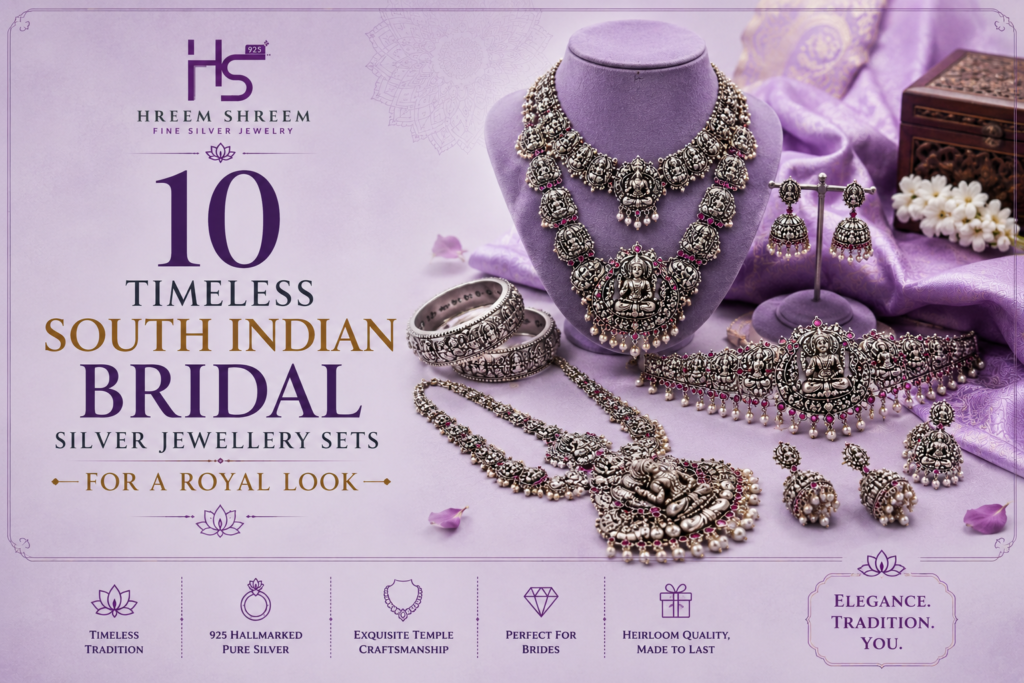

Gold prices right now are, frankly, a little insane. Ask anyone who’s priced a bridal trousseau in the last year or two. That’s a big reason so many South Indian brides have quietly switched to hallmarked 925 sterling silver bridal sets finished with 24K gold plating, instead of going all-in on solid gold.
And honestly, nobody at the wedding can tell the difference. Same heavy Nakshi carving, same deep red Kemp stones, same rich antique Gheru finish that makes the whole set look decades old in the best way. You get the full regal look, the weight, the heirloom feel, at a fraction of what 22K gold would cost. That leftover budget usually ends up going straight into the Kanjeevaram silks or the actual wedding celebrations, which, let’s be honest, is where a lot of brides would rather spend it anyway.
Here are ten sets that show up in almost every serious South Indian bridal trousseau, and why each one earns its spot.
1. The Classic Lakshmi Kasu Mala Set
This is the coin necklace, overlapping gold-plated silver coins stamped with Goddess Lakshmi, usually paired with matching coin drop earrings. It’s typically the short or medium necklace worn over the Muhurtham Kanjeevaram, and there’s a reason it’s the one piece almost nobody skips. It’s meant to invite prosperity into the marriage, which is a nice thing to be wearing on the most important day of your life.
2. The Grand Nakshi Temple Haram Set
If the Kasu Mala is the foundation, the Nakshi Haram is the showstopper. This long, layered necklace features deeply carved deity figures, peacocks, sometimes the mythical Annapakshi bird, all connected through multi-strand silver beadwork. It’s usually what anchors the entire bridal neck stack and gives that dramatic length photographers love.
3. The Traditional Manga Malai (Mango Haram) Set
Mango-shaped pendants, one after another, studded with crimson Kemp stones and small freshwater pearls. It’s a fertility symbol traditionally, standing for new beginnings, and it looks stunning against green, maroon, or gold silk. If you’re going for that classic postcard South Indian bridal photo, this is usually in the frame somewhere.
4. The Royal Kemp-Studded Choker & Jhumka Set
A close-fitting choker set with ruby-red spinels, paired with heavy multi-tier jhumkas that have pearl drops hanging off them. This combination does a lot of work for high-collared blouses especially, since the choker sits right at the neckline and frames the whole face.
5. The Antique Gheru Finish Temple Kada Set
These are the wrist kadas, openable and heavy, with hand-engraved Naga (serpent) work and screw clasps for security. They usually feature Kirtimukha motifs, which are meant to be protective. Brides typically stack these with regular Kasu bangles and the classic green glass bangles, one set per wrist.
6. The Celestial Vanki (Armlet) Set
V-shaped, adjustable armbands worn above the elbow, usually featuring a small Lakshmi pendant with pearl clusters hanging below. These are the pieces that quietly steal attention during rituals like the Kannikadhanam, especially if the blouse has elbow-length embroidery worth showing off.
7. The Elaborate Nethi Chutti / Mathapatti Set
This is your maang tikka, but the bridal version, multi-stranded with side chains that follow the hairline and Kemp stone detailing throughout. It’s honestly one of the most photographed pieces of the whole trousseau, since it frames the bride’s face directly.
8. The Temple Oddiyanam (Waist Belt)
A wide silver belt, sometimes fully rigid and sometimes semi-flexible, carved with temple architecture, deities, and floral vines. Its main job is cinching in the heavy Kanjeevaram silk at the waist, which honestly also makes the whole saree drape look far more structured through a long ceremony.
9. The Pearl-Guttapusalu Necklace Set
A coastal Andhra style, small freshwater pearl fringes hanging beneath a Kemp-studded neckband. It’s softer than most of the other pieces on this list, and it works especially well if the bride’s silk is a pastel shade rather than deep red.
10. The Regal Jadamai (Hair Ornament Set)
Interlocking silver plates that run down the length of the braid, usually depicting the sun, moon, and floral motifs. This is the piece that finishes the look from behind, since so much of a South Indian bridal look is actually about how the back appears in photos, not just the front.
Silver or Solid Gold? What You’re Actually Choosing Between
A full solid 22K gold bridal trousseau typically runs anywhere from ₹15 lakhs to well past ₹35 lakhs. A comparable 24K gold-plated 925 silver set, covering the same pieces, usually costs somewhere between ₹45,000 and ₹1.5 lakhs total.
The visual difference in photos is basically nothing, both carry that same rich antique Gheru finish. Where they really differ is what happens after the wedding. Solid gold usually goes straight into a bank locker and stays there. A silver set, on the other hand, you can actually wear again for family functions without the constant anxiety of losing something worth lakhs. Both are properly hallmarked too, gold with BIS certification, and 925 silver with its own BIS hallmark plus a HUID code, so authenticity isn’t really the concern people assume it is.
FAQs
Will gold-plated silver bridal sets actually look real in wedding photography? Yes. Good quality bridal sets use 2.5 to 5-micron 24K gold plating combined with the traditional Gheru antique treatment, and even high-definition wedding photography genuinely can’t tell it apart from solid 22K gold.
How far in advance should I order a custom set? Give it 4 to 6 weeks at least. The hand-carved Nakshi and repoussé work takes real time from skilled artisans, and you’ll also need room for fittings, stone setting, and the final hallmarking process.
Can I mix and match sets from this list, or should I buy a full matching combo? Most brides do a mix. The Kasu Mala or Nakshi Haram usually anchors the look, and pieces like the Vanki or Oddiyanam get added based on the blouse design and how much detailing the saree already has. A full matching combo looks cohesive, but there’s no rule saying you can’t build your own stack.
Does the gold plating on a silver bridal set wear off quickly? Not if it’s genuinely high-micron plating. A 2.5 to 5-micron 24K coat holds up well through the wedding and several functions after, especially if you’re not wearing the set daily. It can always be re-plated later once it does start to fade.
Is 925 silver bridal jewellery heavy enough to look “bridal,” or does it feel lightweight? It’s genuinely heavy, comparable to solid gold in most cases, since sterling silver isn’t a lightweight metal to begin with. The weight and drape you see in bridal photos comes through just as well as it would in gold.
Conclusion
Ten pieces, one full trousseau, and honestly none of it requires solid gold to look right. That’s really the shift happening in South Indian bridal jewellery right now. Brides aren’t compromising on the heavy, layered, temple-carved look their mothers and grandmothers wore. They’re just getting there through hallmarked 925 silver instead of a metal that costs several times more for the same visual effect.
If you’re starting to plan your own trousseau, begin with the anchor pieces, the Kasu Mala or Nakshi Haram, and build outward from there based on your blouse and saree choices. Check the hallmark and HUID code on every piece, confirm the plating micron count before you buy, and the rest tends to fall into place on its own.
Planning Your Trousseau
If you’re putting together your South Indian wedding trousseau and want that museum-grade temple jewellery look without the solid-gold price tag attached, HS925 Fine Silver Jewellery in Shanti Nagar, Bangalore, crafts bespoke hallmarked 925 sterling silver bridal sets, everything from a full Kasu Mala to a complete Oddiyanam, finished with guaranteed 24K gold micron plating and authentic Gheru work.