

AI-Powered Threat Detection in 2026: How MSP Security Architecture Is Changing
Introduction
Managed Service Providers handle multiple client environments at once. This creates complexity in monitoring, detection, and response. Traditional security systems struggle to keep up with this scale and variation.
AI-based threat detection changes how security systems process data, identify risks, and respond to events. This shift affects how MSP security architecture is structured and operated.
Quick summary
AI-powered threat detection replaces rule-based monitoring with behavior-based analysis. It allows MSPs to detect unknown threats, reduce false alerts, and respond faster across multi-tenant environments.
Why Traditional SIEM Falls Short in MSP Environments
Traditional SIEM systems depend on predefined rules and log collection. This creates several limitations in MSP environments.
- High volume of alerts leads to fatigue
- Many alerts lack real threat context
- Systems struggle to scale across multiple clients
These systems work best in controlled environments. MSP environments are dynamic, which reduces their effectiveness.
How AI Changes Threat Detection Models
AI introduces a different approach to identifying threats.
Instead of matching known signatures, systems analyze behavior patterns. This allows detection of unknown or evolving threats.
Machine learning models process large datasets to identify anomalies. These anomalies may indicate unusual system or user behavior.
Predictive models assign risk scores based on patterns. This helps prioritize which threats require attention.
Core Technologies Used in AI-Based Cyber Defense
AI-enhanced EDR and XDR systems
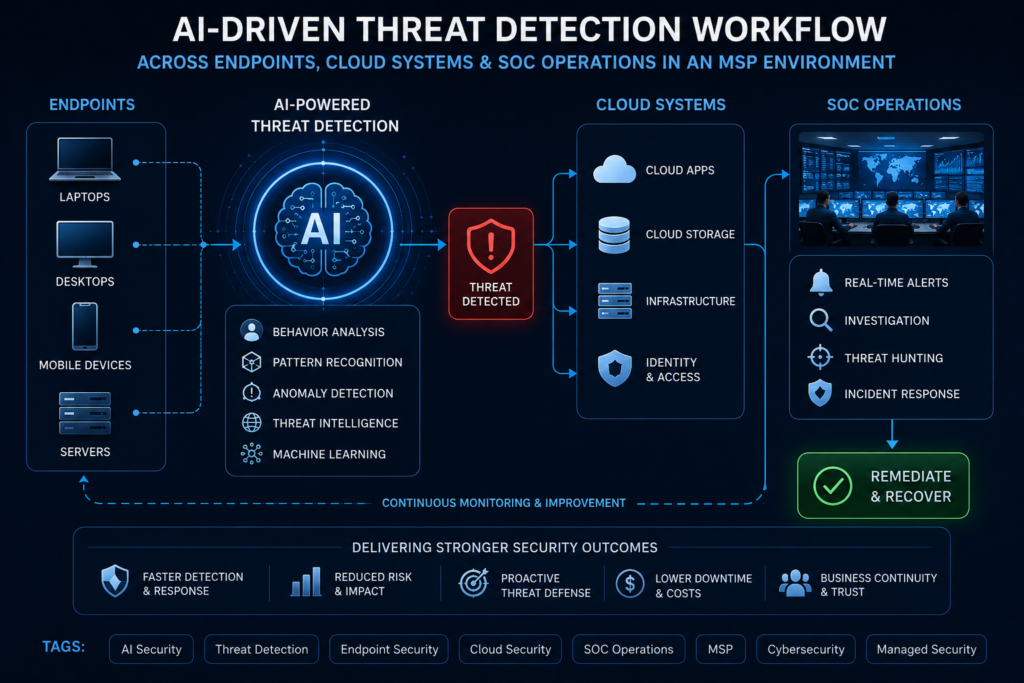
Endpoint Detection and Response tools collect endpoint data. AI improves their ability to detect patterns across devices.
Extended Detection and Response expands this visibility across networks, cloud systems, and applications.
AI-supported SOC operations
Security Operations Centers use AI to filter alerts and highlight relevant incidents.
This reduces manual analysis and helps focus on verified threats.
Cloud-native detection systems
Cloud environments generate large amounts of data. AI systems process this data in real time.
This allows faster identification of suspicious activity across distributed systems.
Zero Trust models with AI analysis
Zero Trust requires verification for every access request.
AI adds continuous monitoring of user behavior. This helps detect abnormal access patterns even after authentication.
How AI Reduces Threat Dwell Time
Threat dwell time refers to how long a threat remains undetected.
AI reduces this time through continuous monitoring. Systems analyze activity across endpoints, networks, and cloud services.
Event correlation links related activities into a single threat view.
Automated response mechanisms trigger actions such as isolating devices or blocking access.
AI in Multi-Tenant and Hybrid MSP Environments
MSPs manage shared infrastructure across different clients.
This creates challenges in separating data and maintaining visibility.
AI systems normalize data from different sources into a consistent format.
They provide centralized monitoring across on-premise and cloud systems.
This allows detection across hybrid environments without separate tools for each system.
Limitations and Constraints of AI in MSP Security
AI-based systems depend on data quality. Poor data leads to inaccurate detection.
Integration with older systems can be difficult. Many legacy tools are not designed for AI workflows.
Cost can increase with large-scale data processing requirements.
Compliance requirements may limit how data is collected and used.
These constraints affect how AI systems are deployed and managed.
Observed Outcomes for MSPs Using AI Detection
AI-based detection changes how security operations function.
Detection accuracy improves when systems learn from large datasets.
Response times decrease due to automated workflows.
Operational load shifts from manual review to system monitoring.
Overall system resilience improves through continuous monitoring and adaptation.
Current Direction of AI in Cybersecurity Operations
Security systems are moving toward partial automation.
AI models continue to learn from new data inputs.
Some systems can adjust responses without human input, but full autonomy is still limited.
Human oversight remains necessary for validation and decision-making.
Conclusion
AI-powered threat detection changes how MSPs structure cybersecurity systems.
The shift from rule-based systems to behavior-based analysis allows better detection across complex environments.
However, AI systems depend on data quality, integration, and governance.
Current development shows movement toward more automated systems, but not complete replacement of human oversight.
FAQs
How does AI-driven threat detection improve MSP security operations?
AI analyzes behavior patterns, detects anomalies, and supports faster response across systems.
What is the difference between traditional SIEM and AI-based detection?
Traditional SIEM uses predefined rules, while AI systems identify unknown threats using behavior analysis.
Can small businesses benefit from AI cybersecurity?
Yes. AI allows scalable monitoring across multiple systems without large teams.
How does AI reduce threat dwell time?
Through continuous monitoring, event correlation, and automated response actions.
What role does Zero Trust play in AI cybersecurity?
Zero Trust controls access, while AI monitors behavior after access is granted.
What are the challenges of AI implementation for MSPs?
Data quality, system integration, cost, and compliance constraints.
For related infrastructure and security context, explore:Framewerx services