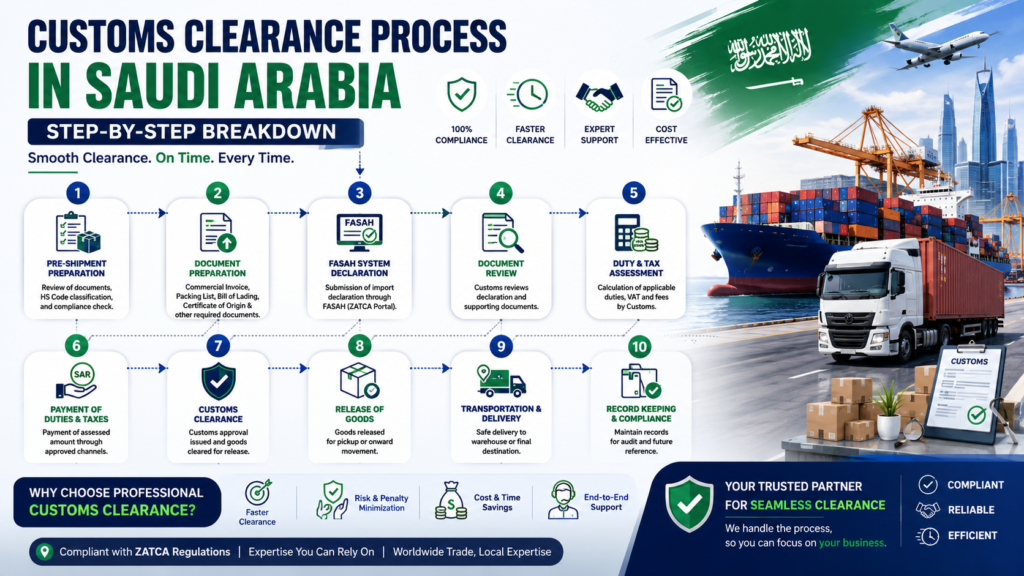

Understanding saudi customs clearance is essential for businesses importing goods into the Kingdom. Whether you’re dealing with import documentation, customs regulations, cargo release procedures, duty payments, shipment processing, trade compliance, or product certification requirements, knowing how the customs system works can help prevent costly delays and ensure smooth delivery of goods. Saudi Arabia has modernized its customs infrastructure through digital platforms and streamlined regulations, making the import process more efficient than ever. However, importers must still follow specific procedures to successfully clear their shipments.
What Is Customs Clearance?
Customs clearance is the official process through which imported goods are reviewed and approved by customs authorities before entering Saudi Arabia. During this process, customs officials verify shipment details, assess applicable duties and taxes, confirm compliance with regulations, and authorize cargo release.
The process ensures that:
- Imported goods meet Saudi regulations
- Duties and taxes are collected correctly
- Restricted or prohibited items are controlled
- Product safety standards are maintained
- International trade operates efficiently
Without proper customs clearance, shipments cannot legally enter the Saudi market.
Why Saudi Customs Clearance Is Important
Saudi Arabia is one of the largest import destinations in the Middle East. Every day, thousands of shipments arrive through:
- Seaports
- Airports
- Land border crossings
Efficient customs clearance helps businesses:
- Avoid shipment delays
- Reduce storage and demurrage costs
- Maintain supply chain continuity
- Ensure legal compliance
- Improve customer satisfaction
Even minor documentation errors can result in customs holds and additional expenses.
Key Authorities Involved in the Process
Several government entities participate in regulating imports.
Saudi Customs Authorities
Customs officials oversee:
- Cargo inspections
- Documentation verification
- Duty collection
- Shipment release
SASO (Saudi Standards, Metrology and Quality Organization)
SASO develops technical regulations and product standards applicable to imported goods.
SABER Platform
The SABER platform facilitates:
- Product registration
- Conformity certification
- Shipment certification
- Compliance verification
Many regulated products require SABER approval before customs clearance.
Documents Required for Saudi Customs Clearance
Accurate documentation is the foundation of a successful import process.
Commercial Invoice
The commercial invoice contains:
- Product descriptions
- Quantity of goods
- Unit pricing
- Total shipment value
- Buyer and seller information
Customs authorities use this document to determine customs valuation.
Packing List
The packing list provides:
- Number of packages
- Weight details
- Dimensions
- Product contents
This helps customs officials verify cargo information.
Bill of Lading or Airway Bill
This transportation document serves as proof of shipment ownership.
Depending on the shipping method:
- Sea freight uses a Bill of Lading
- Air freight uses an Airway Bill
Certificate of Origin
This document confirms the country where the goods were manufactured.
It may affect tariff treatment and regulatory requirements.
Product Compliance Certificates
Certain goods require additional certifications such as:
- SABER Certificate
- Product Certificate of Conformity (PCoC)
- Shipment Certificate of Conformity (SCoC)
- Health certificates
- Industry-specific permits
Step-by-Step Saudi Customs Clearance Process
Understanding each stage helps importers prepare effectively.
Step 1: Shipment Arrival
The process begins when cargo arrives at a Saudi port, airport, or land border.
At this stage:
- Shipment details are registered
- Documentation is submitted
- Customs procedures are initiated
Importers should ensure all paperwork is prepared before arrival.
Step 2: Customs Declaration Submission
The importer or customs broker submits an electronic customs declaration.
Information provided includes:
- Product descriptions
- HS codes
- Shipment value
- Country of origin
- Importer details
- Supporting documents
Accuracy is critical because errors can trigger delays and inspections.
Step 3: Documentation Review
Customs officials review submitted documentation to verify:
- Product classifications
- Invoice accuracy
- Compliance certificates
- Import permits
- Shipment consistency
Any discrepancies may require clarification or additional documentation.
Step 4: Customs Valuation
Customs authorities determine the value of imported goods.
The valuation typically includes:
- Product cost
- Freight charges
- Insurance costs
- Other applicable charges
This value forms the basis for duty calculations.
Step 5: Duty and VAT Assessment
After valuation, customs authorities calculate:
Customs Duties
Duty rates vary depending on:
- Product category
- HS code classification
- Trade agreements
Value Added Tax (VAT)
VAT is generally applied according to Saudi tax regulations.
Importers must settle all charges before shipment release.
Step 6: Compliance Verification
Products subject to technical regulations undergo compliance verification.
Authorities may review:
- SABER registration
- Product conformity certificates
- Safety reports
- Technical documentation
Failure to meet compliance requirements may result in shipment delays.
Step 7: Cargo Inspection (If Required)
Some shipments are selected for inspection.
Reasons include:
- Random selection
- High-risk goods
- Documentation concerns
- Regulatory requirements
Inspectors verify that the physical cargo matches submitted records.
Step 8: Customs Release
Once all requirements have been satisfied, customs authorities approve the shipment.
Cargo can then be released for:
- Warehousing
- Distribution
- Retail delivery
- Manufacturing use
This marks the completion of the customs clearance process.
Understanding HS Codes
HS (Harmonized System) Codes are internationally recognized product classification codes used by customs authorities worldwide.
Correct classification affects:
- Duty rates
- Compliance requirements
- Product restrictions
- Customs processing speed
Incorrect HS codes are among the most common causes of customs delays.
Products Requiring Additional Approvals
Certain product categories require extra compliance measures.
Electrical Products
- Home appliances
- Electronics
- Lighting equipment
Automotive Components
- Tires
- Spare parts
- Vehicle accessories
Cosmetics and Personal Care Products
- Beauty products
- Skincare items
- Fragrances
Construction Materials
- Building supplies
- Industrial equipment
- Safety products
Many of these products require SABER certification before importation.
Common Customs Clearance Challenges
Importers frequently encounter issues that can delay cargo release.
Incomplete Documentation
Missing paperwork often causes customs holds.
Examples include:
- Missing invoices
- Incomplete packing lists
- Absent certificates
Incorrect Product Classification
Using the wrong HS code may result in:
- Duty assessment errors
- Compliance issues
- Additional inspections
Missing Certifications
Products requiring conformity certificates may face delays if approvals are not obtained beforehand.
Delayed Duty Payments
Cargo cannot be released until all duties and taxes have been paid.
Benefits of Working With Customs Clearance Experts
Professional customs clearance providers offer valuable assistance throughout the process.
They help with:
- Documentation preparation
- Customs declarations
- Product classification
- Duty calculations
- Compliance management
- Shipment tracking
Their expertise can significantly reduce delays and administrative burdens.
Best Practices for Faster Customs Clearance
Businesses can improve clearance efficiency by following these recommendations.
Prepare Documents Early
Gather all required paperwork before shipment arrival.
Verify Product Compliance
Confirm certification requirements before shipping goods.
Use Accurate HS Codes
Proper classification prevents customs complications.
Monitor Shipment Status
Track cargo regularly to identify issues quickly.
Partner With Experienced Customs Brokers
Professional support often speeds up processing and improves compliance.
The Future of Saudi Customs Clearance
Saudi Arabia continues investing in trade facilitation and logistics modernization under Vision 2030.
Recent developments include:
- Electronic customs declarations
- Automated processing systems
- Digital compliance verification
- Integrated shipment tracking
- Faster cargo release procedures
These advancements are helping make imports more efficient and transparent.
Conclusion
The saudi customs clearance process plays a vital role in ensuring goods enter the Kingdom legally, safely, and efficiently. From preparing documentation and submitting declarations to obtaining compliance certifications and paying duties, each stage of the process requires careful attention to detail.
Businesses that understand the customs clearance process, maintain accurate records, and comply with Saudi regulations can significantly reduce delays and improve supply chain performance. By working with experienced customs clearance professionals and staying informed about regulatory updates, importers can navigate Saudi Arabia’s import procedures with confidence and achieve long-term success in one of the region’s most dynamic markets.