

National Conference on Permaculture 2026: A Practical Path to Sustainable Living
Permaculture is becoming an important approach for people who want to live in harmony with nature while creating healthier, more resilient, and productive environments. It goes beyond conventional farming by combining ecological design, responsible resource management, food production, and community well-being. For anyone interested in understanding how these ideas can be applied in real life, the national conference on permaculture 2026 offers an opportunity to learn directly from experienced practitioners and sustainability experts.
Organized by AOL Permaculture at the Art of Living International Ashram in Bangalore, the event is designed around the theme of moving from seeds to sustainability. The conference focuses on practical knowledge that can help farmers, landowners, professionals, students, families, and aspiring permaculture practitioners understand the complete journey of creating a regenerative farm.
What Is Permaculture?
Permaculture is a method of designing human living systems by observing and working with natural patterns. Instead of continuously extracting resources from the environment, permaculture encourages people to regenerate soil, conserve water, increase biodiversity, grow nutritious food, and use resources thoughtfully.
The philosophy is commonly associated with three important principles: care for the Earth, care for people, and fair share. These principles can be applied not only to agriculture but also to homes, communities, water management, energy systems, and sustainable livelihoods.
AOL Permaculture describes permaculture as designing with nature and learning from natural systems. Its programs are intended to help participants understand these principles and put them into practice through learning and hands-on experience.
Why the National Conference on Permaculture 2026 Matters
The national conference on permaculture 2026 is particularly relevant at a time when farmers and communities are looking for practical ways to deal with soil degradation, water shortages, changing climate conditions, and increasing pressure on agricultural resources.
The conference is not presented simply as a traditional farming event. Instead, it aims to provide an integrated roadmap covering land selection, soil health, water systems, infrastructure, ecosystem design, economics, and the well-being of the farmer.
For people who have unused land or are planning to start a farm, this broader approach can be valuable. Sustainable farming is rarely about one technique. Successful land regeneration requires understanding how water, soil, plants, animals, infrastructure, people, and finances work together.
What You Can Learn at the Conference
One of the key strengths of the national conference on permaculture 2026 is its focus on practical questions faced by people who want to establish or improve a farm.
Land and Farm Planning
Choosing the right land is an important first step. The conference covers topics such as soil quality, water availability, topography, agricultural policies, subsidies, zoning, and certifications. Participants can also learn about collective ownership approaches and ways to build stronger relationships with surrounding communities.
Soil Regeneration and Food Forests
Healthy soil is the foundation of a productive ecosystem. Sessions are designed to explore living soil, advanced composting, liquid bio-fertilizers, food forests, agroforestry, and climate-specific plant planning.
Instead of focusing only on short-term crop production, permaculture encourages the development of diverse systems where fruit trees, vegetables, timber, seasonal crops, and other plants can work together.
Water Conservation and Infrastructure
Water management is another major part of regenerative land design. The conference includes discussions around keyline systems, swales, ponds, rainwater management, drought resilience, and monsoon planning.
Participants can also explore appropriate technologies such as solar energy systems and decentralized infrastructure that can help farms become more self-reliant.
Economics and Sustainable Livelihoods
Sustainability also needs to make economic sense. Farmers and landowners need practical answers about investment, farm income, workforce requirements, markets, and long-term management.
The national conference on permaculture 2026 brings together practitioners who can share real-world perspectives on farm economics and regenerative enterprises. This can help participants look beyond theory and consider how ecological farming can become a viable livelihood.
Who Should Attend?
The event can be useful for a wide range of people. Existing farmers may find new approaches for improving their land, while aspiring farmers can gain a clearer understanding of what is involved before making major investments.
It is also relevant for urban professionals and families interested in sustainable living, landowners with unused property, investors and farming collectives, students, retirees, and people interested in ecological restoration.
For beginners, the conference can provide a broad introduction to the different components of permaculture. For experienced practitioners, it can create opportunities to exchange ideas and connect with people working on similar challenges.
Learning From Experienced Practitioners
The national conference on permaculture 2026 brings together speakers from areas including regenerative agriculture, water conservation, ecological design, natural farming, health, agricultural communication, and climate-resilient land management.
Among the confirmed speakers are Binay Singh, Head of Art of Living Permaculture; Dr. Nanda Kishore Methuku; Abhinav Roy; Ashish Singhal; Prof. Dr. Chandrashekhar M. Biradar; Dr. Devaraja Reddy N.J.; Patanjali Jha; Shri Rajendra Bhat; and Dnyaneshwar Bodke. Their backgrounds represent different perspectives on ecological restoration and sustainable agriculture.
The event will also include guidance from Gurudev Sri Sri Ravi Shankar, adding a focus on the connection between environmental responsibility, personal well-being, and sustainable living.
A Practical Experience, Not Just a Conference
What makes the national conference on permaculture 2026 different is its emphasis on practical learning. The program covers the complete farm journey, from finding suitable land and establishing infrastructure to developing healthy soil, planting food forests, managing water, and creating sustainable systems.
Participants are also expected to have access to technical sessions, legal and policy discussions, networking opportunities, community interactions, and an AOL Permaculture Farm Tour.
This practical perspective can help participants understand how permaculture principles look when applied to real land rather than only discussed in books or classrooms.
When and Where Is the Conference?
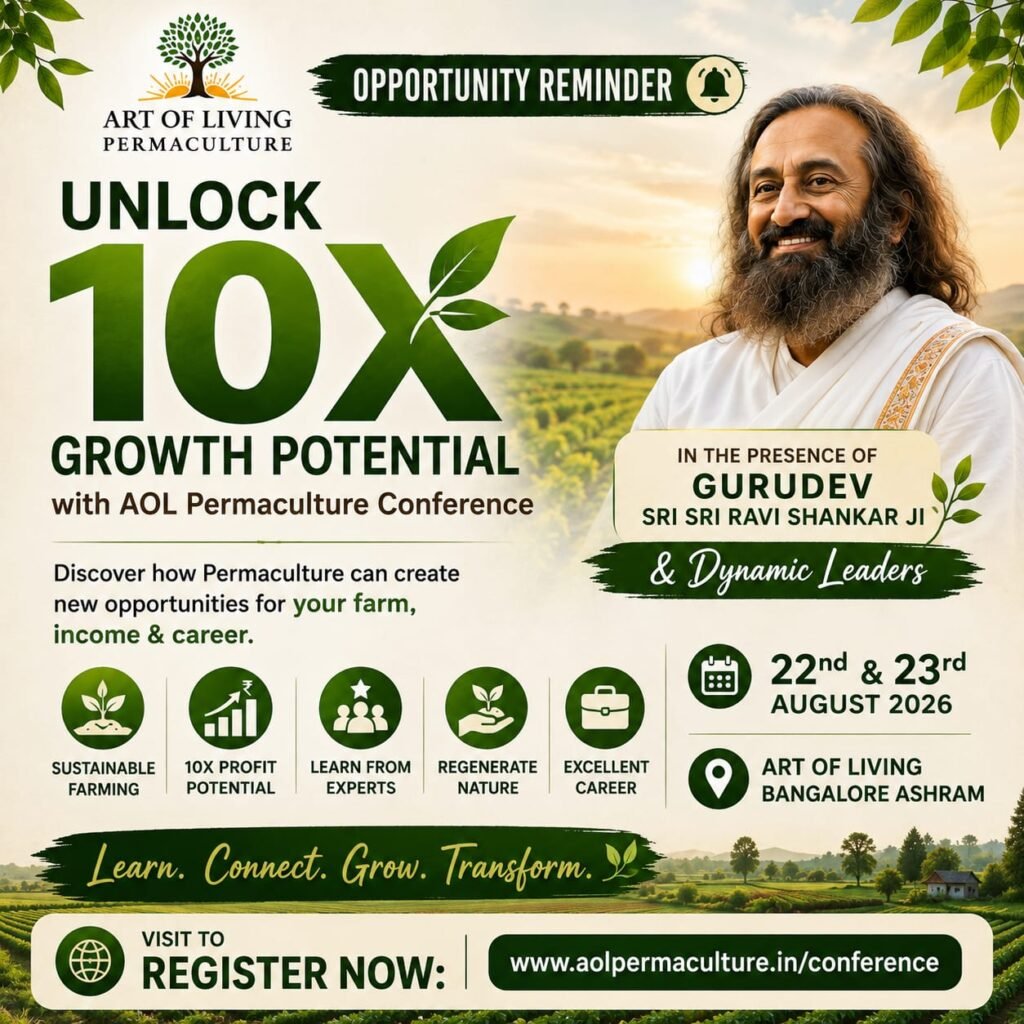
The national conference on permaculture 2026 is scheduled for August 22 and 23, 2026, at the Art of Living International Ashram on Kanakapura Road in Bangalore. The event is planned as a two-day learning experience for people interested in sustainable agriculture, ecological restoration, and regenerative living.
Interested participants can learn more about the conference, its program, speakers, and registration through the AOL Permaculture website.
Conclusion
The national conference on permaculture 2026 offers an opportunity to look at sustainable farming from a much wider perspective. From healthy soil and water conservation to food forests, farm infrastructure, economics, and personal well-being, the event brings together many elements needed to build regenerative systems.
For farmers, landowners, students, professionals, and sustainability enthusiasts, learning directly from experienced practitioners can provide valuable insights that are difficult to gain from theory alone. Permaculture is ultimately about creating systems that support people while restoring the natural environment.
As interest in healthier food, resilient agriculture, and responsible land management continues to grow, events such as this can help turn sustainable ideas into practical action. The conference provides a space to learn, connect, and explore how individuals and communities can contribute to a more regenerative future.