

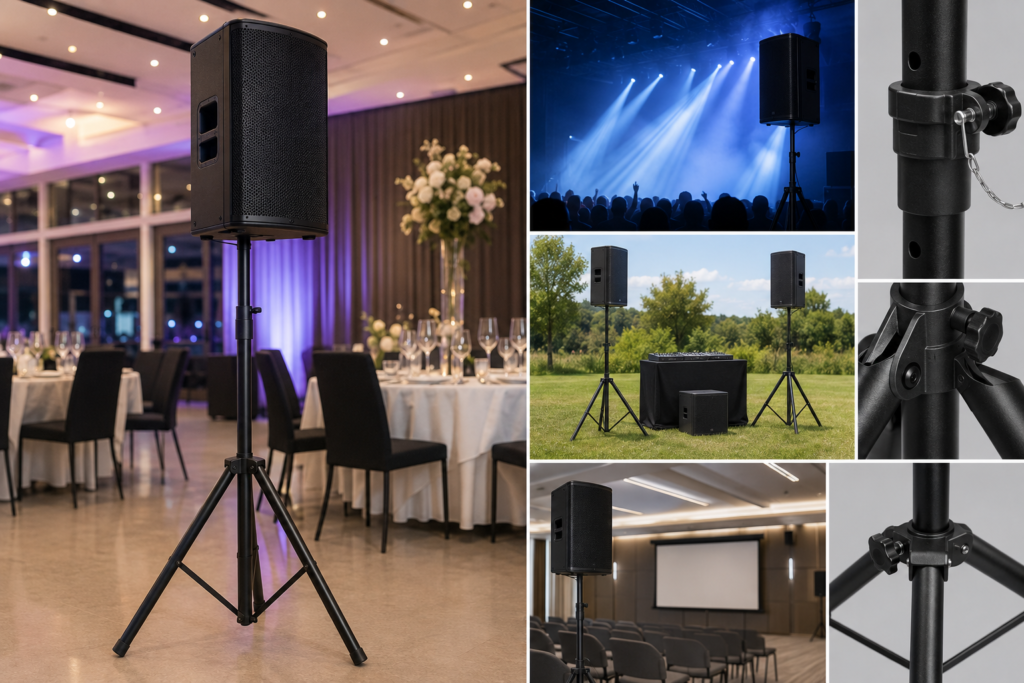

Whether you’re setting up a home listening room, preparing for a live performance, recording a podcast, or hosting an event, most people focus on the speakers themselves. They compare power ratings, frequency response, and brand reputation—but often overlook one surprisingly important part of the setup: Speaker Stands.
Yet even the highest-quality speakers can underperform if they’re placed incorrectly. Poor positioning can reduce clarity, weaken bass, blur stereo imaging, and create unwanted vibrations that distort sound. A properly selected stand or mounting solution helps speakers perform as they were designed, allowing listeners to hear more detail, better balance, and improved consistency across the room.
This guide explains why speaker placement matters, how different stand types solve different problems, and what to consider before choosing the right support for your audio system.
Why Placement Matters More Than Many People Realise
Sound behaves differently depending on the room and the location of your speakers. Hard surfaces reflect sound waves, furniture absorbs certain frequencies, and walls can reinforce or cancel bass.
The goal isn’t simply to make speakers higher—it’s to position them where sound reaches listeners with minimal interference.
Correct placement can help:
- Improve stereo imaging
- Increase vocal clarity
- Reduce unwanted reflections
- Minimise floor vibration
- Deliver more consistent sound throughout the listening area
According to research from the Audio Engineering Society (AES), loudspeaker placement significantly affects perceived frequency response and spatial imaging, particularly in untreated rooms. Similarly, Dolby Laboratories recommends positioning speakers at ear level whenever practical to achieve accurate sound reproduction.
How Speaker Height Changes the Listening Experience
Most speakers are engineered so that the tweeter—the driver responsible for high frequencies—projects directly toward the listener’s ears.
If speakers sit too low:
- High frequencies become less detailed.
- Dialogue becomes harder to understand.
- Stereo imaging becomes less precise.
If speakers are too high:
- Sound may feel disconnected.
- Midrange balance changes.
- The listening position becomes less accurate.
A well-positioned stand helps maintain the intended listening angle without requiring awkward furniture arrangements.
Understanding Different Types of Speaker Stands
Not every environment requires the same support system. Choosing the right style depends on where the speakers will be used.
1. Tripod Designs
Tripod speaker stands are among the most versatile options for portable audio systems.
They’re commonly used for:
- DJ performances
- Live bands
- Community events
- Conferences
- Weddings
- Outdoor presentations
Benefits include:
- Adjustable height
- Portable folding design
- Stable footprint
- Quick setup and pack-down
Many professional models also include locking safety pins and reinforced tubing for additional security.
2. Studio Isolation Platforms
Recording studios face a different challenge.
When monitors sit directly on desks, vibrations transfer into the furniture, colouring the sound and reducing monitoring accuracy.
Isolation stands help by:
- Decoupling speakers from the desk
- Reducing resonance
- Improving stereo focus
- Delivering more accurate mixes
For musicians, producers, and content creators, these subtle improvements often make editing decisions easier.
3. Permanent Wall Installations
Some spaces simply don’t have room for floor-standing equipment.
This is where wall mount speaker brackets become practical.
They’re frequently used in:
- Restaurants
- Schools
- Retail stores
- Churches
- Meeting rooms
- Home theatres
Advantages include:
- Saving valuable floor space
- Better cable management
- Fixed listening angles
- Reduced trip hazards
Professional installation is recommended whenever speakers are mounted above head height to ensure structural safety.
4. Adjustable Mounting Systems
Many installers also rely on speaker stand brackets when integrating loudspeakers with lighting trusses, poles, or custom support systems.
These accessories allow greater flexibility for unusual installations while maintaining safe weight distribution and secure positioning.
Choosing brackets that match both the speaker weight and mounting hardware is essential for long-term reliability.
Also Read : How Wedding Backdrops Can Transform an Ordinary Venue
Common Placement Mistakes That Reduce Audio Quality
Even excellent equipment can sound disappointing if installed poorly.
Some of the most common issues include:
Speakers Positioned Against Walls
Placing speakers directly against walls often exaggerates bass frequencies.
The result may sound powerful initially but can quickly become muddy or boomy.
Leaving some distance between the rear of the speaker and the wall usually creates a more balanced sound.
Uneven Heights
If one speaker sits higher than the other, stereo imaging suffers.
Listeners may struggle to identify instrument placement or dialogue location within recordings.
Unstable Supports
Wobbly furniture introduces vibration and movement.
Stable supports reduce unwanted resonance and improve overall clarity.
Incorrect Listening Angle
Pointing speakers too far inward—or not enough—changes how sound reaches listeners.
Small adjustments can noticeably improve imaging and tonal balance.
Choosing the Right Stand for Different Applications
Every environment has unique requirements.
Home Listening
Priorities include:
- Matching ear height
- Stable construction
- Attractive appearance
- Good cable management
Home Theatre
Consistency matters most.
Front speakers should remain level with one another while surrounds should follow the system manufacturer’s placement recommendations.
Live Events
Portability becomes critical.
Look for:
- Lightweight materials
- Quick height adjustment
- Strong locking mechanisms
- High load capacity
Commercial Spaces
Permanent installations often prioritise:
- Safety
- Clean aesthetics
- Long-term durability
- Tamper resistance
Materials Matter More Than You Might Expect
Different materials influence both durability and acoustic performance.
Steel
Often preferred for professional applications because it offers:
- Excellent strength
- Long service life
- High weight capacity
- Stability
Aluminium
Ideal for portable setups because it is:
- Lightweight
- Corrosion resistant
- Easy to transport
Composite Materials
Some studio products combine engineered polymers with metal components to reduce vibration while maintaining rigidity.
Safety Should Never Be an Afterthought
Large loudspeakers can weigh considerably more than many people expect.
Always check:
- Maximum load rating
- Locking mechanisms
- Base stability
- Floor condition
- Mount compatibility
If children or large crowds will be nearby, additional precautions become even more important.
For overhead or wall-mounted systems, follow manufacturer instructions carefully and use appropriate anchors suited to the building material.
Features Worth Looking For
Not every feature is essential, but several can improve both convenience and performance.
Useful features include:
- Adjustable height
- Locking safety pins
- Cable management channels
- Rubber isolation pads
- Non-slip feet
- Wide tripod footprint
- Corrosion-resistant finishes
- Easy folding mechanisms
Choosing quality hardware often means fewer adjustments and greater confidence during everyday use.
Do Expensive Stands Always Sound Better?
Not necessarily.
The biggest improvement usually comes from:
- Proper height
- Stable support
- Correct positioning
- Safe installation
Premium models may include stronger materials, smoother adjustment systems, and improved vibration control, but even modestly priced options can produce excellent results when chosen appropriately.
Instead of focusing only on price, consider:
- Speaker weight
- Room size
- Intended use
- Portability requirements
- Frequency of setup
These factors usually have a greater impact on satisfaction than cost alone.
A Simple Setup Checklist
Before switching on your system, work through this quick checklist.
✔ Tweeters positioned close to ear level
✔ Left and right speakers at equal height
✔ Stable support with no wobble
✔ Speakers angled toward the listening position
✔ Adequate space from walls where practical
✔ Cables secured safely
✔ Load ratings within manufacturer limits
These small checks often produce surprisingly noticeable improvements.
Final Thoughts
Good sound isn’t determined solely by the speakers you purchase. Placement, stability, and proper support all influence what reaches your ears. Whether you’re building a home entertainment system, recording music, or preparing for a live event, taking the time to choose suitable Speaker Stands and mounting solutions can make a meaningful difference without changing the speakers themselves.
If you’re comparing options for different applications, JD’s Sound & Lighting offers a broad selection of professional audio support equipment—from portable tripods and studio isolation solutions to specialised mounting hardware—making it easier to match the right product to your specific setup while following good installation practices.