

On-page SEO is one of the most important parts of a successful search engine optimization strategy. While backlinks, technical SEO, and off-page activities can improve a website’s authority, on-page SEO ensures that search engines can understand what your pages are about and that visitors can easily find useful information.
Whether you run a business website, blog, e-commerce store, or service-based website, optimizing your individual web pages can help improve visibility, attract relevant traffic, and create a better user experience.
What Is On-Page SEO?
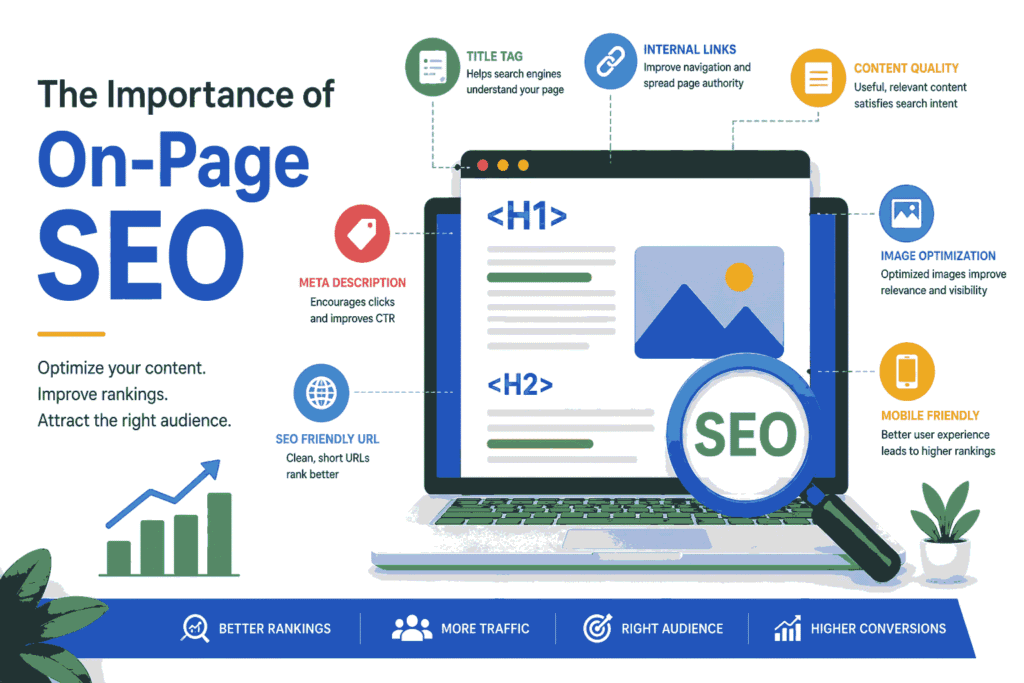
On-page SEO refers to the process of optimizing elements within a webpage to improve its visibility in search engine results. These elements include content, headings, title tags, meta descriptions, URLs, images, internal links, keyword usage, and overall page structure.
The main goal is not simply to add keywords to a page. Instead, on-page SEO helps search engines understand the topic and purpose of a page while making the content useful and accessible to users.
Why Is On-Page SEO Important?
1. Helps Search Engines Understand Your Content
Search engines need to understand the subject of a webpage before deciding which search queries it may be relevant for.
Clear headings, descriptive titles, relevant keywords, well-structured content, and meaningful URLs provide search engines with important context.
For example, a page targeting the topic “website design services” should clearly explain website design, its benefits, the services offered, and related information. This makes the page easier for both search engines and users to understand.
2. Improves Search Engine Visibility
A properly optimized page has a better chance of appearing for relevant search queries.
On-page SEO allows you to strategically use your primary and related keywords in important areas such as the title, H1 heading, introduction, subheadings, body content, image alt text, and URL where appropriate.
However, keyword stuffing should be avoided. Search engines increasingly focus on relevance, quality, and user satisfaction rather than simply counting keyword repetitions.
3. Creates a Better User Experience
SEO is not only about search engines. It is also about helping visitors find and understand information quickly.
Good on-page optimization improves readability through:
- Clear headings and subheadings
- Short and easy-to-read paragraphs
- Relevant images
- Useful internal links
- Logical content structure
- Mobile-friendly presentation
- Clear calls to action
When visitors can easily navigate and understand your website, they are more likely to stay longer and take meaningful actions.
4. Helps Target the Right Keywords
Keyword research tells you what your audience is searching for, while on-page SEO helps you incorporate those topics naturally into your content.
For example, instead of targeting only “SEO,” a business might create a page around a more specific search intent such as “on-page SEO services” or “how to optimize a website for Google.”
Understanding search intent is particularly important. Your content should provide the information, solution, product, or service that users are actually looking for.
5. Improves Click-Through Rates
Your title tag and meta description can influence whether someone clicks your result after seeing it in Google.
A compelling title should clearly communicate what the page offers. A useful meta description can provide additional context and encourage users to visit the page.
For example, instead of using a generic title like “SEO Services,” a more descriptive title could be “On-Page SEO Services to Improve Search Visibility.”
Higher relevance between the search query, title, and content can help attract more qualified visitors.
Important Elements of On-Page SEO
Several elements should be considered when optimizing a webpage.
Title Tag: Clearly describes the page and includes the primary topic where appropriate.
Meta Description: Provides a concise summary that encourages users to click.
Headings: H1, H2, and H3 headings organize content and make the page easier to understand.
URL Structure: Short, descriptive URLs help users and search engines understand the page topic.
Content: Content should be original, useful, accurate, and aligned with the user’s search intent.
Keywords: Primary and related keywords should be incorporated naturally without over-optimization.
Images: Relevant images can improve engagement, while descriptive file names and alt text can provide additional context.
Internal Links: Linking related pages helps users discover more information and allows search engines to understand relationships between pages.
On-Page SEO and Content Quality
One of the biggest mistakes businesses make is treating SEO as a keyword-placement exercise.
Modern SEO requires content that genuinely helps users. A page should answer important questions, explain concepts clearly, demonstrate expertise, and provide practical value.
For competitive topics, adding original insights, examples, data, experience, FAQs, and useful explanations can make a page more valuable than generic content.
On-Page SEO Is an Ongoing Process
SEO is not something you optimize once and forget.
Search trends, competitors, user behavior, and search engine systems can change over time. Regularly reviewing your important pages can help identify opportunities for improvement.
You can analyze metrics such as impressions, clicks, click-through rate, rankings, and organic traffic using tools such as Google Search Console and other SEO platforms.
Based on the data, you can update titles, improve content, add internal links, target related topics, and address gaps in the information provided.
Conclusion
On-page SEO is a fundamental part of building a search-friendly website. It helps search engines understand your content, improves relevance for target keywords, enhances user experience, and can increase your website’s ability to attract qualified organic traffic.
However, effective on-page SEO is not about manipulating search engines. It is about creating well-structured, relevant, useful, and easy-to-understand webpages that satisfy search intent.
If you combine strong content with proper on-page optimization, technical SEO, and a sustainable off-page strategy, you can build a stronger foundation for long-term organic search growth.