
In the labyrinthine universe of avant-garde fashion, Rei Kawakubo’s Comme des Garcons (CdG) is widely revered as the ultimate architect of “anti-fashion.” Since the brand’s Paris debut in 1981, Kawakubo has built an empire by aggressively challenging standard notions of beauty, symmetry, and commercial appeal with shredded fabrics, multi-limbed silhouettes, and cerebral, unwearable runway sculptures.
Yet, if you walk down the street in London, Tokyo, New York, or Paris, you are most likely to recognize the brand not by a three-headed woolen gown, but by a simple, minimalist graphic: a cartoon red heart featuring a pair of wide, mischievous, black-and-white eyes.
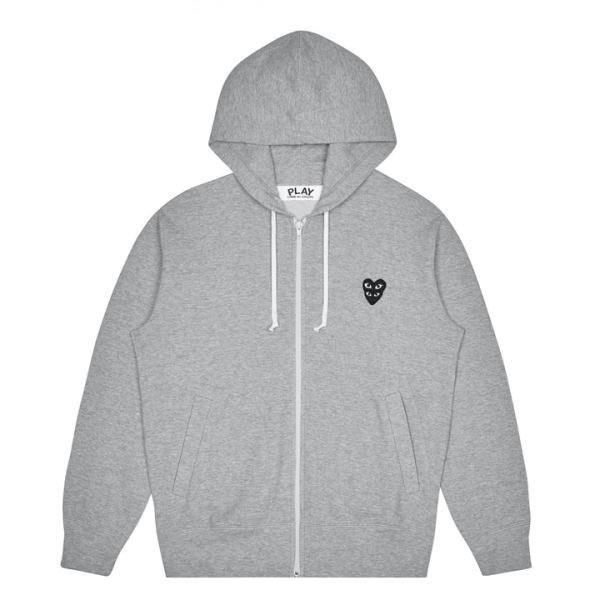
This logo belongs to Comme des Garçons PLAY, a casual diffusion line launched in 2002. Described by the house as “a sign, a symbol, a feeling,” PLAY successfully bridged the canyon between elite, intimidating high fashion and everyday global streetwear. It is a masterclass in economic subversion, funding Kawakubo’s radical creative experiments while becoming one of the most recognizable luxury logos of the 21st century.
The Birth of the “Anti-Design” Logo
The origin of the PLAY line is deeply rooted in irony. Founded in 2002, the collection was conceived as an explicit antithesis to high-concept runway design. Instead of attempting to invent entirely new, paradigm-shifting shapes, Kawakubo decided to do something far more radical for an avant-garde pioneer: she embraced the ultra-basic.
PLAY would completely eschew the traditional fashion calendar. It refused to change with the seasons, focusing instead on a permanent capsule of timeless wardrobe essentials: premium cotton T-shirts, striped long-sleeve Breton tops, classic pullovers, zip-up hoodies, and wool cardigans.
To give this line of basics an unmistakable identity, Kawakubo utilized a design submitted by Polish graphic artist Filip Pagowski. Paradoxically, Pagowski hadn’t even created the logo for the PLAY line specifically. He had drawn the quirky, bug-eyed red heart instantaneously during an unrelated creative session in the late 1990s.
“I remember working on something… not connected to anything,” Pagowski later recalled. “I got this idea of a red heart with a set of eyes. I drew it instantaneously and the first draft was it.”
Kawakubo dug the illustration out of her archives years later when she needed a symbol that was immediate, distinct, and dripping with youthful personality. Unlike traditional corporate logos that feel sterile and calculated, Pagowski’s heart featured rough, uneven, uncalibrated lines—looking less like a luxury emblem and more like an expressive sketch drawn by a rebellious teenager.
The Symbiotic Business of “Beautiful Chaos”
For high-fashion purists, the meteoric rise of the PLAY line is occasionally viewed with a touch of cynicism. It can feel jarring to see a fashion house built on radical deconstruction become synonymous with mass-produced casual wear. However, from a business perspective, engineered alongside CdG CEO Adrian Joffe, PLAY is the financial lifeblood that allows pure art to exist.
Comme des Garcons Play operates entirely independently, refusing the corporate backing of luxury conglomerates like LVMH or Kering. To maintain total creative freedom over her main runway collections—which often generate zero commercial retail sales—Kawakubo relies on a highly structured ecosystem of sub-labels.
| Sub-Label Category | Design Philosophy | Commercial Role |
| Comme des Garçons (Main Line) | High-concept, sculptural, uncompromising art. | Brand prestige, critical acclaim, museum curation. |
| Comme des Garçons Homme Plus | Avant-garde menswear rewriting traditional tailoring rules. | High-end retail anchor. |
| Comme des Garçons PLAY | Essential basics decorated with recurring graphic motifs. | Global volume, massive cash flow generation. |
| Comme des Garçons Wallet / Parfum | Unconventional agendered scents and accessible leather goods. | Entry-level luxury acquisition. |
The massive profit margins generated by selling premium, basic cotton tees and knitwear to mainstream consumers directly fund the fabric R&D, elaborate staging, and non-commercial textiles required for Kawakubo’s boundary-pushing Paris runway spectacles.
The Footwear Phenomenon: CdG PLAY x Converse
You cannot discuss the legacy of Comme des Garçons PLAY without exploring its most culturally pervasive partnership: the ongoing collaboration with Converse.
First introduced in 2009 and streamlined on the premium Chuck Taylor All Star ’70 silhouette in 2015, the Converse x Comme des Garçons PLAY sneaker became a generation-defining piece of footwear. The design formula was deceptively simple: take an internationally beloved, utilitarian canvas shoe, and place Pagowski’s peeping heart logo peeking over the midsole.
The shoe became an overnight sensation, striking the perfect equilibrium between accessible pricing and high-fashion prestige. It was adopted globally by a remarkably diverse demographic—spanning skater subcultures, high school students, tech workers, and A-list musicians like Kanye West, Rihanna, and Drake. For over a decade, it has remained a foundational staple of street style, acting as an easily accessible gateway drug that introduces younger generations to the wider, more intimidating world of Japanese avant-garde design.
A Borderless Icon
By stripping away the intellectual pretense often associated with high fashion, Comme des Garçons PLAY accomplished something truly rare: it democratized a cult label without diluting its cool factor. Whether printed in oversized camouflage patterns, scaled down to a tiny embroidered chest patch, or flipped upside down, that little bug-eyed heart remains an international badge of creative belonging.
Rei Kawakubo proved that true design genius isn’t just about creating complex, multi-layered structural puzzles; sometimes, it is about recognizing the power of a single, perfect emotion captured on a plain white canvas. PLAY proves that even within the highest echelons of art, there is always room to relax, smile, and play.