

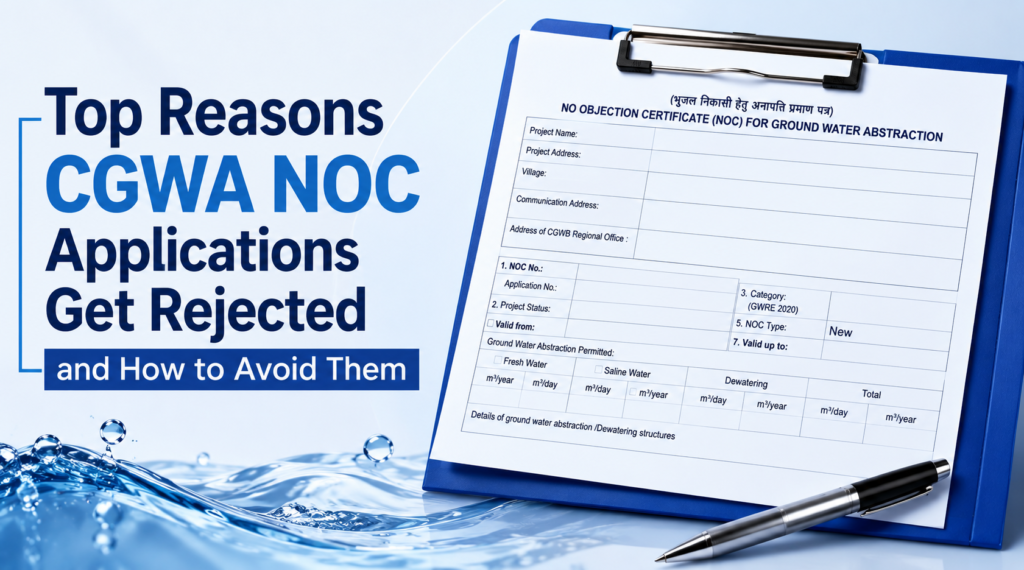

Groundwater has become one of the most carefully regulated natural resources in India due to increasing demand across industrial, commercial, infrastructure, and institutional sectors. Organizations that rely on groundwater extraction must comply with regulatory requirements designed to ensure responsible and sustainable water use.
Obtaining a CGWA NOC is an important part of this compliance process, as it confirms that groundwater extraction aligns with applicable environmental and regulatory standards.
Despite careful planning, many applications are delayed or rejected because of documentation errors, technical inconsistencies, or failure to meet the latest compliance requirements. Understanding these common reasons helps applicants prepare stronger submissions and reduce unnecessary project delays.
Understanding the Approval Process
The Central Ground Water Authority regulates groundwater extraction to protect aquifers and encourage sustainable groundwater management across the country.
Before granting approval, authorities evaluate several technical and administrative aspects of an application, including groundwater availability, hydrogeological conditions, water demand, recharge measures, environmental impact, and supporting documentation. Every detail submitted during the application process contributes to the overall assessment, making accuracy and consistency essential for successful approval.
Incomplete Documentation Creates Immediate Challenges
One of the leading causes of application rejection is incomplete documentation. Regulatory authorities require comprehensive information to verify ownership, project details, groundwater requirements, and technical feasibility.
Missing records, outdated certificates, unclear maps, or incomplete reports often result in delays because officials cannot proceed with technical evaluation without the required information.
Applications should include all mandatory documents in their latest format while ensuring every record matches the submitted project details. Even minor discrepancies between documents may trigger additional verification, extending the approval timeline.
Technical Reports Must Be Accurate and Reliable
Technical reports form the foundation of the evaluation process. Hydrogeological investigations provide valuable information regarding groundwater availability, aquifer conditions, recharge potential, and long-term sustainability.
The Central Ground Water Authority carefully examines these technical reports to determine whether groundwater extraction is environmentally sustainable and complies with the applicable regulatory framework. Reports prepared without proper field observations, containing outdated information, or lacking sufficient technical analysis often fail to meet the required standards and become one of the primary reasons behind application rejection.
Incorrect Water Requirement Assessment
Every groundwater extraction proposal must justify the quantity of water required for operational purposes. Water demand calculations should accurately reflect production capacity, occupancy, industrial processes, institutional activities, or commercial operations.
Applications containing unrealistic consumption estimates raise concerns regarding the necessity of groundwater extraction. Overestimated demand may appear excessive, while underestimated figures create doubts about operational feasibility. Accurate calculations supported by genuine project data improve the credibility of an application and reduce the likelihood of regulatory objections.
Lack of Groundwater Recharge Planning
Groundwater extraction should always be accompanied by measures that support groundwater recharge and conservation. Authorities expect applicants to demonstrate their commitment to sustainable water management through rainwater harvesting systems, recharge structures, stormwater management, and other conservation initiatives.
Applications that fail to explain groundwater replenishment measures often receive additional scrutiny because sustainable groundwater management remains a key objective of regulatory authorities. Proper recharge planning demonstrates environmental responsibility while strengthening the overall application.
Errors in Borewell Information
Every borewell proposed for groundwater extraction must be supported with complete technical information. Authorities evaluate borewell specifications, extraction capacity, location details, and groundwater abstraction estimates during the approval process.
Incomplete or inaccurate borewell information creates uncertainty regarding groundwater utilization and technical feasibility. Consistency between engineering drawings, project reports, and borewell specifications is therefore essential to avoid unnecessary clarification requests.
Failure to Follow Updated Guidelines
Groundwater regulations continue to evolve as environmental priorities and water management policies develop. Applications prepared using outdated requirements frequently encounter compliance issues because regulatory expectations may have changed after previous submissions or earlier project planning stages.
Applicants should always review the latest regulatory framework before preparing documents. Following current requirements ensures that technical reports, declarations, supporting documents, and compliance measures meet the standards expected during evaluation.
Inconsistent Project Information
Consistency remains one of the most important aspects of regulatory documentation. Different reports should present identical information regarding project capacity, groundwater requirement, land ownership, borewell specifications, and operational details.
When submitted documents contain conflicting figures or contradictory statements, authorities often require additional clarification before continuing the evaluation process. Such inconsistencies not only delay approval but may also affect the credibility of the overall application.
Weak Water Conservation Strategy
Modern groundwater regulation emphasizes efficient water utilization alongside groundwater extraction. Authorities expect organizations to demonstrate practical efforts toward reducing water consumption through conservation measures and responsible resource management.
Applications that overlook wastewater reuse, recycling systems, efficient fixtures, or process optimization may appear incomplete from an environmental perspective. Integrating water conservation planning into project design reflects a proactive approach toward sustainable groundwater management and strengthens compliance.
Poor Site Information and Mapping
Location accuracy is another essential requirement during technical evaluation. Incorrect coordinates, unclear site layouts, inconsistent survey information, or mismatched land records often create verification difficulties.
Authorities rely on accurate mapping to understand groundwater conditions and project location before granting approval. Providing verified site information supported by proper documentation minimizes the possibility of technical objections during review.
Delayed Response to Regulatory Queries
Even well-prepared applications may require clarification during technical assessment. Regulatory authorities sometimes request additional documents, revised reports, or supplementary explanations before final approval.
Applicants who fail to respond within the specified timeline often experience prolonged delays or rejection. Maintaining regular communication and submitting requested information promptly helps keep the approval process moving efficiently.
The Importance of Professional Preparation
Groundwater compliance involves far more than completing application forms. Every document submitted contributes to the overall technical assessment conducted by regulatory authorities. Proper planning ensures that hydrogeological investigations, groundwater calculations, conservation measures, and supporting records work together as a complete compliance package.
A carefully prepared application minimizes avoidable errors while improving transparency throughout the approval process. It also demonstrates that groundwater extraction has been planned responsibly with consideration for environmental sustainability and long-term resource management.
Organizations that invest sufficient time in technical preparation generally experience smoother regulatory review compared to applications prepared without adequate planning. Accurate documentation, reliable technical studies, updated compliance measures, and consistent project information collectively improve approval efficiency.
Conclusion
Obtaining approval for groundwater extraction requires careful attention to technical accuracy, regulatory compliance, and environmental responsibility.
Most application rejections occur because of preventable mistakes such as incomplete documentation, inconsistent project information, inaccurate hydrogeological assessments, insufficient recharge planning, or failure to comply with current regulatory requirements.
Understanding these common issues enables applicants to prepare stronger submissions that meet regulatory expectations from the beginning. A well-prepared CGWA Borewell NOC application reflects not only regulatory compliance but also a commitment to responsible groundwater management.
By ensuring every document is complete, every technical report is accurate, and every compliance requirement is addressed, organizations can significantly improve the likelihood of timely approval while contributing to sustainable groundwater conservation.
Frequently Asked Questions
1. What is the purpose of a CGWA NOC?
A CGWA NOC is a regulatory approval required for groundwater extraction in applicable areas to ensure groundwater resources are used responsibly and sustainably.
2. Who issues permission for groundwater extraction?
Permission is granted by the appropriate regulatory authority after reviewing technical documents, groundwater availability, environmental considerations, and compliance with applicable guidelines.
3. Why do groundwater approval applications get rejected?
Most applications are rejected because of incomplete documentation, inaccurate technical reports, inconsistent project information, missing recharge plans, or non-compliance with current regulatory requirements.
4. Is a hydrogeological study important during the approval process?
Yes. A professionally prepared hydrogeological study helps authorities evaluate groundwater availability, recharge potential, and the environmental suitability of groundwater extraction.
5. How can applicants improve approval chances?
Applicants can improve approval prospects by preparing accurate documentation, maintaining consistency across all reports, following updated regulatory guidelines, and ensuring technical studies are comprehensive and professionally prepared.