

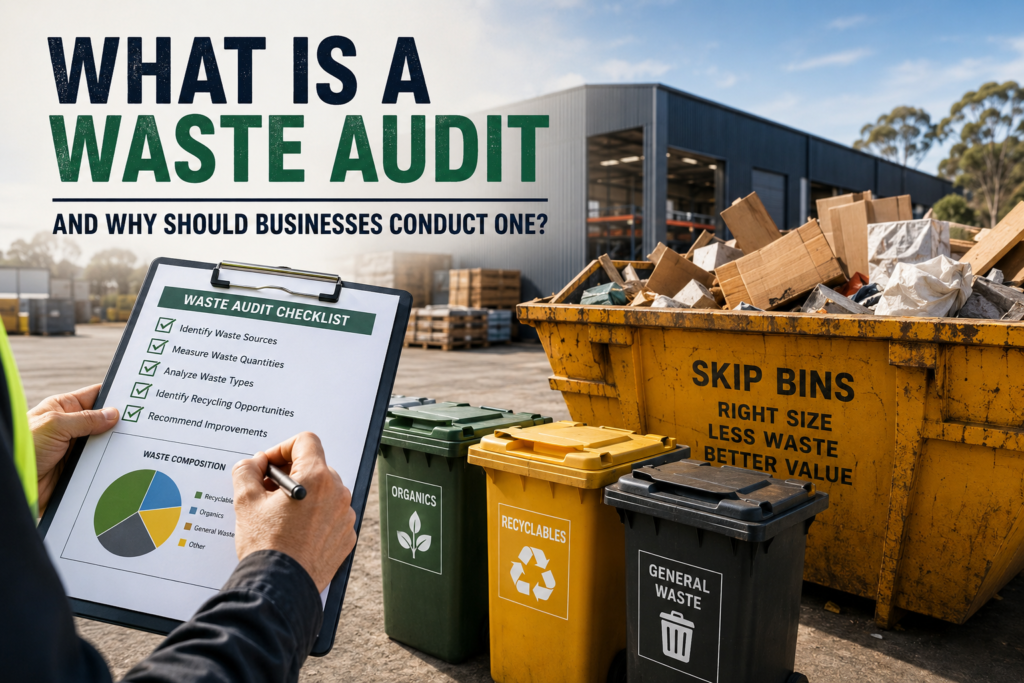

What Is a Waste Audit and Why Should Businesses Conduct One?
For many businesses, waste is simply something that gets placed in a bin and collected at the end of the day. However, the contents of those bins can reveal valuable information about how efficiently a business uses resources, manages operating costs and handles its environmental responsibilities.
A waste audit provides a structured way to understand what a business throws away, how much waste it generates and where improvements can be made. According to the Australian Government’s business guidance, waste audits can establish a baseline, identify landfill waste and recycling opportunities, and highlight which areas of a business are generating waste.
What Is a Waste Audit?
A waste audit is a systematic assessment of the waste produced by a business over a specific period.
The process can involve reviewing waste collection records, examining bin contents, identifying different waste streams and estimating or measuring the volume of materials being discarded. Businesses can look at categories such as cardboard, paper, plastics, food waste, green waste, metals and general rubbish.
The goal isn’t simply to find out how much rubbish a company produces. It is to understand why that waste is being generated and whether it could be reduced, reused or recycled.
For example, an office might discover that a large percentage of its general waste consists of recyclable cardboard and paper. A building company may find that excessive quantities of timber, concrete or packaging are being discarded. Once these patterns are identified, businesses can make more informed decisions about purchasing, recycling and waste disposal.
Why Should Businesses Conduct a Waste Audit?
1. Identify Where Waste Is Coming From
One of the biggest advantages of a waste audit is visibility.
Businesses often know how much they spend on waste collection without knowing exactly what they are paying to dispose of. An audit can identify the types of waste being produced and the areas of the business responsible for generating it.
This information makes it easier to address the source rather than simply dealing with the waste after it has been created.
2. Reduce Unnecessary Waste Costs
Waste audits can uncover opportunities to reduce operating expenses.
For instance, a business may discover that its current waste collection arrangement doesn’t match the amount of waste it actually produces. It may also find that recyclable materials are being mixed with general waste, increasing the amount sent for disposal.
Understanding the volume and type of waste generated can help businesses make better decisions about collection frequency, recycling arrangements and skip bin sizes.
Choosing an appropriately sized bin is particularly important for businesses and project sites. A bin that is too small may require additional collections, while one that is significantly larger than necessary can represent wasted capacity.
3. Improve Recycling
A waste audit can reveal materials that are regularly being thrown away even though they may have recycling or recovery potential.
Cardboard, paper, metals and certain other materials can often be separated from general waste. By identifying these materials, businesses can improve source separation and potentially reduce their reliance on landfill disposal.
The Australian Government recommends sorting and tracking business waste to understand the types, quantities and frequency of waste being generated.
4. Improve Workplace Waste Practices
A waste audit can also reveal behavioural issues.
If recyclable materials consistently appear in general waste bins, the problem may not be the waste collection system itself. Employees may need clearer signage, additional bins or better information about which materials belong in each waste stream.
Once an audit identifies these problems, businesses can introduce practical changes such as clearer labels, improved bin placement and staff education.
5. Support Sustainability Goals
Businesses are increasingly looking for practical ways to reduce their environmental impact. Waste reduction can be an important part of this effort.
Reducing the amount of waste sent to landfill can support broader sustainability objectives while also encouraging more efficient use of resources. Business.gov.au notes that effective waste management can contribute to sustainability, cost reduction and improved business practices.
How Does a Business Conduct a Waste Audit?
A basic waste audit doesn’t necessarily need to be complicated. Businesses can begin by following a few straightforward steps.
Step 1: Review Current Waste Services
Start by looking at existing bins, collection schedules, invoices and waste disposal arrangements. Record how frequently bins are collected and whether they are consistently full, partially full or overflowing.
Step 2: Identify Waste Types
Determine what materials are being discarded. Depending on the business, this could include cardboard, paper, packaging, plastics, food waste, green waste, metals, construction materials and general rubbish.
Step 3: Measure Waste Volumes
Estimate or measure the amount of each waste type generated over a representative period. Larger businesses may benefit from more detailed measurements, while smaller businesses can begin with simple volume estimates.
Step 4: Look for Avoidable Waste
Ask whether particular materials could be reduced, reused, recycled or purchased differently.
For example, excessive packaging may indicate an opportunity to change suppliers, while large amounts of recyclable material in general waste may indicate a need for better separation.
Step 5: Adjust the Waste Management System
Use the audit findings to make practical changes. This could involve adding recycling streams, changing collection schedules, educating staff or selecting a more suitable waste container.
For businesses dealing with larger quantities of rubbish, reviewing skip bin sizes can also help ensure the waste disposal setup matches the actual volume generated. Skippy Bin Adelaide provides options ranging from compact 2m³ bins through to larger 30m³ options, allowing businesses and projects to consider capacity based on their waste requirements.
When Should a Business Conduct a Waste Audit?
A waste audit can be useful at almost any stage, but it can be particularly valuable when a business is experiencing increasing waste costs, changing its operations, moving premises or introducing new sustainability initiatives.
It can also be worthwhile before changing waste collection arrangements. Having a clear understanding of waste volumes and materials makes it easier to select an appropriate disposal strategy instead of relying on assumptions.
Businesses don’t necessarily need to conduct a detailed physical audit every month. A periodic review can help track whether changes are actually reducing waste and improving recycling performance.
Turning Waste Data Into Better Decisions
The biggest value of a waste audit comes from what happens after the information has been collected.
Simply discovering that a business produces a large amount of waste isn’t enough. The findings should lead to practical action. Businesses can use the information to reduce unnecessary purchasing, improve recycling, change collection arrangements and select waste containers that better match their requirements.
For example, if an audit shows that a renovation project is generating significantly more material than originally expected, reviewing the available skip bin options can help the project team select a suitable capacity rather than repeatedly filling smaller containers.
Final Thoughts
A waste audit gives businesses something they often lack: a clear picture of what is actually happening to their waste.
By identifying waste sources, measuring volumes and recognising materials that could be reduced or recovered, businesses can make smarter decisions about their waste systems. The result can be lower unnecessary costs, improved recycling practices and a more organised approach to waste management.
For businesses undertaking clean-ups, renovations or projects that generate substantial amounts of waste, selecting the right container is an important part of the process. Reviewing available skip bin sizes before booking can help ensure the chosen capacity is appropriate for the project and the amount of waste expected.