


ServiceM8 has earned its reputation. For small field service businesses, particularly sole traders and compact teams in trades like electrical, plumbing, and HVAC, it’s been a reliable workhorse. Clean mobile app, straightforward job management, solid invoicing.
More technicians in the field. More complex scheduling needs. More clients expecting real-time updates, online booking, and polished customer communication. The platform that worked perfectly at two staff starts showing its limits at eight.
If you’re at that inflection point, this is the right time to explore a ServiceM8 alternative that can scale with where your business is actually heading.
What to Look for in a ServiceM8 Alternative
Before jumping to platform names, it’s worth knowing what capabilities actually matter at the growth stage you’re targeting.
- Dispatch that handles complexity. A drag-and-drop board showing technician availability, location, and current job status, updating in real time, is non-negotiable once your team reaches a certain size. You can’t manage eight people on a whiteboard or a basic list view.
- Quoting that converts. Professional, itemized quotes that customers can accept digitally, with automated follow-up if they haven’t responded in 48 hours, directly impact your win rate. This is a revenue feature, not an admin feature.
- Integrated payments in the field. Your technician completes the job, the customer pays on their phone or tablet, the invoice is closed. Same day. No office follow-up required. For a growing business, this is a cash flow game-changer.
- Customer portal or communication hub. A self-service portal where clients can view job history, upcoming appointments, and outstanding invoices reduces inbound calls to your office and makes your business look significantly more professional.
- Scalable pricing that doesn’t punish growth. Per-user pricing models can quietly become one of your larger software expenses as you hire. Alternatives with flat-tier or job-volume-based pricing often make more financial sense as headcount grows.
The Best ServiceM8 Alternatives in 2026
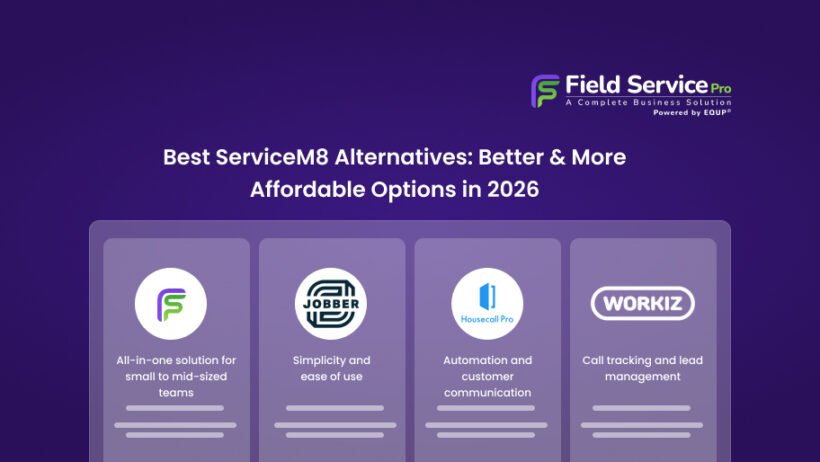
One of the more complete ServiceM8 alternatives for growing businesses that want more than just job management. FieldServicePro bundles 30+ business tools into one platform, including scheduling and dispatch, automated estimates, recurring billing, a custom CRM, client portal, and built-in marketing automation covering email, SMS, and WhatsApp. The AI-powered features (chatbot, smart scheduler, automated estimates) are genuinely useful rather than just marketed additions. There’s a 15-day free trial and a mobile app for both iOS and Android. Worth evaluating seriously if you’re outgrowing ServiceM8’s scope, not just its scale.
- Jobber
Jobber is the most frequently cited ServiceM8 alternative among growing field service businesses, and the reasons are consistent: the dispatch view is cleaner at scale, the customer communication tools are stronger, and the quoting-to-invoice workflow is tighter. It handles service agreements well and the mobile app is genuinely field-ready. For businesses between 5 and 25 field staff, it tends to be the sweet spot.
- Housecall Pro
A strong contender, particularly for businesses that generate a lot of inbound leads from online sources. Housecall Pro’s online booking and customer messaging tools are among the best in the category. If your growth strategy leans heavily on digital lead generation and repeat business from existing customers, it deserves a close look.
- ServiceTitan
The enterprise-grade option. If you’re running a larger operation, think 20+ technicians, multiple service lines, complex reporting needs, ServiceTitan’s depth is unmatched. It’s a significant investment in both cost and implementation time, but businesses at that scale typically recoup it quickly through operational efficiency gains.
- FieldEdge
Particularly strong for HVAC and plumbing businesses with a focus on recurring maintenance contracts. The service agreement management is detailed and the QuickBooks integration is among the most reliable in the category, important if your bookkeeper lives in that ecosystem.
- Workiz
A newer player that’s grown fast, especially among businesses that rely on phone and online leads. Built-in call tracking, strong automation features, and a clean UI make it worth evaluating if you’re modernizing your lead-to-job workflow alongside your field operations.
Making the Switch Without Disrupting Your Operation
Switching field service platforms mid-season is genuinely disruptive if you don’t plan it right. A few things that make the transition smoother:
Run both platforms in parallel for 2-4 weeks if your budget allows it. Don’t migrate everything on day one, start with new jobs and let existing ones close out on the old system.
Export your customer and job history before you cancel anything. Most platforms will import this data, but the format matters. Ask your new provider’s onboarding team exactly what they need and in what format before you export.
Train your techs on the mobile app before go-live, not on the day of. A 30-minute walkthrough on an actual job makes adoption dramatically faster.
And pick your go-live date deliberately. Don’t switch platforms in your busiest month. A quieter period gives you room to troubleshoot without pressure.
The Bottom Line
ServiceM8 got a lot of field service businesses off spreadsheets and paper job cards. That’s a genuine contribution. But the best tool for the stage you’re in now isn’t necessarily the best tool for the stage you’re growing into.
If your team is expanding, your customer expectations are rising, and you’re starting to feel the operational ceiling. That’s not a reason to push through with the same software. That’s a signal to find the ServiceM8 alternative that was built for where you’re going, not where you started.
The businesses winning in field service right now are the ones that treat their software as infrastructure and not an afterthought.