


The SEO industry has never been simple, but the arrival of AI has made it even harder to read. On paper, almost every agency now claims to be “AI-powered” or “AI-first.” In practice, the gap between marketing language and real capability has never been wider. Enterprise brands end up in a difficult position. Budgets are significant, expectations are high, and yet it is still surprisingly easy to end up with work that looks polished in reports but does very little for actual visibility or revenue.
The real challenge is not finding an AI SEO agency. It is finding one that understands how search has changed, how AI systems interpret content, and how to build long-term authority instead of short-term output. Due diligence is no longer optional. It is the only way to separate meaningful capability from surface-level claims.
This checklist is not about theory. It is about what actually matters when enterprise brands evaluate partners in a space where almost everyone sounds the same at first glance.
Professionalism in SEO Is Not About Size
One of the most common misconceptions enterprise teams carry is that bigger agencies automatically mean better outcomes. That assumption breaks quickly in SEO.
Some of the strongest performers in this field are small, highly focused teams that stay close to the work. On the other hand, some large agencies operate on scaled templates where strategy is reused across hundreds of clients with minimal adjustment.
Real professionalism is not about headcount or brand size. It shows up in how work is approached. You can usually recognize it through clarity of thinking, willingness to explain decisions, and a consistent connection between strategy and outcomes.
This is also where experienced firms like ThatWare position themselves differently, focusing on structured methodology rather than volume-based execution.
What matters most is whether the agency treats SEO as a living system or as a production line.
The Methodology Question That Reveals Everything
If there is one question that consistently exposes the difference between real expertise and surface-level service, it is this: “Can you walk me through your methodology in detail?”
Strong agencies respond with clarity. They can explain how they audit a site, how they interpret search visibility in AI-driven environments, how they identify gaps in topical coverage, and how they prioritize actions. Their answers are structured but not rehearsed. They can also admit uncertainty where it exists, which is often a sign of genuine experience.
Weaker agencies tend to lean on vague phrases. You will hear terms like “AI-driven insights” or “proprietary systems” without any meaningful explanation of what those systems actually do. The language sounds advanced, but the substance is missing.
This difference is not cosmetic. It is foundational. If an agency cannot clearly explain how it works, it is unlikely to deliver predictable outcomes.
For enterprise buyers comparing options, this is where resources like enterprise AI SEO due diligence become useful in structuring the right questions before committing.
What a Real AI SEO Strategy Looks Like in Practice
A professional AI SEO approach is not built around keyword lists. It is built around understanding how search systems interpret meaning, entities, and authority.
The first step is always a deep audit. Not just technical checks, but a full evaluation of how a brand is represented across search ecosystems. This includes how knowledge graphs understand the entity, how the brand appears in AI-generated answers, and where gaps exist in topical coverage.
From there, strategy moves toward topical authority rather than isolated rankings. Instead of chasing hundreds of disconnected keywords, the focus shifts to building a network of content that reinforces expertise across a subject area. This is how modern search systems evaluate credibility.
Technical SEO also evolves in this context. Structured data is no longer just about rich snippets. It helps AI systems understand context, relationships, and meaning. When implemented properly, it becomes part of how visibility is earned, not just how pages are formatted.
Reporting is another area where real agencies stand apart. Strong partners focus on meaningful signals like qualified traffic, conversions, and visibility in AI-generated responses. Weak ones often highlight surface metrics that look impressive but do not connect to business outcomes.
At the enterprise level, many decision makers begin exploring best AI SEO services when they realize that traditional SEO models no longer match how search behavior is evolving.
Red Flags That Should Not Be Ignored
There are certain patterns that consistently show up in underperforming partnerships.
Guaranteed rankings are the most obvious. No serious SEO professional will promise fixed positions in a system influenced by AI-driven ranking models, personalization, and constant algorithm updates. Anyone offering guarantees is either oversimplifying reality or ignoring it completely.
Another warning sign is heavy reliance on “black box” systems. If an agency cannot explain what it is doing or why, that lack of transparency becomes a risk. Real expertise can be explained, even if the underlying systems are complex.
A third issue is reporting that focuses only on vanity metrics. High impressions and traffic spikes may look good on slides, but they mean very little without context. What matters is whether visibility translates into qualified demand.
Long-term contracts without clear performance checkpoints are another concern. Confidence in execution usually shows up as accountability, not restriction.
What Enterprise Brands Should Actually Expect
When working with a capable AI SEO partner, the difference is visible early.
Onboarding is structured and business-focused, not template-driven. Strategy documents are specific, not generic frameworks copied from previous clients. Communication is consistent and direct, without unnecessary complexity.
Most importantly, the work evolves with feedback. If something is not working, it is acknowledged and adjusted rather than hidden behind reporting language.
In stronger setups, the focus is not just on producing content but on building long-term search authority. That includes aligning technical SEO, content strategy, and entity optimization into a single direction rather than treating them as separate tasks.
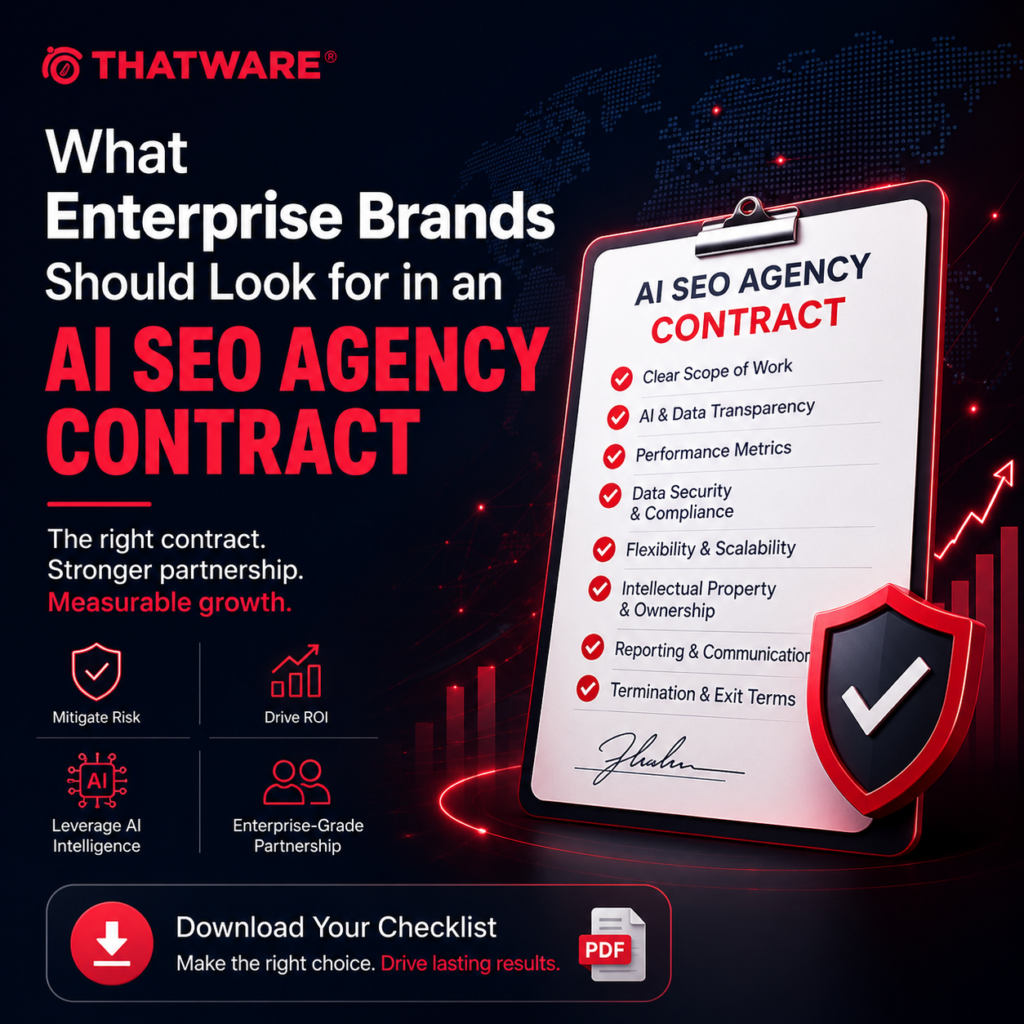
A Practical Due Diligence Checklist
Enterprise teams evaluating agencies should focus on a few core questions:
- Can the agency explain its methodology without vague language?
- Does it understand entity-based search and AI interpretation of content?
- Is reporting tied to business outcomes or just traffic metrics?
- Are expectations realistic, or are guarantees being offered?
- Is there transparency in how decisions are made?
These questions form the backbone of real evaluation. Everything else is secondary.
The idea behind modern enterprise AI SEO due diligence is not to complicate selection, but to remove noise from decision-making so enterprise brands can see capability more clearly.
Final Perspective
At its core, choosing an AI SEO partner is not about chasing the most advanced claims or the most polished presentations. It is about identifying whether the agency understands how search actually works today and whether they are honest enough to operate within that reality.
The strongest relationships in this space are built on clarity, consistency, and accountability. Everything else fades over time.
Brands that prioritize substance over surface tend to see more stable and meaningful growth, especially in a search environment shaped increasingly by AI systems. That is where real advantage is built.
And in practice, firms like ThatWare continue to stand out because they focus on methodology first, execution second, and communication throughout.
Last Update: June 18, 2026