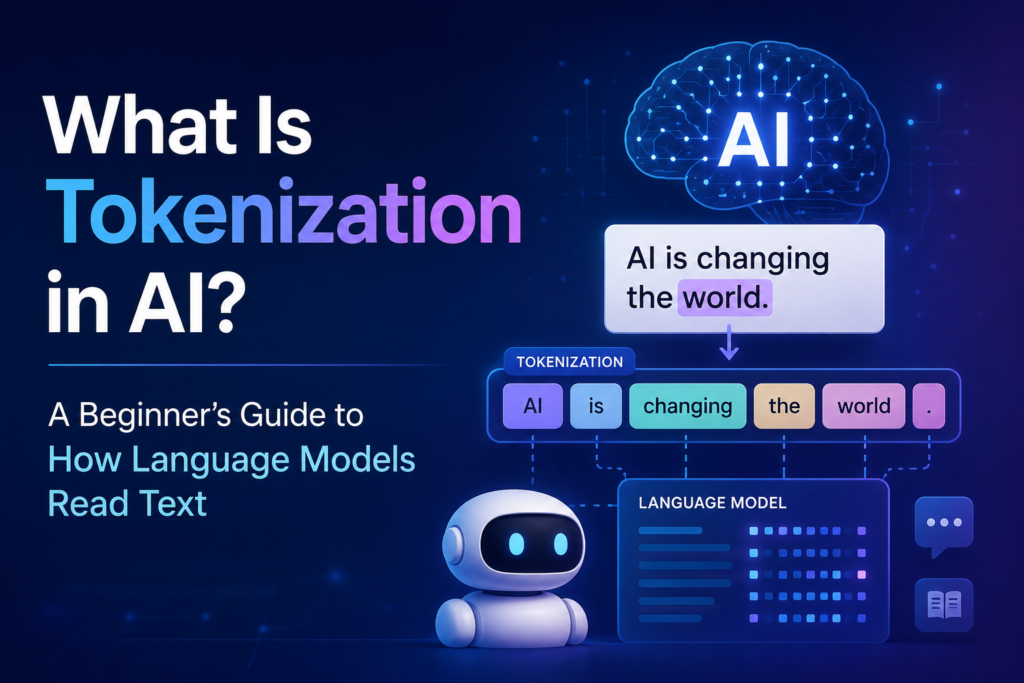

When you type a question into a chatbot or ask an AI assistant to summarize a document, it might feel like the model is reading your words the same way you do. In reality, before any AI model can process language, it has to break your text down into smaller pieces called tokens. This process, known as tokenization, is the foundation of every natural language processing (NLP) system, from search engines to large language models (LLMs) like GPT and Claude.
Understanding tokenization helps demystify how AI “reads” text, why some languages are harder for models to handle than others, and why the length of your prompt affects both performance and cost. This guide breaks down the basics of tokenization for anyone new to the topic.
What Is Tokenization?
Tokenization is the process of converting raw text into smaller units, called tokens, that a machine learning model can process numerically. Computers don’t understand words or sentences directly. They understand numbers. Tokenization acts as a bridge between human language and the numerical format models require.
A token isn’t always a full word. Depending on the tokenization method used, it could be:
- A whole word (e.g., “computer”)
- Part of a word (e.g., “comput” and “er”)
- A single character
- Punctuation marks or whitespace
For example, the sentence “Tokenization helps AI understand text” might be split into tokens like: [“Token”, “ization”, ” helps”, ” AI”, ” understand”, ” text”]. Notice that even a single word can be broken into multiple tokens depending on how common that word is in the model’s training data.
Why Tokenization Matters in AI
Tokenization isn’t just a technical preprocessing step. It directly influences how well a model performs and how efficiently it operates.
1. It Determines Vocabulary Size
Every AI language model works with a fixed vocabulary of tokens, often ranging from tens of thousands to over 100,000 unique tokens. A well-designed tokenizer balances vocabulary size with the ability to represent rare or complex words efficiently.
2. It Affects Model Accuracy
If a tokenizer splits words in a way that loses meaningful structure, the model may struggle to understand relationships between words. Poor tokenization can lead to less accurate predictions, especially with technical terms, names, or non-English text.
3. It Impacts Cost and Speed
Most commercial AI APIs charge based on the number of tokens processed, not the number of words. Longer or more complex text results in more tokens, which increases both processing time and cost. This is why understanding tokenization is useful even for non-technical users who want to manage API usage efficiently.
Common Tokenization Methods
Several tokenization techniques are used across modern NLP systems, each with different trade-offs.
Word-Based Tokenization
The earliest and simplest method splits text by spaces and punctuation, treating each word as a token. While intuitive, this approach creates enormous vocabularies and struggles with rare words or typos, since any word not seen during training becomes an unrecognized token.
Character-Based Tokenization
This method breaks text into individual characters. It handles any word, even misspelled or invented ones, but produces very long token sequences, making it computationally expensive for large texts.
Subword Tokenization
Most modern LLMs use subword tokenization methods, such as Byte Pair Encoding (BPE) or WordPiece. These approaches split rare or complex words into smaller, meaningful chunks while keeping common words intact. This strikes a balance between vocabulary size and the model’s ability to handle unfamiliar words, making it the standard choice for state-of-the-art language models today.
Tokenization Beyond Text: A Note on Multimodal AI
While tokenization is most commonly associated with text, similar principles apply in computer vision. Vision Transformer (ViT) models, for instance, divide images into fixed-size patches and treat each patch as a “token,” allowing the model to process visual data using techniques originally developed for language. This overlap highlights how tokenization has become a foundational concept across multiple areas of AI, not just NLP.
Why Tokenization Matters for Everyday AI Use
Even if you never build a language model yourself, understanding tokenization platform development can help you:
- Write more efficient prompts by avoiding unnecessary repetition or verbosity
- Understand why AI models sometimes struggle with uncommon words, names, or non-English languages
- Estimate the cost of using AI APIs, since pricing is typically based on token count
- Better interpret why certain outputs may seem inconsistent when input phrasing changes slightly
Final Thoughts
Tokenization may seem like a small technical detail, but it plays a central role in how AI models interpret and generate language. From determining vocabulary size to influencing cost and accuracy, the way text is broken into tokens shapes nearly every interaction we have with modern AI systems. As language models continue to evolve, tokenization methods are likely to become even more refined, helping AI understand human language with greater nuance and efficiency.
Whether you’re a developer building NLP applications or simply a curious user of AI tools, understanding this foundational concept offers valuable insight into how the technology behind your favorite chatbot or writing assistant actually works.